Product Design, Manufacturing & Innovation Resources
家 » レンツの法則

レンツの法則

1834
  • Heinrich Lenz
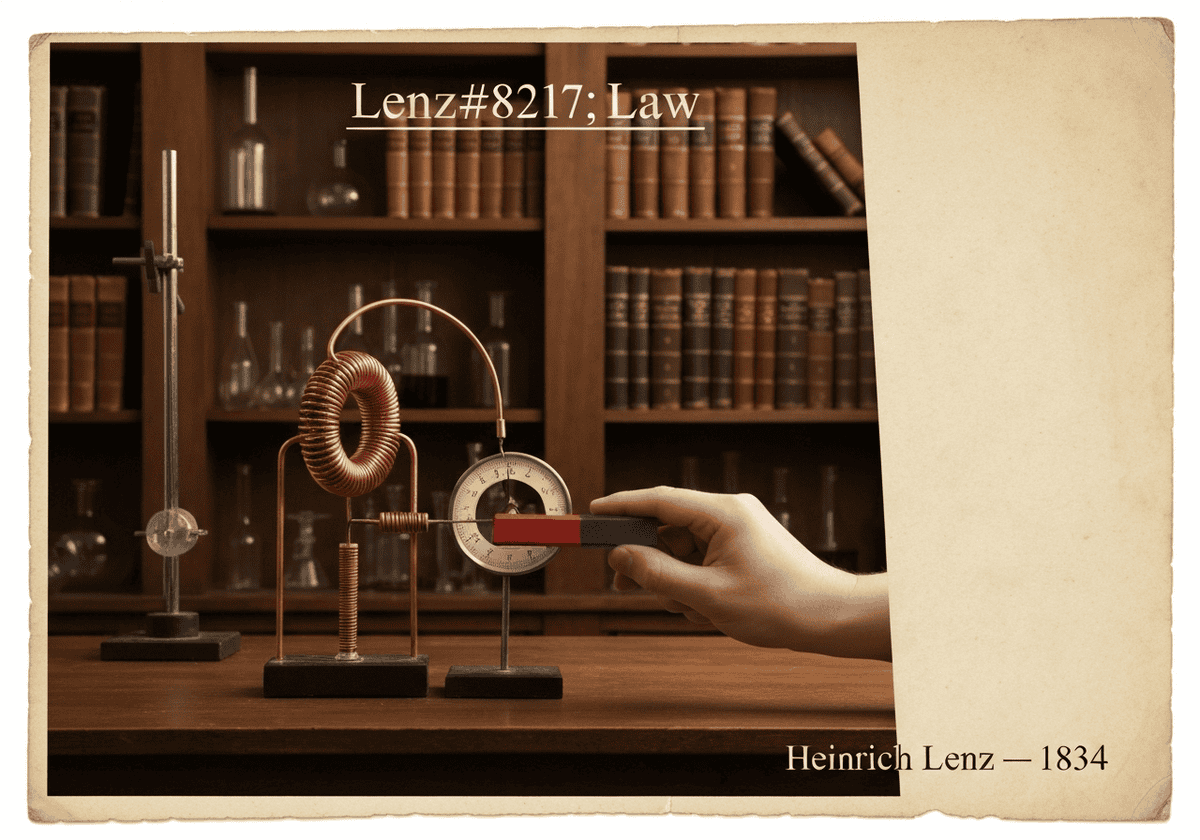
Laboratory setup demonstrating Lenz's Law with copper coil and galvanometer.

(画像はイメージです)

Lenz’s law provides the direction of the induced electromotive force (EMF) and current resulting from electromagnetic induction. It states that the induced current will flow in a direction that creates a magnetic field opposing the change in magnetic flux that produced it. This principle is a consequence of the conservation of energy and is represented by the negative sign in Faraday’s law.
Lenz’s law is a crucial qualitative rule that complements Faraday’s law of induction by specifying the direction of the induced current. While Faraday’s law quantifies the magnitude of the induced EMF ([latex]\mathcal{E} = -\frac{d\Phi_B}{dt}[/latex]), the negative sign embodies Lenz’s law. The law is fundamentally a statement about エネルギー保全 in electromagnetic systems. If the induced current were to flow in a direction that reinforced the change in flux, it would create a larger change in flux, which would induce an even larger current, leading to a runaway process that generates infinite energy from nothing, violating the principle of エネルギー保存の法則.

Instead, the induced current generates its own magnetic field that counteracts the initial change. For example, if the north pole of a magnet is moved towards a conducting loop, the magnetic flux through the loop increases. To oppose this increase, the induced current will flow in a direction that makes the loop’s face act like a north pole, repelling the incoming magnet. This requires work to be done to push the magnet against the repulsive force, and this mechanical work is converted into the electrical energy of the induced current.

Conversely, if the north pole is moved away from the loop, the flux decreases. The induced current will now flow in the opposite direction, creating a south pole on the loop’s face to attract the receding magnet, opposing its departure. This principle is elegantly applied in eddy current brakes, where a rotating metal disc moving through a magnetic field has circular eddy currents induced within it. These currents create magnetic fields that oppose the rotation, generating a smooth, contactless braking force that converts kinetic energy into heat within the disc.

UNESCO Nomenclature: 2205
電磁気学

タイプ

物理原理

混乱

実質的な

使用法

広く普及している

前駆物質

  • マイケル・ファラデーによる電磁誘導の発見(1831年)
  • エネルギー保存の法則
  • 電流によって発生する磁場の理解(アンペールの法則)

アプリケーション

  • 渦電流 ブレーキ
  • IHクッキングヒーター
  • 金属探知機
  • 高感度天秤における減衰機構
  • 漏電遮断器(GFCI)
  • 心臓ペースメーカー(感知用)
  • ハイブリッド車における回生ブレーキ

特許:

NA

潜在的なイノベーションのアイデア

  • self-regulating thermal switches where induced currents generate heat to oppose a temperature-driven magnetic change
  • passive magnetic levitation systems for transport that are inherently stable due to opposing fields
  • haptic feedback gloves that use induced eddy currents to create resistance sensations
  • silent, frictionless door-closing mechanisms based on eddy current damping
  • fail-safe elevator braking systems that activate automatically during power loss
  • energy-harvesting shock absorbers for vehicles
  • contactless stirring devices for molten metals in industrial processes
  • self-orienting ソーラー panels that use induced currents to track the sun’s movement
関連:レンツの法則、電磁誘導、誘導電流、磁束、エネルギー保存則、右手の法則、渦電流、逆起電力。

歴史的背景

レンツの法則

1831
1831
1832
1834
1835
1838
1841
1829
1831
1831
1833
1834
1836
1839-01-01
1842

(日付が不明または関連性がない場合、例えば「流体力学」などでは、その注目すべき出現時期の概算値が提示されます。)

10年目 周年

フルサイズの画像とダウンロードは、登録会員のみが100%無料で利用できます。