Product Design, Manufacturing & Innovation Resources
Casa » Teorema lavoro-energia

Teorema lavoro-energia

1829
  • Gaspard-Gustave Coriolis
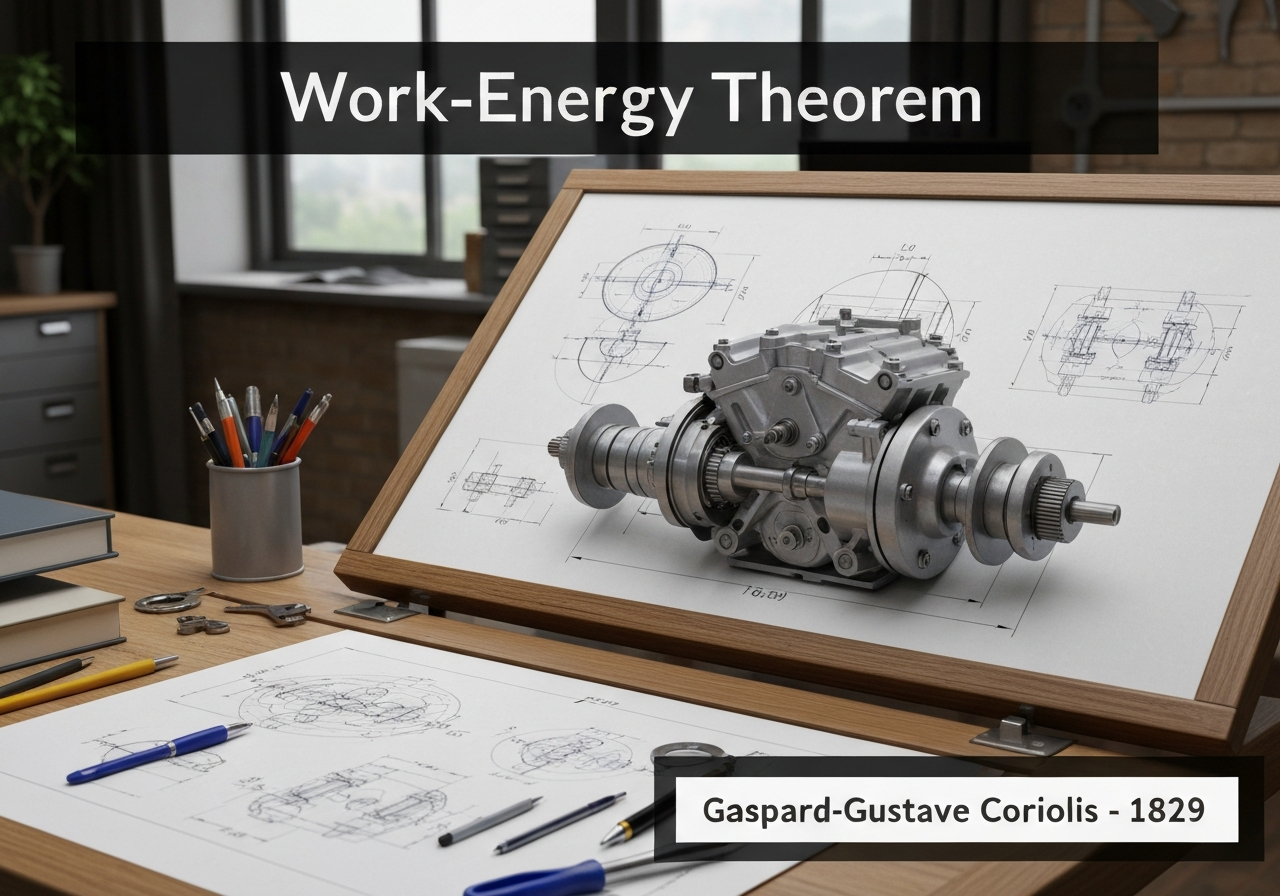
Mechanical engineering workspace illustrating the work-energy theorem application.

(Immagine generata a solo scopo illustrativo)

Il teorema lavoro-energia afferma che il lavoro netto (W) compiuto da tutte le forze che agiscono su una particella è uguale alla variazione della sua energia cinetica (ΔE_k). Matematicamente, W = ΔE_k = E_{k,f} – E_{k,i}[/latex]. Questo principio collega direttamente i concetti di forza, spostamento ed energia, fornendo un potente strumento per analizzare il moto senza utilizzare direttamente le leggi di Newton. seconda legge.
The work-energy theorem provides a direct link between the dynamics of forces and the kinematics of motion, expressed through the language of energy. It is derived directly from Newton’s seconda legge, [latex]F_{net} = ma[/latex]. By integrating the net force with respect to displacement, one can show that this integral equals the change in the quantity [latex]\frac{1}{2}mv^2[/latex]. Coriolis formally defined this integral as “work” and [latex]\frac{1}{2}mv^2[/latex] as “kinetic energy,” thereby formulating the theorem as [latex]W_{net} = \Delta E_k[/latex]. This was a significant conceptual advance because it allows for the analysis of complex systems without needing to solve differential equations of motion directly. For example, to find the final speed of an object after being acted upon by a variable force over a certain distance, one can simply calculate the total work done and equate it to the change in kinetic energy. The theorem applies to the work done by the *net* force. If one considers the work done by individual forces, it can be partitioned. For instance, the work done by conservative forces (like gravity) equals the negative change in potential energy, leading to the broader principle of the conservation of mechanical energy ([latex]\Delta E_k + \Delta E_p = W_{non-conservative}[/latex]).

UNESCO Nomenclature: 2209
- Meccanica

Tipo

Sistema astratto

Interruzione

Fondamento

Utilizzo

Uso diffuso

Precursori

  • La seconda legge del moto di Isaac Newton ([latex]F=ma[/latex])
  • Definizione di lavoro meccanico come forza per spostamento
  • La formula per l'energia cinetica classica ([latex]E_k = frac{1}{2}mv^2[/latex])

Applicazioni

  • progettazione ingegneristica di motori e propulsori
  • analisi delle collisioni in fisica
  • biomeccanica del movimento umano e animale
  • calcolo delle distanze di arresto dei veicoli
  • calcoli astronomici delle manovre orbitali

Brevetti:

NA

Idee e potenziali innovazioni

  • software for designing more efficient internal combustion engines by precisely modeling the work done by expanding gases on pistons
  • haptic feedback suits for virtual reality that apply forces to simulate the work required to lift or push virtual objects, creating realistic immersion
  • smart prosthetic limbs that use the work-energy theorem to calculate the energy required for a desired movement, optimizing battery life
  • ai-driven robotics for manufacturing that minimize energy consumption by calculating the most efficient path and force application (work) to achieve a task (change in kinetic energy)
  • educational physics software that visually demonstrates the work-energy theorem with interactive simulations
  • advanced braking systems that calculate the exact work needed to stop a vehicle and optimize the distribution between friction and regenerative braking
  • geotechnical engineering software that models the work required for excavation and drilling in different materials
  • robotic exoskeletons for rehabilitation that apply controlled forces to help patients perform exercises, measuring the work done to track progress
  • analysis tools for asteroid deflection missions, calculating the work required from an impactor to alter a celestial body’s kinetic energy
  • computational fluid dynamics models that calculate the work done by forze aerodinamiche on aircraft to predict changes in speed and altitude
Related to: work-energy theorem, kinetic energy, work, force, displacement, net work, risparmio energetico, classical mechanics, dynamics, fisica delle particelle.

Contesto storico

Teorema lavoro-energia

1821
1822
1827
1829
1831
1831
1833
1820
1822
1824
1827
1831
1831
1832
1834

(se la data è sconosciuta o non rilevante, ad esempio "meccanica dei fluidi", viene fornita una stima approssimativa della sua notevole comparsa)

decimo anno anniversario

Le immagini a grandezza naturale e i download sono disponibili, gratuitamente al 100%, solo per gli utenti registrati.

> Login <