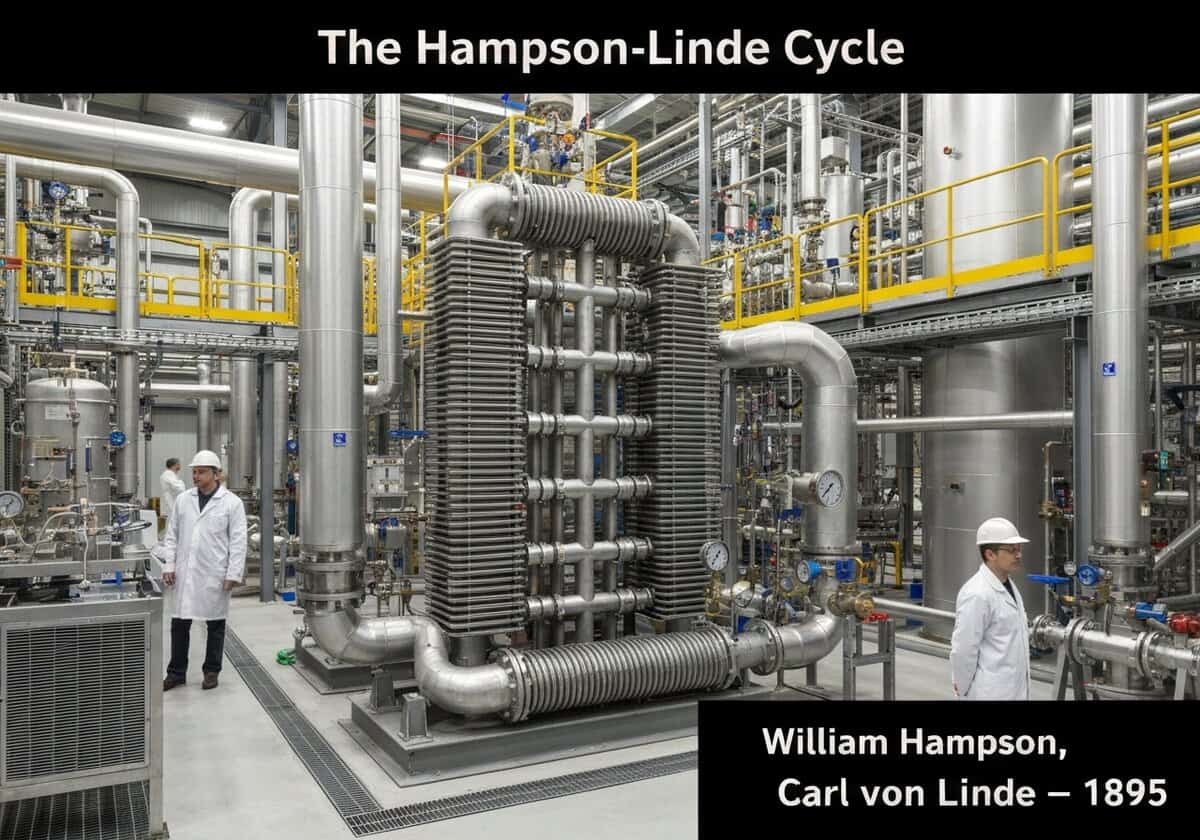
Independently developed by William Hampson in Britain and Carl von Linde in Germany, this cycle represented a major breakthrough. Its elegance lies in its simplicity and self-reinforcing nature. The key component is the regenerative heat exchanger, typically a set of coiled pipes. Incoming high-pressure gas flows through an inner pipe, while the cold, expanded gas from the ジュール・トムソン valve flows back over the outside of this pipe. This counter-flow arrangement ensures the incoming gas is continuously pre-cooled by the coldest available return gas. With each pass, the temperature of the gas entering the expansion valve drops further. Eventually, the temperature falls below the gas’s inversion temperature, and the Joule-Thomson expansion produces significant cooling. This cooling is carried back through the heat exchanger, creating a positive feedback loop until the temperature is low enough for a fraction of the gas to condense into a liquid upon expansion. This process made the large-scale, commercial production of liquid air feasible for the first time.
portable oxygen generators for remote medical facilities
closed-loop cryogenic cooling for magnetic levitation (maglev) transport systems
small-scale nitrogen liquefiers for agricultural use (e.g., cryopreservation of semen)
enhanced oil recovery systems using liquefied nitrogen injection
cryogenic machining for improved surface finish on difficult materials
liquid air energy storage (LAES) systems for grid-scale power balancing
advanced cryosurgery tools with finer temperature control
on-demand liquefaction systems for rocket propellant loading
cryogenic food freezing for superior quality preservation
compact air separation units for aircraft onboard oxygen generation (OBOGS)
Related to: Hampson-Linde cycle, regenerative cooling, Joule-Thomson effect, liquefaction, cryogenics, air separation, heat exchanger, Carl von Linde, throttling, counter-flow.