Product Design, Manufacturing & Innovation Resources
家 » 燃料電池の電位に関するネルンストの式

燃料電池の電位に関するネルンストの式

1889
  • Walther Nernst
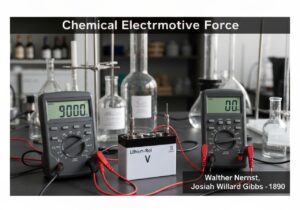
Fuel cell experiment in a laboratory demonstrating Nernst equation applications in electrochemistry.

(画像はイメージです)

の ネルンスト この方程式は可逆性を定量化する 起電力 (EMF) or open-circuit voltage of a fuel cell under non-standard conditions. It links the cell potential ([latex]E[/latex]) to its standard potential ([latex]E^0[/latex]), temperature, and the activities (approximated by partial pressures) of reactants and products. The equation is [latex]E = E^0 – \frac{RT}{nF} \ln Q[/latex], where Q is the reaction quotient.


の ネルンスト equation is a cornerstone of electrochemistry, derived from the relationship between the change in Gibbs free energy and the cell potential, [latex]\Delta G = -nFE[/latex]. In the equation [latex]E = E^0 – \frac{RT}{nF} \ln Q[/latex], [latex]R[/latex] is the universal gas constant, [latex]T[/latex] is the absolute temperature in Kelvin, [latex]n[/latex] is the number of moles of electrons transferred per mole of reaction, and [latex]F[/latex] is the Faraday constant (charge per mole of electrons). The reaction quotient [latex]Q[/latex] for a hydrogen-oxygen 燃料電池 ([latex]H_2 + \frac{1}{2}O_2 \rightarrow H_2O[/latex]) is [latex]Q = \frac{p_{H_2O}}{p_{H_2} \cdot p_{O_2}^{1/2}}[/latex], where [latex]p[/latex] represents the partial pressures of the gaseous species.

この方程式は、燃料電池の挙動に関するいくつかの重要な側面を明らかにします。まず、反応物の分圧([latex]p_{H_2}[/latex]、[latex]p_{O_2}[/latex])が高くなるとセル電圧が増加し、生成物の分圧([latex]p_{H_2O}[/latex])が増加するとセル電圧が低下することを示しています。次に、理想電圧の温度依存性を説明しています。ネルンストの式は理論上の最大電圧を定義しますが、燃料電池の実際の動作電圧は、反応速度論、内部抵抗、およびセルから電流が引き出された後の物質輸送制限から生じる過電圧(または分極)と呼ばれる不可逆的な損失のために、常に低くなります。

UNESCO Nomenclature: 2203
物理化学

タイプ

抽象システム

混乱

実質的な

使用法

広く普及している

前駆物質

  • 熱力学の法則、特にギブスの化学ポテンシャルに関する研究
  • Faraday’s laws of electrolysis
  • 化学平衡の概念と質量作用の法則

アプリケーション

  • 特定の動作温度および圧力下における燃料電池の最大可能電圧を予測する
  • 反応物枯渇による燃料電池の性能と電圧損失のモデリング
  • 電圧と効率を高めるための高圧燃料電池システムの設計
  • 電気化学および電池科学における基礎研究
  • イオン選択性電極およびpHメーターの校正

特許:

NA

潜在的なイノベーションのアイデア

  • real-time nernst potential calculators integrated into fuel cell control systems for efficiency optimization
  • sensors that directly measure reactant activities at the 触媒 surface for more accurate modeling
  • 開発 触媒 that operate efficiently at lower partial pressures, minimizing the nernstian voltage drop
  • fuel cell systems that use pressure modulation to actively manage the reaction quotient and stabilize output voltage
  • educational software that visualizes the impact of changing parameters in the nernst equation
  • using nernst principles to design concentration cells for low-grade waste heat recovery
  • ai models that predict deviations from the nernst potential based on cell degradation data
  • membranes that actively transport product water away from the cathode to maintain a favorable reaction quotient
  • microfluidic fuel cells that precisely control reactant concentrations to maximize nernst potential
  • using the nernst equation to assess the viability of novel fuel/oxidant pairs for new types of fuel cells
関連キーワード:ネルンストの式、電気化学、電池電位、電圧、ギブズ自由エネルギー、反応商、分圧、熱力学、ウォルター・ネルンスト、開回路電圧。

歴史的背景

燃料電池の電位に関するネルンストの式

1884
1887
1888
1889
1890
1890
1895
1884
1885
1887
1889
1890
1890
1895
1895

(日付が不明または関連性がない場合、例えば「流体力学」などでは、その注目すべき出現時期の概算値が提示されます。)

10年目 周年

フルサイズの画像とダウンロードは、登録会員のみが100%無料で利用できます。