Product Design, Manufacturing & Innovation Resources
Lar » O Ciclo Hampson-Linde

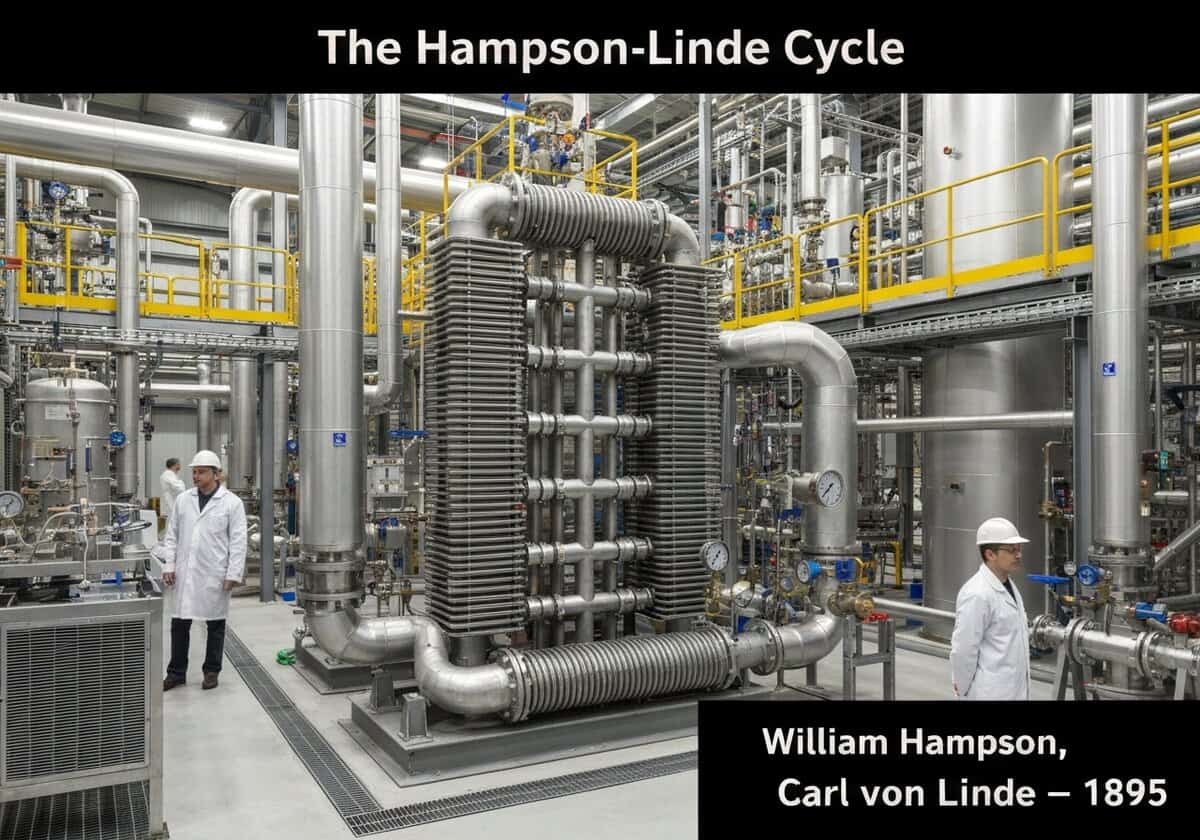
O Ciclo Hampson-Linde

1895
  • William Hampson
  • Carl von Linde
Industrial gas liquefaction facility utilizing the Hampson-Linde cycle for cryogenics.

(Imagem gerada apenas para fins ilustrativos)

The Hampson-Linde cycle liquefies gases like air using the Joule-Thomson effect combined with regenerative cooling. High-pressure gas is cooled in a counter-flow heat exchanger by the cold, low-pressure gas returning from the expansion valve. This progressively lowers the temperature at the valve until it drops below the critical point and liquefaction begins, forming the basis for the modern gas liquefaction setor.


Independently developed by William Hampson in Britain and Carl von Linde in Germany, this cycle represented a major breakthrough. Its elegance lies in its simplicity and self-reinforcing nature. The key component is the regenerative heat exchanger, typically a set of coiled pipes. Incoming high-pressure gas flows through an inner pipe, while the cold, expanded gas from the Joule-Thomson valve flows back over the outside of this pipe. This counter-flow arrangement ensures the incoming gas is continuously pre-cooled by the coldest available return gas. With each pass, the temperature of the gas entering the expansion valve drops further. Eventually, the temperature falls below the gas’s inversion temperature, and the Joule-Thomson expansion produces significant cooling. This cooling is carried back through the heat exchanger, creating a positive feedback loop until the temperature is low enough for a fraction of the gas to condense into a liquid upon expansion. This process made the large-scale, commercial production of liquid air feasible for the first time.

UNESCO Nomenclature: 2212
Termodinâmica

Tipo

Ciclo Termodinâmico

Interrupção

Substancial

Uso

Uso generalizado

Precursores

  • Efeito Joule-Thomson (Joule e Thomson)
  • Conceito de troca de calor em contracorrente
  • Princípio de resfriamento regenerativo da Siemens (desenvolvido para fornos)
  • Avanços na tecnologia de compressão de alta pressão

Aplicações

  • produção industrial de ar líquido, nitrogênio, oxigênio e argônio
  • equipamentos padrão de laboratório para liquefação de gases
  • criogenia research
  • Estágio de pré-resfriamento para liquefatores de hidrogênio e hélio
  • liquid air energy storage (LAES)

Patentes:

  • GB189524525A
  • DE88824

Ideias de Inovação Potencial

  • portable oxygen generators for remote medical facilities
  • closed-loop cryogenic cooling for magnetic levitation (maglev) transport systems
  • small-scale nitrogen liquefiers for agricultural use (e.g., cryopreservation of semen)
  • enhanced oil recovery systems using liquefied nitrogen injection
  • cryogenic machining for improved surface finish on difficult materials
  • liquid air energy storage (LAES) systems for grid-scale power balancing
  • advanced cryosurgery tools with finer temperature control
  • on-demand liquefaction systems for rocket propellant loading
  • cryogenic food freezing for superior quality preservation
  • compact separação de ar units for aircraft onboard oxygen generation (OBOGS)
Related to: Hampson-Linde cycle, regenerative cooling, Joule-Thomson effect, liquefaction, cryogenics, air separation, heat exchanger, Carl von Linde, throttling, counter-flow.

Contexto histórico

O Ciclo Hampson-Linde

1889
1890
1890
1895
1895
1899
1900
1889
1890
1890
1895
1895
1896
1900
1900

(Caso a data seja desconhecida ou irrelevante, por exemplo, "mecânica dos fluidos", é fornecida uma estimativa aproximada de seu surgimento notável)

10º ano aniversário

Imagens em tamanho real e downloads estão disponíveis apenas, 100% gratuitos, para membros registrados.