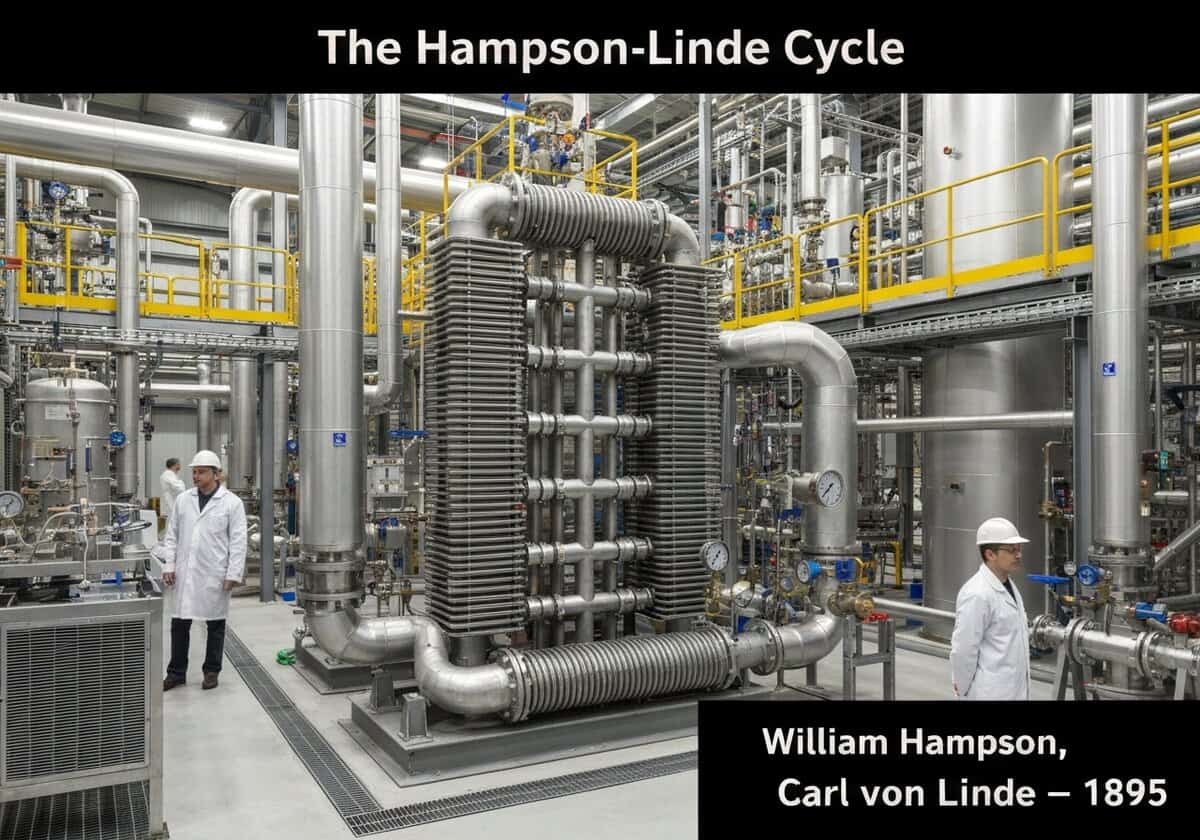
Independently developed by William Hampson in Britain and Carl von Linde in Germany, this cycle represented a major breakthrough. Its elegance lies in its simplicity and self-reinforcing nature. The key component is the regenerative heat exchanger, typically a set of coiled pipes. Incoming high-pressure gas flows through an inner pipe, while the cold, expanded gas from the Joule-Thomson valve flows back over the outside of this pipe. This counter-flow arrangement ensures the incoming gas is continuously pre-cooled by the coldest available return gas. With each pass, the temperature of the gas entering the expansion valve drops further. Eventually, the temperature falls below the gas’s inversion temperature, and the Joule-Thomson expansion produces significant cooling. This cooling is carried back through the heat exchanger, creating a positive feedback loop until the temperature is low enough for a fraction of the gas to condense into a liquid upon expansion. This process made the large-scale, commercial production of liquid air feasible for the first time.
enhanced oil recovery systems using liquefied nitrogen injection
低温加工可改善难加工材料的表面光洁度
用于电网规模电力平衡的液态空气储能(LAES)系统
具有更精细温度控制的先进冷冻手术工具
on-demand liquefaction systems for rocket propellant loading
低温冷冻食品,确保优质保存
用于飞机机载氧气生成(OBOGS)的紧凑型空气分离装置
Related to: Hampson-Linde cycle, regenerative cooling, Joule-Thomson effect, liquefaction, cryogenics, air separation, heat exchanger, Carl von Linde, throttling, counter-flow.