Product Design, Manufacturing & Innovation Resources
Heim » Der Hampson-Linde-Zyklus

Der Hampson-Linde-Zyklus

1895
  • William Hampson
  • Carl von Linde
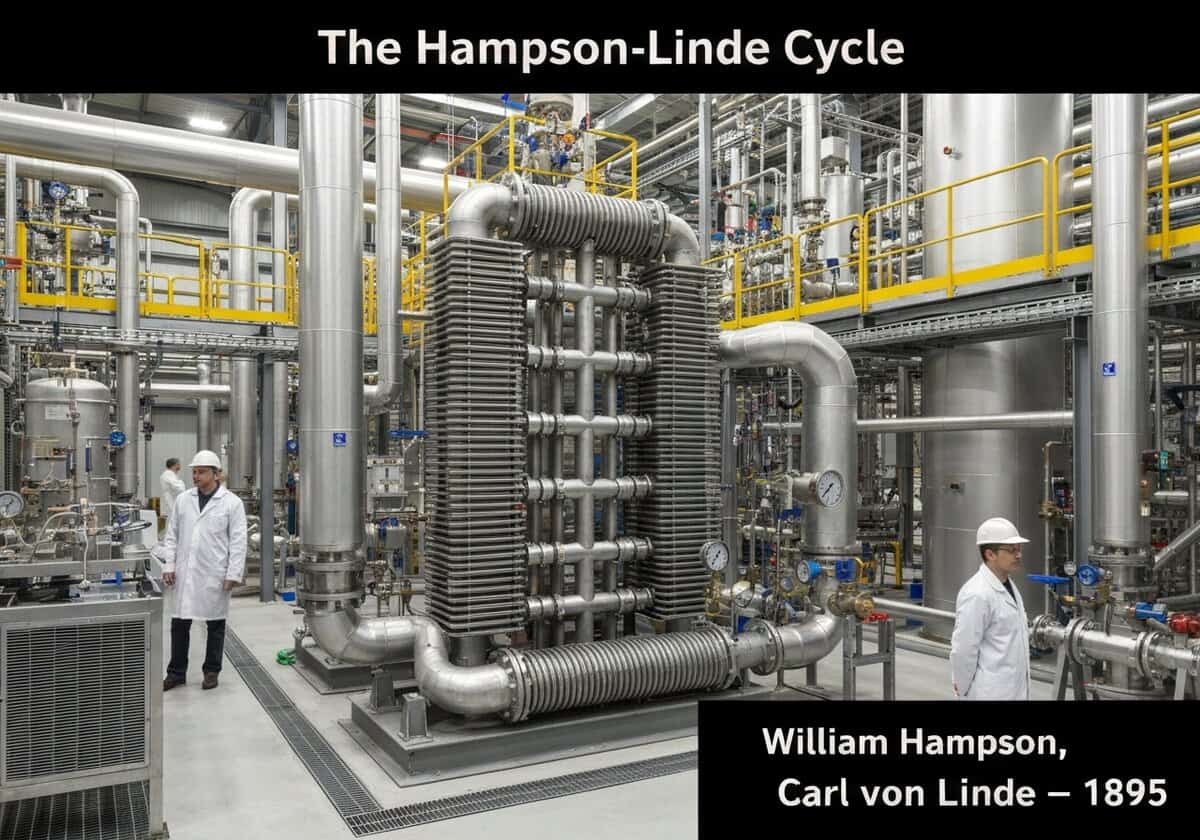
Industrielle Gasverflüssigungsanlage, die den Hampson-Linde-Kreislauf für die Kryogenik nutzt.

(Abbildung dient nur zur Veranschaulichung)

The Hampson-Linde cycle liquefies gases like air using the Joule-Thomson effect combined with regenerative cooling. High-pressure gas is cooled in a counter-flow heat exchanger by the cold, low-pressure gas returning from the expansion valve. This progressively lowers the temperature at the valve until it drops below the critical point and liquefaction begins, forming the basis for the modern gas liquefaction Industrie.

Independently developed by William Hampson in Britain and Carl von Linde in Germany, this cycle represented a major breakthrough. Its elegance lies in its simplicity and self-reinforcing nature. The key component is the regenerative heat exchanger, typically a set of coiled pipes. Incoming high-pressure gas flows through an inner pipe, while the cold, expanded gas from the Joule-Thomson valve flows back over the outside of this pipe. This counter-flow arrangement ensures the incoming gas is continuously pre-cooled by the coldest available return gas. With each pass, the temperature of the gas entering the expansion valve drops further. Eventually, the temperature falls below the gas’s inversion temperature, and the Joule-Thomson expansion produces significant cooling. This cooling is carried back through the heat exchanger, creating a positive feedback loop until the temperature is low enough for a fraction of the gas to condense into a liquid upon expansion. This process made the large-scale, commercial production of liquid air feasible for the first time.

UNESCO Nomenclature: 2212
- Thermodynamik

Typ

Thermodynamischer Zyklus

Störung

Wesentliche

Verwendung

Weitverbreitete Verwendung

Vorläufer

  • Joule-Thomson-Effekt (Joule und Thomson)
  • Konzept des Gegenstrom-Wärmeaustauschs
  • regeneratives Kühlprinzip von Siemens (entwickelt für Öfen)
  • Fortschritte in der Hochdruckkompressionstechnologie

Anwendungen

  • industrielle Produktion von flüssiger Luft, Stickstoff, Sauerstoff und Argon
  • Standard-Laborgeräte zur Verflüssigung von Gasen
  • Kryogenik Forschung
  • Vorkühlstufe für Wasserstoff- und Heliumverflüssiger
  • liquid air energy storage (LAES)

Patente:

  • GB189524525A
  • DE88824

Potenzielle Innovationsideen

  • tragbare Sauerstoffgeneratoren für abgelegene medizinische Einrichtungen
  • Geschlossener kryogener Kühlkreislauf für Magnetschwebebahnsysteme
  • kleine Stickstoffverflüssiger für landwirtschaftliche Zwecke (z. B. Kryokonservierung von Samen)
  • enhanced oil recovery systems using liquefied nitrogen injection
  • Kryogene Bearbeitung für eine verbesserte Oberflächengüte bei schwierigen Materialien
  • Flüssigluft-Energiespeichersysteme (LAES) für den netzweiten Leistungsausgleich
  • fortschrittliche Kryochirurgie-Instrumente mit feinerer Temperaturkontrolle
  • On-Demand-Verflüssigungssysteme für die Beladung von Raketentreibstoff
  • Kryogenes Einfrieren von Lebensmitteln für höchste Qualitätserhaltung
  • compact Luftzerlegung units for aircraft onboard oxygen generation (OBOGS)
Related to: Hampson-Linde cycle, regenerative cooling, Joule-Thomson effect, liquefaction, cryogenics, air separation, heat exchanger, Carl von Linde, throttling, counter-flow.

Historischer Kontext

Der Hampson-Linde-Zyklus

1889
1890
1890
1895
1895
1899
1900
1889
1890
1890
1895
1895
1896
1900
1900

(wenn das Datum unbekannt oder nicht relevant ist, z. B. „Strömungsmechanik“, wird eine gerundete Schätzung seines bemerkenswerten Auftretens bereitgestellt)

10. Jahr Jubiläum

Bilder in voller Größe und Downloads sind nur für registrierte Mitglieder 100% kostenlos verfügbar.

> Login <