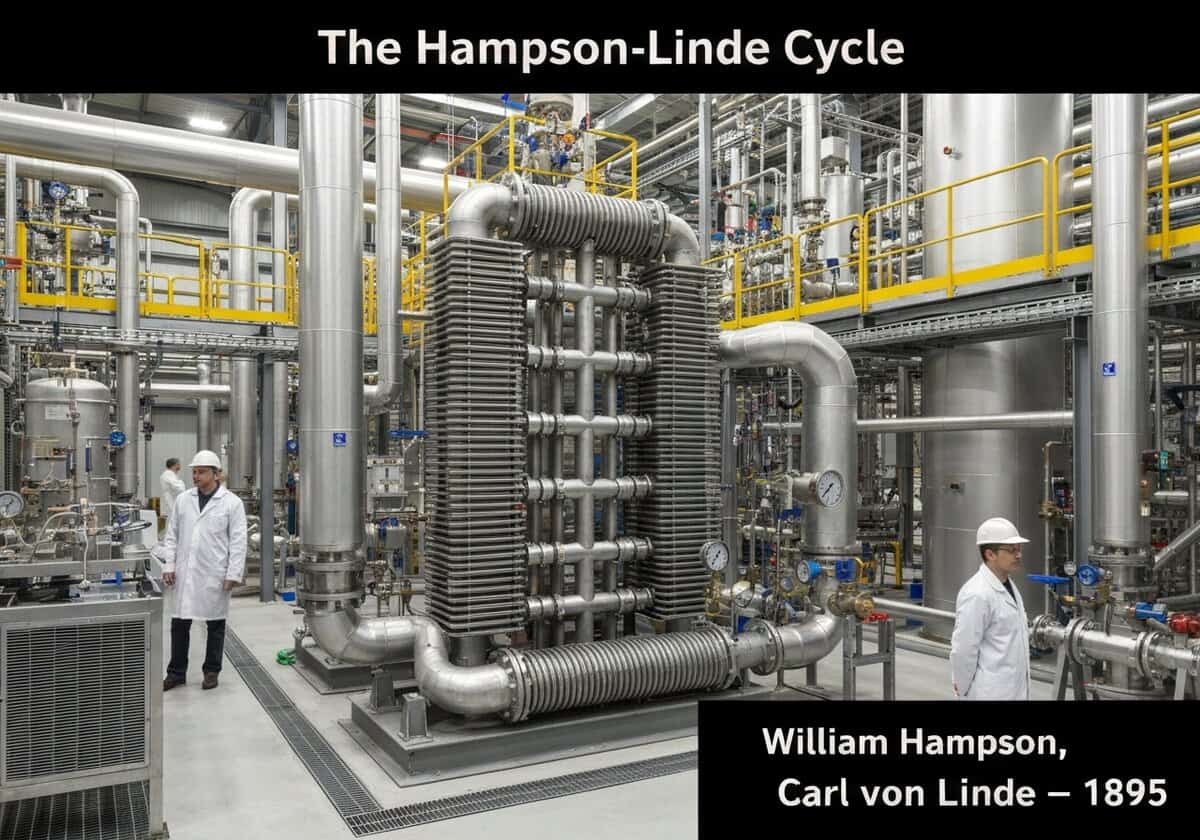
햄슨-린데 사이클은 줄-톰슨 효과와 재생 냉각을 결합하여 공기와 같은 기체를 액화합니다. 고압 가스는 팽창 밸브에서 되돌아오는 차가운 저압 가스에 의해 역류 열교환기에서 냉각됩니다. 이러한 냉각 과정을 통해 밸브의 온도가 임계점 이하로 점차 낮아지면서 액화가 시작되며, 이는 현대 가스 액화 산업의 기초가 됩니다.

(설명을 위한 생성된 이미지입니다)
햄슨-린데 사이클은 줄-톰슨 효과와 재생 냉각을 결합하여 공기와 같은 기체를 액화합니다. 고압 가스는 팽창 밸브에서 되돌아오는 차가운 저압 가스에 의해 역류 열교환기에서 냉각됩니다. 이러한 냉각 과정을 통해 밸브의 온도가 임계점 이하로 점차 낮아지면서 액화가 시작되며, 이는 현대 가스 액화 산업의 기초가 됩니다.
Independently developed by William Hampson in Britain and Carl von Linde in Germany, this cycle represented a major breakthrough. Its elegance lies in its simplicity and self-reinforcing nature. The key component is the regenerative heat exchanger, typically a set of coiled pipes. Incoming high-pressure gas flows through an inner pipe, while the cold, expanded gas from the 줄-톰슨 valve flows back over the outside of this pipe. This counter-flow arrangement ensures the incoming gas is continuously pre-cooled by the coldest available return gas. With each pass, the temperature of the gas entering the expansion valve drops further. Eventually, the temperature falls below the gas’s inversion temperature, and the Joule-Thomson expansion produces significant cooling. This cooling is carried back through the heat exchanger, creating a positive feedback loop until the temperature is low enough for a fraction of the gas to condense into a liquid upon expansion. This process made the large-scale, commercial production of liquid air feasible for the first time.
햄슨-린데 사이클
(날짜를 알 수 없거나 관련이 없는 경우, 예를 들어 "유체역학"의 경우, 주목할 만한 등장 시기를 대략적으로 추정하여 제공합니다.)

고화질 이미지 및 다운로드는 등록된 회원에게만 100% 무료로 제공됩니다.
> 로그인 <