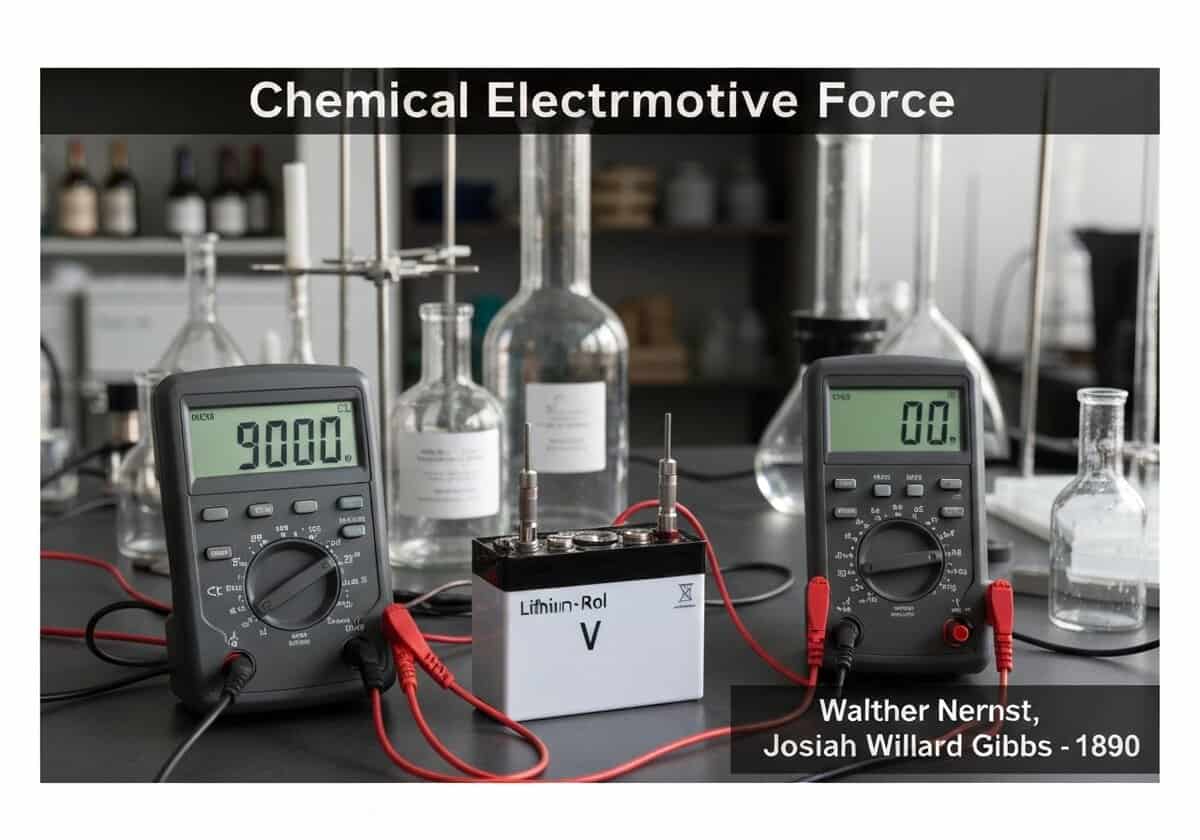
電池や燃料電池などの電気化学セルでは、起電力は化学反応によって発生します。電荷の分離は、2つの異なる電極で起こる酸化還元反応によって駆動されます。セルの最大起電力は、反応のギブズ自由エネルギーの変化([latex]Delta G[/latex])と[latex]mathcal{E} = -frac{Delta G}{nF}[/latex]の関係にあります。ここで、[latex]n[/latex]は電子のモル数、[latex]F[/latex]はファラデー定数です。


(画像はイメージです)
電池や燃料電池などの電気化学セルでは、起電力は化学反応によって発生します。電荷の分離は、2つの異なる電極で起こる酸化還元反応によって駆動されます。セルの最大起電力は、反応のギブズ自由エネルギーの変化([latex]Delta G[/latex])と[latex]mathcal{E} = -frac{Delta G}{nF}[/latex]の関係にあります。ここで、[latex]n[/latex]は電子のモル数、[latex]F[/latex]はファラデー定数です。

の 起電力 in a chemical source arises from the potential energy difference of electrons in different chemical species. In a galvanic cell, two dissimilar metals (electrodes) are placed in an electrolyte, creating two half-cells. At one electrode (the anode), an oxidation reaction occurs, releasing electrons. At the other electrode (the cathode), a reduction reaction occurs, consuming electrons. This creates an electrical potential difference between the electrodes. The chemical reactions effectively act as a “charge pump,” doing work on the electrons to move them from a lower potential energy state to a higher one, thus establishing the EMF.
The theoretical maximum EMF is determined by the thermodynamics of the reaction, specifically the change in Gibbs free energy ([latex]Delta G[/latex]), which represents the maximum non-expansion work that can be extracted from a thermodynamically closed system. The ネルンスト equation further refines this by relating the EMF to the standard electrode potential and the concentrations (or activities) of the reactants and products, showing how the cell’s voltage changes as the reaction proceeds and concentrations vary. This thermodynamic basis is fundamental to designing batteries with specific voltage outputs and energy densities, and for understanding processes like electrolysis, where an external EMF is used to drive a non-spontaneous chemical reaction.
化学起電力
(日付が不明または関連性がない場合、例えば「流体力学」などでは、その注目すべき出現時期の概算値が提示されます。)

フルサイズの画像とダウンロードは、登録会員のみが100%無料で利用できます。
> ログイン <