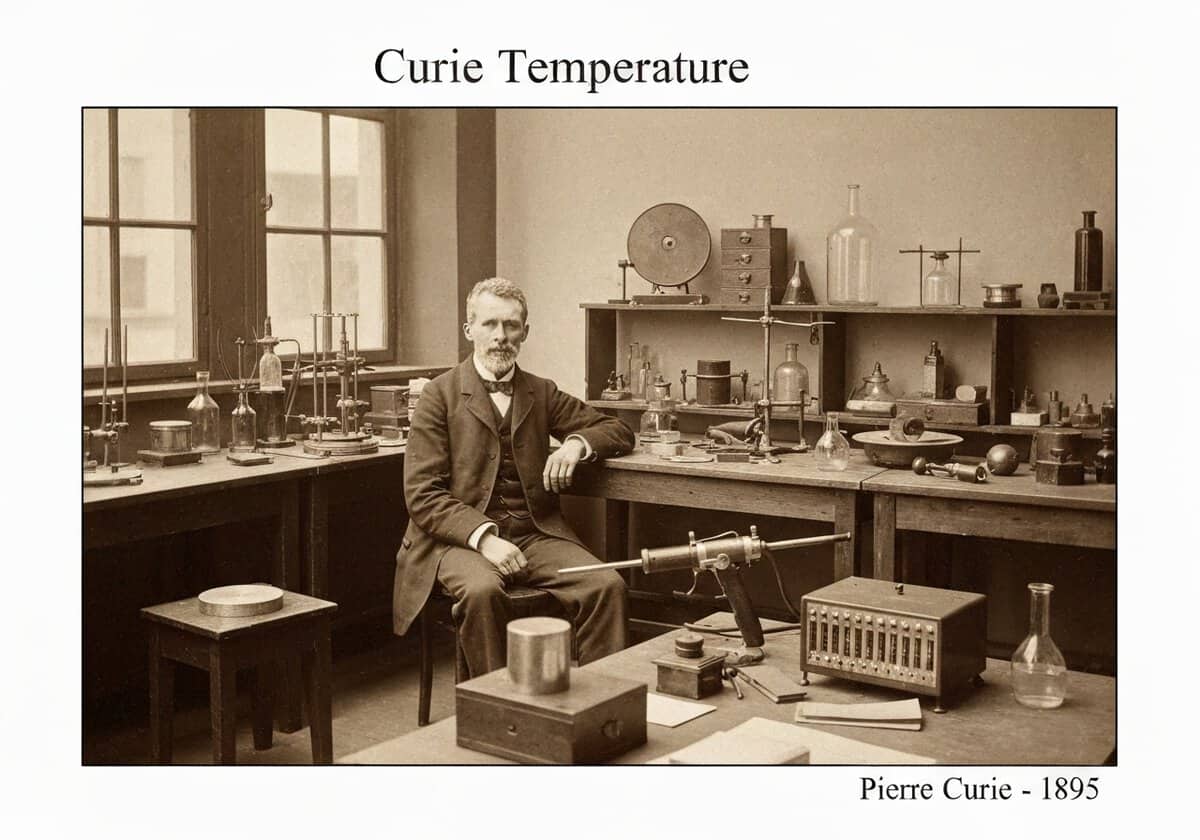
キュリー温度([latex]T_c[/latex])、またはキュリー点とは、特定の物質が永久磁性を失う臨界温度のことです。強磁性体の場合、[latex]T_c[/latex]を超えると常磁性体になります。この転移は相転移であり、熱エネルギーが原子モーメントの自発的な磁気秩序を引き起こす量子力学的交換相互作用を克服するのに十分な強さになることで起こります。


(画像はイメージです)
キュリー温度([latex]T_c[/latex])、またはキュリー点とは、特定の物質が永久磁性を失う臨界温度のことです。強磁性体の場合、[latex]T_c[/latex]を超えると常磁性体になります。この転移は相転移であり、熱エネルギーが原子モーメントの自発的な磁気秩序を引き起こす量子力学的交換相互作用を克服するのに十分な強さになることで起こります。

Pierre Curie discovered that a material’s magnetism changed at a specific temperature, a finding that was crucial for understanding the nature of magnetism. Below the Curie temperature ([latex]T_c[/latex]), the exchange interaction dominates, forcing adjacent atomic magnetic moments to align, creating the spontaneous magnetization characteristic of 強磁性. As the temperature increases, thermal agitation causes the moments to fluctuate more randomly. At the Curie temperature, the thermal energy is sufficient to completely disrupt this long-range ordering. The material undergoes a second-order phase transition, and its spontaneous magnetization drops to zero. Above [latex]T_c[/latex], the material is paramagnetic; an external magnetic field can still induce a weak alignment of the atomic moments, but this alignment disappears once the field is removed.
それぞれ ferromagnetic material has a unique Curie temperature. For example, iron’s [latex]T_c[/latex] is 770 °C (1043 K), cobalt’s is 1130 °C (1403 K), and nickel’s is 358 °C (631 K). This property is exploited in various テクノロジー. For instance, magneto-optical discs use a laser to heat a small spot of magnetic material above its Curie point, allowing a weak magnetic field to change its magnetic orientation to write data. In paleomagnetism, the Curie temperature is fundamental for studying the Earth’s past magnetic field, as magnetic minerals in cooling volcanic rocks align with the Earth’s field and lock in that orientation as they cool below their [latex]T_c[/latex].
キュリー温度
(日付が不明または関連性がない場合、例えば「流体力学」などでは、その注目すべき出現時期の概算値が提示されます。)

フルサイズの画像とダウンロードは、登録会員のみが100%無料で利用できます。
> ログイン <