Product Design, Manufacturing & Innovation Resources
घर » हैम्पसन-लिंडे चक्र

हैम्पसन-लिंडे चक्र

1895
  • William Hampson
  • Carl von Linde
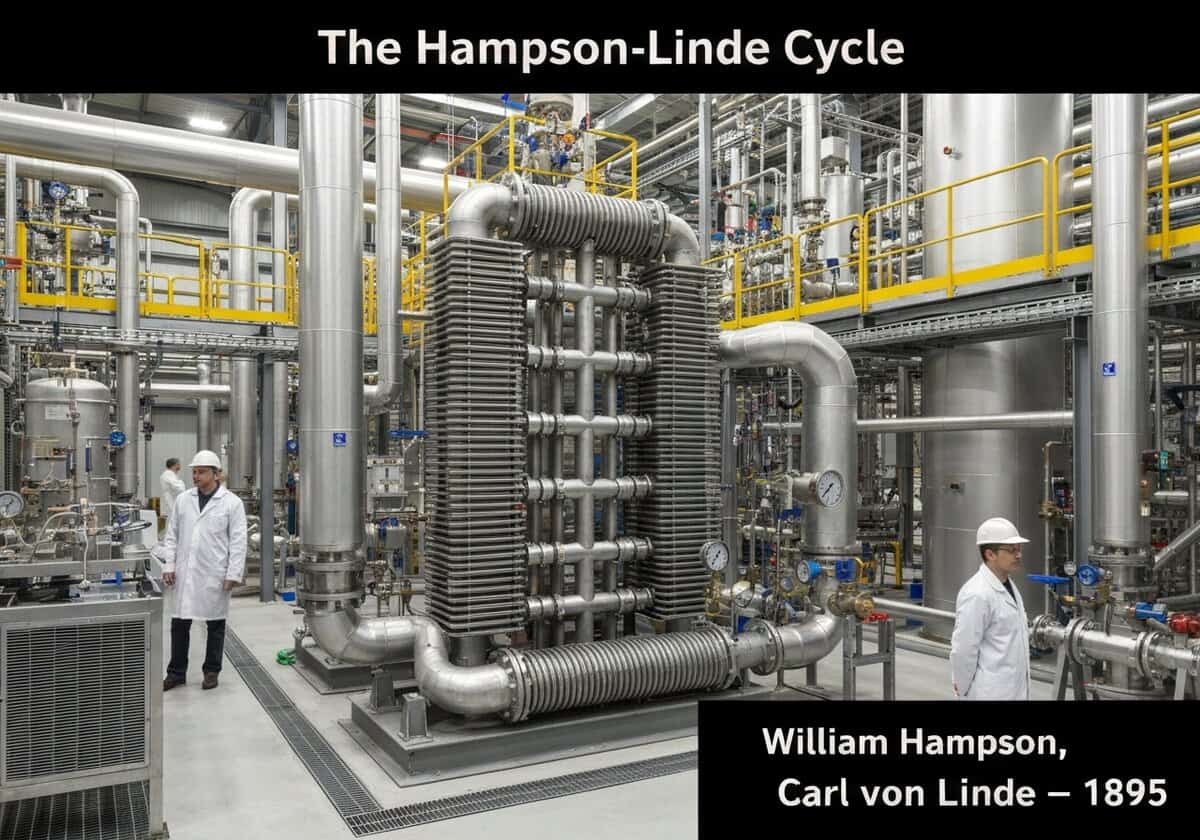
Industrial gas liquefaction facility utilizing the Hampson-Linde cycle for cryogenics.

(यह छवि केवल उदाहरण के लिए बनाई गई है)

The Hampson-Linde cycle liquefies gases like air using the Joule-Thomson effect combined with regenerative cooling. High-pressure gas is cooled in a counter-flow heat exchanger by the cold, low-pressure gas returning from the expansion valve. This progressively lowers the temperature at the valve until it drops below the critical point and liquefaction begins, forming the basis for the modern gas liquefaction industry.


Independently developed by William Hampson in Britain and Carl von Linde in Germany, this cycle represented a major breakthrough. Its elegance lies in its simplicity and self-reinforcing nature. The key component is the regenerative heat exchanger, typically a set of coiled pipes. Incoming high-pressure gas flows through an inner pipe, while the cold, expanded gas from the Joule-Thomson valve flows back over the outside of this pipe. This counter-flow arrangement ensures the incoming gas is continuously pre-cooled by the coldest available return gas. With each pass, the temperature of the gas entering the expansion valve drops further. Eventually, the temperature falls below the gas’s inversion temperature, and the Joule-Thomson expansion produces significant cooling. This cooling is carried back through the heat exchanger, creating a positive feedback loop until the temperature is low enough for a fraction of the gas to condense into a liquid upon expansion. This process made the large-scale, commercial production of liquid air feasible for the first time.

UNESCO Nomenclature: 2212
ऊष्मागतिकी

Type

ऊष्मागतिक चक्र

व्यवधान

संतोषजनक

उपयोग

व्यापक उपयोग

शगुन

  • जूल-थॉमसन प्रभाव (जूल और थॉमसन)
  • विपरीत धारा ऊष्मा विनिमय की अवधारणा
  • सीमेंस का पुनर्योजी शीतलन सिद्धांत (भट्टियों के लिए विकसित)
  • उच्च दाब संपीड़न प्रौद्योगिकी में प्रगति

आवेदन

  • तरल वायु, नाइट्रोजन, ऑक्सीजन और आर्गन का औद्योगिक उत्पादन
  • गैसों को द्रवीकृत करने के लिए मानक प्रयोगशाला उपकरण
  • cryogenics अनुसंधान
  • हाइड्रोजन और हीलियम द्रवीकरण यंत्रों के लिए पूर्व-शीतलन चरण
  • liquid air energy storage (LAES)

पेटेंट:

  • GB189524525A
  • DE88824

संभावित नवाचार विचार

  • दूरस्थ चिकित्सा सुविधाओं के लिए पोर्टेबल ऑक्सीजन जनरेटर
  • चुंबकीय उत्तोलन (मैगलेव) परिवहन प्रणालियों के लिए बंद-लूप क्रायोजेनिक शीतलन
  • कृषि उपयोग के लिए छोटे पैमाने के नाइट्रोजन द्रवीकरण यंत्र (उदाहरण के लिए, वीर्य का क्रायोप्रिजर्वेशन)
  • enhanced oil recovery systems using liquefied nitrogen injection
  • कठिन सामग्रियों पर बेहतर सतह परिष्करण के लिए क्रायोजेनिक मशीनिंग
  • ग्रिड-स्तरीय विद्युत संतुलन के लिए तरल वायु ऊर्जा भंडारण (एलएईएस) प्रणाली
  • बेहतर तापमान नियंत्रण वाले उन्नत क्रायोसर्जरी उपकरण
  • रॉकेट प्रणोदक लोडिंग के लिए ऑन-डिमांड द्रवीकरण प्रणाली
  • बेहतर गुणवत्ता संरक्षण के लिए क्रायोजेनिक खाद्य फ्रीजिंग
  • compact वायु पृथक्करण units for aircraft onboard oxygen generation (OBOGS)
Related to: Hampson-Linde cycle, regenerative cooling, Joule-Thomson effect, liquefaction, cryogenics, air separation, heat exchanger, Carl von Linde, throttling, counter-flow.

ऐतिहासिक संदर्भ

हैम्पसन-लिंडे चक्र

1889
1890
1890
1895
1895
1899
1900
1889
1890
1890
1895
1895
1896
1900
1900

(यदि तिथि अज्ञात है या प्रासंगिक नहीं है, उदाहरण के लिए "द्रव यांत्रिकी", तो इसके उल्लेखनीय उद्भव का एक अनुमानित आंकड़ा प्रदान किया गया है)

नवीनतम परिवर्धन

शीर्ष पोस्ट और लेख

शीर्ष मूल उपकरण

10वां वर्ष सालगिरह

पंजीकृत सदस्यों के लिए पूर्ण आकार की छवियाँ और डाउनलोड 100% निःशुल्क उपलब्ध हैं।