Product Design, Manufacturing & Innovation Resources
بيت » دورة هامبسون-ليند

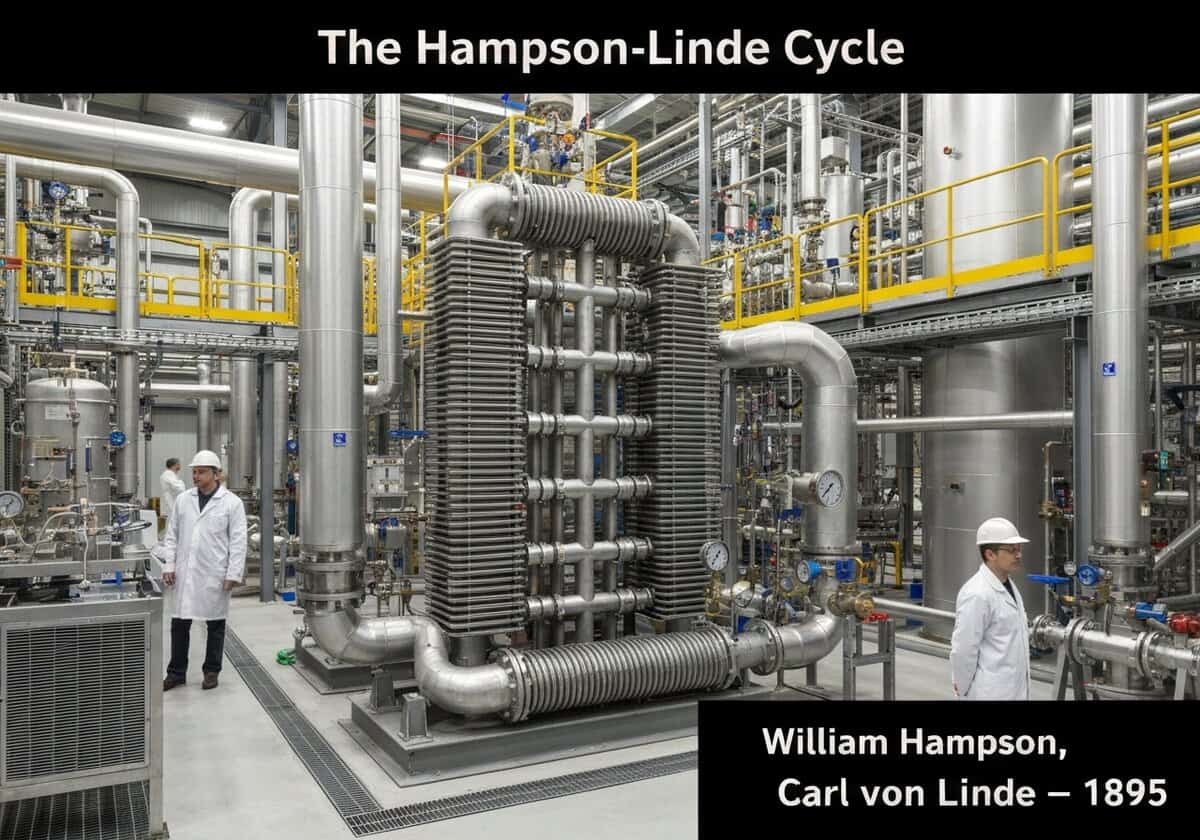
دورة هامبسون-ليند

1895
  • William Hampson
  • Carl von Linde
Industrial gas liquefaction facility utilizing the Hampson-Linde cycle for cryogenics.

(صورة توضيحية فقط)

The Hampson-Linde cycle liquefies gases like air using the Joule-Thomson effect combined with regenerative cooling. High-pressure gas is cooled in a counter-flow heat exchanger by the cold, low-pressure gas returning from the expansion valve. This progressively lowers the temperature at the valve until it drops below the critical point and liquefaction begins, forming the basis for the modern gas liquefaction industry.


Independently developed by William Hampson in Britain and Carl von Linde in Germany, this cycle represented a major breakthrough. Its elegance lies in its simplicity and self-reinforcing nature. The key component is the regenerative heat exchanger, typically a set of coiled pipes. Incoming high-pressure gas flows through an inner pipe, while the cold, expanded gas from the Joule-Thomson valve flows back over the outside of this pipe. This counter-flow arrangement ensures the incoming gas is continuously pre-cooled by the coldest available return gas. With each pass, the temperature of the gas entering the expansion valve drops further. Eventually, the temperature falls below the gas’s inversion temperature, and the Joule-Thomson expansion produces significant cooling. This cooling is carried back through the heat exchanger, creating a positive feedback loop until the temperature is low enough for a fraction of the gas to condense into a liquid upon expansion. This process made the large-scale, commercial production of liquid air feasible for the first time.

UNESCO Nomenclature: 2212
– Thermodynamics

يكتب

Thermodynamic Cycle

خلل

Substantial

الاستخدام

استخدام واسع النطاق

مقدمات

  • تأثير جول-ثومسون (جول وثومسون)
  • مفهوم تبادل الحرارة بالتيار المعاكس
  • Siemens’ regenerative cooling principle (developed for furnaces)
  • التطورات في تكنولوجيا الضغط العالي

التطبيقات

  • الإنتاج الصناعي للهواء السائل والنيتروجين والأكسجين والأرجون
  • المعدات المعملية القياسية لتسييل الغازات
  • cryogenics بحث
  • مرحلة التبريد المسبق لمسالات الهيدروجين والهيليوم
  • liquid air energy storage (LAES)

براءات الاختراع:

  • GB189524525A
  • DE88824

أفكار ابتكارية محتملة

  • مولدات الأكسجين المحمولة للمرافق الطبية النائية
  • التبريد بالتبريد العميق ذي الحلقة المغلقة لأنظمة النقل المغناطيسي المعلق (الماجليف)
  • مُسيِّلات النيتروجين صغيرة الحجم للاستخدام الزراعي (على سبيل المثال، حفظ السائل المنوي بالتبريد)
  • enhanced oil recovery systems using liquefied nitrogen injection
  • التصنيع بالتبريد العميق لتحسين تشطيب السطح للمواد الصعبة
  • أنظمة تخزين طاقة الهواء السائل (LAES) لموازنة الطاقة على نطاق الشبكة
  • أدوات جراحية بالتبريد متقدمة مع تحكم أدق في درجة الحرارة
  • أنظمة التسييل عند الطلب لتحميل الوقود الصاروخي
  • تجميد الأطعمة بالتبريد العميق للحفاظ على الجودة العالية
  • compact air separation units for aircraft onboard oxygen generation (OBOGS)
Related to: Hampson-Linde cycle, regenerative cooling, Joule-Thomson effect, liquefaction, cryogenics, air separation, heat exchanger, Carl von Linde, throttling, counter-flow.

السياق التاريخي

دورة هامبسون-ليند

1889
1890
1890
1895
1895
1899
1900
1889
1890
1890
1895
1895
1896
1900
1900

(إذا كان التاريخ غير معروف أو غير ذي صلة، على سبيل المثال "ميكانيكا الموائع"، يتم توفير تقدير تقريبي لظهوره الملحوظ)

أحدث الإضافات

أهم المنشورات والمقالات

أفضل الأدوات الأصلية

السنة العاشرة عيد

الصور والتنزيلات بالحجم الكامل متاحة فقط، ومجانية تمامًا، للأعضاء المسجلين.