The Capability Maturity Model Integration (CMMI) has emerged as an important framework for organizations striving to enhance their process efficiency, particularly in fields like software development, systems engineering, and IT service management. Originating from the Capability Maturity Model (CMM), CMMI offers a comprehensive ロードマップ 組織がより高いパフォーマンスを達成するためには、以下の5つの明確な成熟度レベルが必要です。 初期段階、管理段階、定義段階、定量的管理段階、最適化段階。
主なポイント
- CMMIは改善します プロセス能力 組織向け
- 5つの成熟度レベルが、段階的な組織成長を導く
- プロセス領域は成熟度に合わせて調整され、パフォーマンスが向上します。
- 評価方法は、コンプライアンスと改善状況を評価する。
- CMMIの導入により、品質と予測可能性が向上する。
能力成熟度モデル統合(CMMI)の定義と目的
能力成熟度モデル統合(CMMI)は、組織プロセスの改善を目的とした構造化されたフレームワークです。CMMIは、ソフトウェア開発、システムエンジニアリング、ITサービス管理、その他関連分野を強化するために必要なツールを組織に提供します。CMMIを導入することで、標準化された手法が確立され、複数のプロジェクトにわたる一貫性と予測可能性が確保されます。

CMMIの主な目的は、組織が現在の慣行からより成熟した効率的なプロセスへと進化するための明確な道筋を示すことです。このモデルは、組織が段階的に導入できる一連のベストプラクティスを提供し、継続的な改善を促進します。
CMMIはさまざまな分野に分かれており、それぞれが特定の業界ニーズに対応するように調整されている。
- 開発向けCMMI(CMMI-DEV)
- サービス向けCMMI(CMMI-SVC)
- CMMI for Acquisition (CMMI-ACQ)
この適応性により、組織は自社の業務目標や課題に合致する適切なCMMI構成を選択することができます。このフレームワークは、プロセス指向の思考と組織学習を中心とした文化を確立することの重要性を強調しています。
ヒント: CMMI導入に先立ち、組織内で「プロセス発見」演習を実施することを検討してください。これは、既存のプロセスをマッピングして、ギャップや改善点を特定する作業です。この準備を行うことで、その後のCMMI導入を効率化し、現状の能力と将来のニーズをより明確に把握することで、関係者の賛同を得やすくなります。
能力成熟度モデル(CMM)からCMMIへの歴史と進化
The Capability Maturity Model (CMM) was initially developed by the Software Engineering Institute (SEI) at カーネギーメロン大学 in the late 1980s. Its primary goal was to help organizations assess and improve their software development processes. CMM introduced a structured framework that outlined five maturity levels, progressively allowing organizations to evolve from chaotic processes to highly optimized ones. This model was initially largely centered on software engineering and provided a foundation for organizations to evaluate their practices and implement improvements in software quality, cost, and schedule performance.

エンジニアリングとマネジメントがシステムエンジニアリングやITサービスマネジメントへと拡大するにつれ、より統合的なアプローチの必要性が明らかになった。そこで、2002年にCMMIが導入され、複数のプロセス改善フレームワークが単一のモデルに統合された。
CMMIは、CMM、システムエンジニアリング能力モデル、統合製品開発能力モデルなどから得られたベストプラクティスを統合したものです。
このモデルは5つの成熟度レベルを維持しつつ、プロセス領域を大幅に拡大した。例えば、CMMIはリスク管理や統合プロジェクト管理といった新たな重点領域を導入し、様々な分野でより汎用性の高いものとなった。
| 年 | Model | Main Focus |
|---|---|---|
| 1989 | CMM | Software Development |
| 2002 | CMMI | Integrated Process Improvement |
ヒント: when adopting CMMI, organizations should conduct a gap analysis of their current processes against the CMMI framework to identify areas for improvement effectively.
The Five Maturity Levels of CMMI Framework
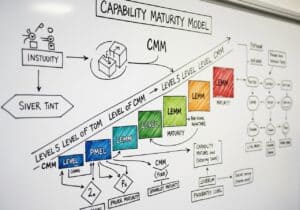
The five maturity levels of the Capability Maturity Model Integration (CMMI) framework serve as a structured path for organizations aiming to improve their processes. Each level builds upon the previous one, representing a progression towards enhanced process capability and institutionalization. The characteristics of each stage are defined as follows:

Maturity Level 1: Initial
- Characteristics: processes at this level are typically ad hoc and chaotic. Work may get completed, but it’s often unpredictable, reactive, and frequently delayed and over budget. Success relies heavily on individual effort rather than defined processes.
- Organizational growth: the organization begins to recognize the need for process improvement but lacks established practices.
Maturity Level 2: Managed
- Characteristics: basic project management processes are established to track cost, schedule, and functionality. Projects are planned, performed, measured, and controlled at the project level, but not necessarily standardized across the organization. The discipline is in place to repeat earlier successes on similar projects.
- Organizational growth: the organization starts to manage projects with defined processes, leading to more predictable outcomes for individual projects. There are still issues to resolve at a broader organizational level.
Maturity Level 3: Defined
- Characteristics: processes are well-characterized, documented, standardized, and integrated into the organization’s standard processes. Organization-wide standards provide guidance across projects, programs, and portfolios. All projects use an approved, tailored version of the organization’s standard processes for developing and maintaining products and services. This level is proactive rather than reactive.
- Organizational growth: the organization establishes consistency and a common understanding of processes across different projects and departments. This leads to improved quality and efficiency.
Maturity Level 4: Quantitatively Managed
- Characteristics: the organization collects detailed measures of process performance and product quality. Both processes and products are quantitatively understood and controlled using statistical and other quantitative techniques. Quantitative objectives for quality and process performance are established and used as criteria in managing processes.
- Organizational growth: the organization gains a deeper understanding of its process capabilities and can predict performance. This allows for data-driven decision-making and more effective control over outcomes.
Maturity Level 5: Optimizing
- Characteristics: this level focuses on continuous process improvement. Improvement is enabled by quantitative feedback from the process and from piloting innovative ideas and technologies. The organization is stable yet flexible, capable of adapting to changing business needs and improving its processes proactively.
- Organizational growth: the organization has a culture of continuous improvement and innovation. Processes are continually refined and adapted to meet evolving goals and to enhance performance.
It’s important to note that CMMI can be appraised using two approaches:
- The staged approach, which is described above, yields a maturity level rating from 1 to 5.
- The continuous approach allows an organization to focus on specific process areas and achieve capability levels for each.
ヒント: prioritize the engagement of cross-functional チーム when implementing CMMI process areas. Having diverse perspectives can lead to richer insights and more effective adaptations of the processes, ultimately facilitating smoother transitions between maturity levels.
Appraisal Methods for CMMI Evaluation
Appraisal methods employed for Capability Maturity Model Integration (CMMI) compliance primarily fall into two categories: formal and informal appraisals. Formal appraisals, such as the CMMI Institute’s Standard Appraisal Method for Process Improvement (スカンピ), offer a comprehensive evaluation of an organization’s processes against specific CMMI standards. SCAMPI is designed to provide a structured assessment, which can be beneficial for organizations seeking official recognition of their maturity level. Informal assessments, on the other hand, may utilize self-assessment tools that allow organizations to gauge their own maturity levels without the need for external validation.
SCAMPI In Short
“Standard CMMI Appraisal Method for Process Improvement” (SCAMPI) works by evaluating an organization’s processes against the Capability Maturity Model Integration (CMMI) framework. It involves a defined process that includes preparation, on-site activities, analysis of objective evidence, generation of findings, and reporting. During the appraisal, a representative sample of an organization’s projects and process instantiations are examined to determine the extent to which CMMI best practices are implemented. This involves identifying and analyzing objective evidence, such as documents and artifacts, and conducting interviews with personnel.
The SCAMPI method has different classes of appraisals (A, B, and C) that vary in rigor and purpose:
- A SCAMPI Class A appraisal is the most formal and is the only one that can result in an official CMMI maturity level rating, which is often used for benchmarking or to meet specific requirements, such as those from the U.S. Department of Defense.
- SCAMPI B appraisals are less rigorous and are often used to gauge progress in process improvement or to prepare for a Class A appraisal, requiring less data and smaller teams.
- SCAMPI C appraisals are the most flexible, can be tailored to specific organizational needs like a quick gap analysis, and can be conducted by a single lead appraiser.
Regardless of the class, the core principle is to compare existing processes to the CMMI model, identify strengths and weaknesses, and provide a basis for process improvement.
For very detailed SCAMPI methodology, we recommend our dedicated article:

The selection of an appropriate appraisal method depends on several factors, including the organization’s current maturity level, project size, and specific compliance needs. This process is often guided by a clear understanding of the organization’s goals and the resources available for appraisal. For instance, a government defense contractor may prioritize SCAMPI A for compliance with federal contracting requirements, while a smaller IT service company may choose a self-assessment pathway to gauge readiness for CMMI adoption.
ヒント: it is advisable for organizations to perform periodic self-assessments prior to formal appraisals to identify gaps and areas for improvement. This proactive approach allows teams to prepare adequately and maximize the benefits realized from formal evaluations.
The implementation of CMMI can drive significant change in organizational culture.
Employees may initially perceive the model as bureaucratic and restrictive; however, once embedded within the company, it can promote a culture of continuous improvement.
ヒント: 従事する stakeholders from all levels early in the CMMI adoption process to promote buy-in and alleviate apprehensions regarding changes.
Technological Readiness Levels (TRL) vs CMMI Levels
Technological Readiness Levels (TRL) and CMMI Levels are distinct frameworks used for different assessment purposes.
These are two different beasts not to be confused: TRLs, developed by NASA, measure the maturity of a specific technology, ranging from initial scientific research (TRL 1) to a flight-proven system (TRL 9). This scale helps in evaluating how ready a particular technology is for deployment within a system. In contrast, CMMI, describe in this article, focuses on the maturity of an organization’s processes for developing, delivering, and acquiring products or services.
TRL assesses the maturity of a technology, while CMMI assesses the maturity of an organization’s processes.
技術成熟度レベル(TRL) A method for estimating the maturity of technologies during the acquisition phase of a program. | CMMI Levels A process improvement methodology providing organizations with a framework to enhance their ability to develop and maintain quality products and services | |
|---|---|---|
| 長所 | Provides a common understanding of technology status; assists in risk management; used for decisions on technology funding and transition. | Increases efficiency and productivity; enhances product and service quality; improves customer satisfaction; helps in risk management and cost reduction. |
| 短所 | Readiness does not always align with appropriateness or technology maturity; a mature product may have different readiness for a specific system context; numerous factors like operational environment relevance and architectural mismatch need consideration. | Can face cultural resistance to change; requires strong management support and significant resources (time, budget, personnel); can be complex to understand and implement. |
| Use Cases | Assessing technology maturity for research, development, and deployment; making decisions on advancing and integrating technology. | Improving processes in product development, service delivery, and system management; benchmarking capabilities. |
| 最適な用途 | Organizations managing research and development of new technologies, particularly in early stages of development and integration. | Organizations seeking to standardize and optimize processes, improve quality, and achieve higher levels of process maturity across various domains. |
CMMI Pro Tips

- Quantitative process management: implement statistical methods to monitor and control process performance. Use control charts and process capability indices (like Cp and Cpk) to evaluate process stability and capability: [latex]Cp = \frac{USL – LSL}{6\sigma}[/latex] and [latex]Cpk = \min\left(\frac{USL – \mu}{3\sigma}, \frac{\mu – LSL}{3\sigma}\right)[/latex]
- Integrate Agile with CMMI: when incorporating Agile methodologies, ensure that Agile practices align with CMMI requirements. Use iterative cycles to gather data and improve processes continuously.
- Process Asset Library: create and maintain a Process Asset Library (PAL) that includes templates, guidelines, and lessons learned. This library serves as a repository for continuous improvement and reference.
- Stakeholder engagement: engage stakeholders throughout the process improvement lifecycle. Regular feedback loops and stakeholder assessments ensure alignment with organizational goals and enhance buy-in.
- Measurement and analysis: define key performance indicators (KPIs) for each process area. Use the following formula for calculating the overall process performance index (PPI): [latex]PPI = \frac{\text{Sum of all KPI scores}}{\text{Number of KPIs}}[/latex]
結論
In closing, the Capability Maturity Model Integration (CMMI) stands as a critical tool for organizations aiming to refine their processes and boost performance across various sectors, including software development, systems engineering, and IT service management. By progressing through its five maturity levels, organizations can not only enhance their project performance but also improve stakeholder satisfaction, as substantiated by the statistic indicating that 72% of CMMI adopters report notable benefits
よくある質問
能力成熟度モデル統合(CMMI)の定義と目的は何ですか?
CMMIは、組織が効果的なプロセスを実現するための重要な要素を提供するプロセス改善フレームワークです。その目的は、プロセス改善とコンプライアンスへの体系的なアプローチを提供することで、組織のパフォーマンスを向上させることです。
能力成熟度モデル(CMM)からCMMIへの進化とはどのようなものですか?
CMMは、ソフトウェア開発プロセスを評価するために1980年代後半に開発されました。CMMIは、より包括的なアプローチとして2000年代初頭に導入され、複数のCMMモデルを単一のフレームワークに統合することで、様々な分野への幅広い適用を可能にしました。
CMMIフレームワークの5つの成熟度レベルとは何ですか?
成熟度レベルは5段階あり、初期段階(プロセスが予測不可能)、管理段階(プロジェクト管理に重点を置く)、定義段階(標準化されたプロセスを重視)、定量的管理段階(指標を用いてプロセスを管理する)、最適化段階(継続的な改善に重点を置く)です。
CMMIにおけるプロセス領域とは何ですか?また、それらは成熟度レベルとどのような関係にありますか?
プロセス領域とは、組織がプロセスを改善するために取り組むべき具体的な領域のことです。各成熟度レベルには、次の成熟度レベルに進む前に取り組むべき一連のプロセス領域が組み込まれており、体系的な開発を保証します。
CMMIの準拠性および評価には、どのような評価方法が用いられますか?
プロセス改善のための標準CMMI評価方法(SCAMPI)は、CMMI準拠を評価するための主要な方法です。SCAMPIは構造化された評価を提供し、さまざまな評価方法を通じて組織が必要な改善基準を満たしていることを保証します。
関連トピック
- アジャイル手法との統合: CMMIがアジャイル開発手法とどのように共存し、プロジェクトのパフォーマンスを向上させることができるかを理解する。
- 変更管理 戦略: CMMIの導入に沿った、プロセスや慣行の変更を管理するための手法。
- 測定と指標: establishing effective metrics to assess process performance and maturity.
- 顧客参加: 顧客との関わり方が、CMMIに準拠したプロセスにどのように影響を与えるかを理解すること。
- プロジェクト管理への影響: CMMIがプロジェクト管理能力と成果をどのように向上させるか。
- CMMIと組織文化: より良い統合のために、組織の文化をCMMIの目標に合わせること。
- CMMIに関するグローバルな視点: CMMIの実践が、世界中のさまざまな文化的背景においてどのように適応され、実施されているか。
用語集
Capability Maturity Model Integration (CMMI): 組織が効果的なプロセス改善を行うための必須要素を提供するプロセス改善フレームワークであり、ソフトウェア開発やサービス提供など、さまざまな領域におけるパフォーマンス、品質、効率性に焦点を当てています。組織の成長を導くための5つの成熟度レベルで構成されています。
Computer Aided Manufacturing (CAM): ソフトウェアとコンピュータ制御の機械を用いて製造工程を自動化し、様々な産業において精密な生産、設計変更、効率的な資源管理を可能にする技術。
Computer-Aided Manufacturing (CAM): ソフトウェアとコンピュータ制御機械を用いて製造工程を自動化することで、精度、効率、生産速度を向上させる。設計と製造のワークフローを統合し、デジタルモデルを物理的な製品に直接変換することを可能にする。
Contract Manufacturer (CM): 他社に代わって製品を製造する会社で、通常は特定の設計および品質仕様に従って製造を行う。この仕組みにより、依頼企業はマーケティングや製品開発といった中核事業に集中できる一方、製造工程は外部委託することができる。
Key Performance Indicator (KPI): a measurable value that demonstrates how effectively an organization is achieving key business objectives, often used to evaluate success at reaching targets.
Network-attached storage (NAS): ネットワークに接続されたストレージデバイスで、複数のユーザーやデバイス間でのデータアクセスと共有を可能にし、通常は集中型のファイルストレージ、バックアップ、管理機能を提供する。コンピュータとは独立して動作し、標準的なネットワークプロトコルを介してアクセスできる。
Personnel Airlock (PAL): a sealed entryway designed to allow personnel to transition between different pressure environments while minimizing contamination and maintaining safety, typically used in space stations, laboratories, or cleanrooms. It features interlocking doors that prevent simultaneous opening.
Process Capability Index (Cpk): プロセスが指定された範囲内でどれだけうまく出力を生成できるかを定量化する統計的指標であり、プロセスの平均値と最も近い仕様限界との関係を、プロセスの変動性を考慮して調整したものである。
Process Performance Index (Ppk): プロセスが仕様限界をどの程度満たしているかを定量化する統計的指標であり、プロセスの平均値と標準偏差を用いて算出される。これは、ばらつきと中心値の両方を考慮した上で、プロセスが定義された限界内で出力を生産できる能力を示す。
Technological Readiness Levels (TRL): 技術の成熟度を評価するために使用される尺度で、基礎研究開発から本格的な展開までを網羅し、通常は1(概念)から9(運用)までの9段階で分類され、技術開発プロセスにおける評価と意思決定を容易にする。