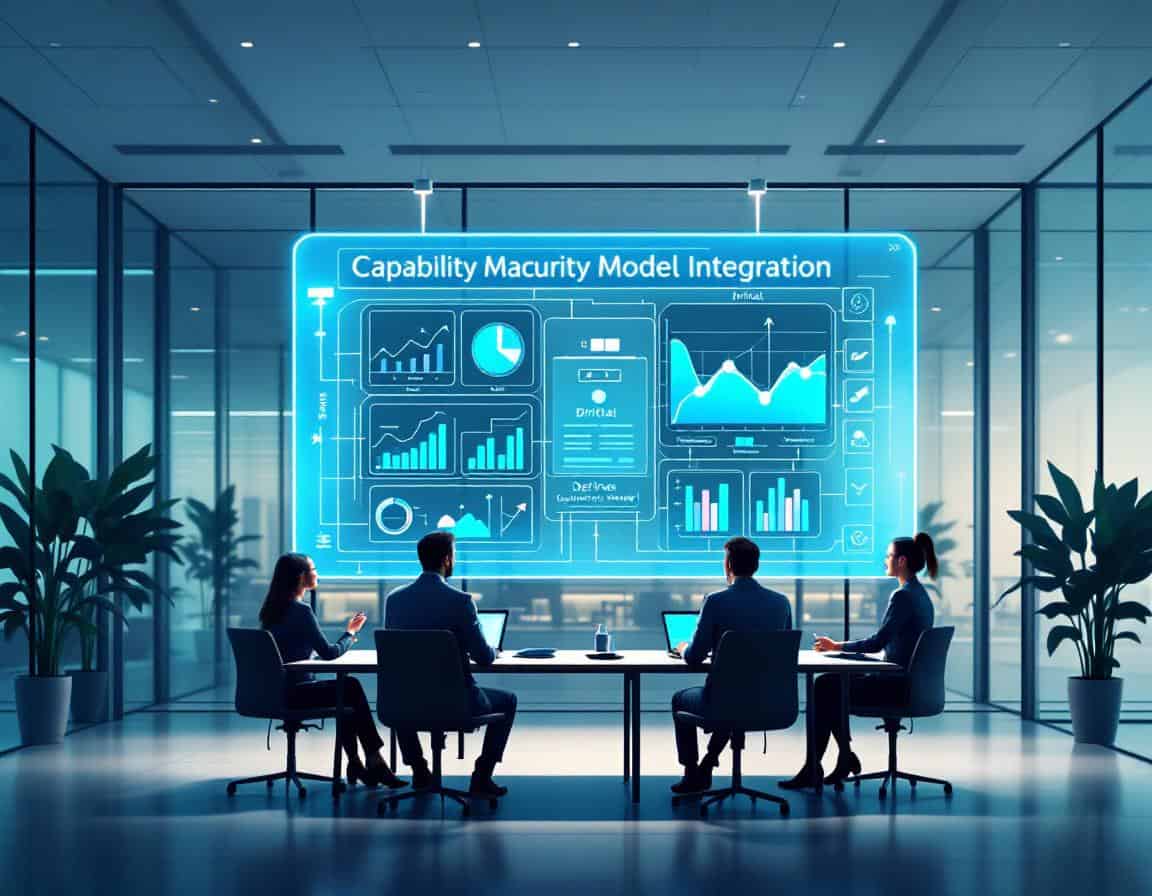
The Capability Maturity Model Integration (CMMI) has emerged as an important framework for organizations striving to enhance their process efficiency, particularly in fields like software development, systems engineering, and IT service management. Originating from the Capability Maturity Model (CMM), CMMI offers a comprehensive 로드맵 조직이 다섯 가지의 뚜렷한 성숙도 단계를 통해 더 높은 성과를 달성할 수 있도록 합니다. 초기, 관리, 정의, 정량적 관리 및 최적화.
핵심 요약
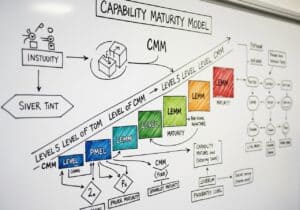
- CMMI는 개선됩니다 프로세스 능력 조직을 위한
- 조직의 점진적인 성장을 위한 다섯 가지 성숙도 단계
- 프로세스 영역은 성숙도에 맞춰 조정되어 성능이 향상됩니다.
- 평가 방법은 규정 준수 및 개선 상태를 평가합니다.
- CMMI를 도입하면 품질과 예측 가능성이 향상됩니다.
CMMI(역량 성숙도 모델 통합)의 정의 및 목적
CMMI(Capability Maturity Model Integration)는 조직 프로세스 개선을 목표로 하는 구조화된 프레임워크입니다. CMMI는 조직에 소프트웨어 개발, 시스템 엔지니어링, IT 서비스 관리 및 기타 관련 분야를 향상시키는 데 필요한 핵심 도구를 제공합니다. CMMI를 구현하면 표준화된 관행이 확립되어 여러 프로젝트 전반에 걸쳐 일관성과 예측 가능성을 보장할 수 있습니다.

CMMI의 주요 목적은 조직이 현재의 관행에서 더욱 성숙하고 효율적인 프로세스로 발전할 수 있는 명확한 경로를 제시하는 것입니다. 이 모델은 조직이 단계적으로 채택하여 지속적인 개선을 촉진할 수 있는 일련의 모범 사례를 제공합니다.
CMMI는 다양한 컨스텔레이션으로 나뉘며, 각 컨스텔레이션은 특정 산업의 요구 사항을 충족하도록 설계되었습니다.
- CMMI 개발(CMMI-DEV)
- CMMI 서비스(CMMI-SVC)
- CMMI 획득 관리(CMMI-ACQ)
이러한 적응성 덕분에 조직은 운영 목표 및 과제에 부합하는 적절한 CMMI 구성(constellation)을 선택할 수 있습니다. 이 프레임워크는 프로세스 중심적 사고와 조직 학습을 중심으로 하는 문화를 구축하는 것의 중요성을 강조합니다.
팁: CMMI 도입에 앞서 조직 내에서 "프로세스 발견" 활동을 실시하는 것을 고려해 보세요. 이 활동은 기존 프로세스를 분석하여 부족한 부분과 개선이 필요한 영역을 파악하는 것입니다. 이러한 사전 준비는 이후 CMMI 구현을 간소화하고, 현재 역량과 미래 요구 사항에 대한 명확성을 높여 이해관계자의 참여를 강화하는 데 도움이 될 수 있습니다.
CMM(역량 성숙도 모델)에서 CMMI(컴퓨터화된 경영 관리 모델)로의 역사와 발전 과정
The Capability Maturity Model (CMM) was initially developed by the Software Engineering Institute (SEI) at 카네기멜론 대학교 in the late 1980s. Its primary goal was to help organizations assess and improve their software development processes. CMM introduced a structured framework that outlined five maturity levels, progressively allowing organizations to evolve from chaotic processes to highly optimized ones. This model was initially largely centered on software engineering and provided a foundation for organizations to evaluate their practices and implement improvements in software quality, cost, and schedule performance.

엔지니어링과 관리가 시스템 엔지니어링 및 IT 서비스 관리로 확장됨에 따라 보다 통합적인 접근 방식의 필요성이 분명해졌습니다. 그리하여 2002년 여러 프로세스 개선 프레임워크를 단일 모델로 통합한 CMMI가 도입되었습니다.
CMMI는 CMM, 시스템 엔지니어링 역량 모델, 통합 제품 개발 역량 모델 등에서 얻은 모범 사례를 통합했습니다.
이 모델은 5단계 성숙도 수준을 유지하면서 프로세스 영역을 크게 확장했습니다. 예를 들어, CMMI는 위험 관리 및 통합 프로젝트 관리와 같은 추가적인 중점 영역을 도입하여 다양한 분야에 더욱 폭넓게 적용할 수 있도록 했습니다.
| 년도 | Model | Main Focus |
|---|---|---|
| 1989 | CMM | Software Development |
| 2002 | CMMI | Integrated Process Improvement |
팁: when adopting CMMI, organizations should conduct a gap analysis of their current processes against the CMMI framework to identify areas for improvement effectively.
The Five Maturity Levels of CMMI Framework
The five maturity levels of the Capability Maturity Model Integration (CMMI) framework serve as a structured path for organizations aiming to improve their processes. Each level builds upon the previous one, representing a progression towards enhanced process capability and institutionalization. The characteristics of each stage are defined as follows:

Maturity Level 1: Initial
- Characteristics: processes at this level are typically ad hoc and chaotic. Work may get completed, but it’s often unpredictable, reactive, and frequently delayed and over budget. Success relies heavily on individual effort rather than defined processes.
- Organizational growth: the organization begins to recognize the need for process improvement but lacks established practices.
Maturity Level 2: Managed
- Characteristics: basic project management processes are established to track cost, schedule, and functionality. Projects are planned, performed, measured, and controlled at the project level, but not necessarily standardized across the organization. The discipline is in place to repeat earlier successes on similar projects.
- Organizational growth: the organization starts to manage projects with defined processes, leading to more predictable outcomes for individual projects. There are still issues to resolve at a broader organizational level.
Maturity Level 3: Defined
- Characteristics: processes are well-characterized, documented, standardized, and integrated into the organization’s standard processes. Organization-wide standards provide guidance across projects, programs, and portfolios. All projects use an approved, tailored version of the organization’s standard processes for developing and maintaining products and services. This level is proactive rather than reactive.
- Organizational growth: the organization establishes consistency and a common understanding of processes across different projects and departments. This leads to improved quality and efficiency.
Maturity Level 4: Quantitatively Managed
- Characteristics: the organization collects detailed measures of 프로세스 성능 and product quality. Both processes and products are quantitatively understood and controlled using statistical and other quantitative techniques. Quantitative objectives for quality and process performance are established and used as criteria in managing processes.
- Organizational growth: the organization gains a deeper understanding of its process capabilities and can predict performance. This allows for data-driven decision-making and more effective control over outcomes.
Maturity Level 5: Optimizing
- Characteristics: this level focuses on continuous process improvement. Improvement is enabled by quantitative feedback from the process and from piloting innovative ideas and technologies. The organization is stable yet flexible, capable of adapting to changing business needs and improving its processes proactively.
- Organizational growth: the organization has a culture of continuous improvement and innovation. Processes are continually refined and adapted to meet evolving goals and to enhance performance.
It’s important to note that CMMI can be appraised using two approaches:
- The staged approach, which is described above, yields a maturity level rating from 1 to 5.
- The continuous approach allows an organization to focus on specific process areas and achieve capability levels for each.
팁: prioritize the engagement of cross-functional 팀 when implementing CMMI process areas. Having diverse perspectives can lead to richer insights and more effective adaptations of the processes, ultimately facilitating smoother transitions between maturity levels.
Appraisal Methods for CMMI Evaluation
Appraisal methods employed for Capability Maturity Model Integration (CMMI) compliance primarily fall into two categories: formal and informal appraisals. Formal appraisals, such as the CMMI Institute’s Standard Appraisal Method for Process Improvement (스캠피), offer a comprehensive evaluation of an organization’s processes against specific CMMI standards. SCAMPI is designed to provide a structured assessment, which can be beneficial for organizations seeking official recognition of their maturity level. Informal assessments, on the other hand, may utilize self-assessment tools that allow organizations to gauge their own maturity levels without the need for external validation.
SCAMPI In Short
그 “Standard CMMI Appraisal Method for Process Improvement” (SCAMPI) works by evaluating an organization’s processes against the Capability Maturity Model Integration (CMMI) framework. It involves a defined process that includes preparation, on-site activities, analysis of objective evidence, generation of findings, and reporting. During the appraisal, a representative sample of an organization’s projects and process instantiations are examined to determine the extent to which CMMI best practices are implemented. This involves identifying and analyzing objective evidence, such as documents and artifacts, and conducting interviews with personnel.
The SCAMPI method has different classes of appraisals (A, B, and C) that vary in rigor and purpose:
- A SCAMPI Class A appraisal is the most formal and is the only one that can result in an official CMMI maturity level rating, which is often used for benchmarking or to meet specific requirements, such as those from the U.S. Department of Defense.
- SCAMPI B appraisals are less rigorous and are often used to gauge progress in process improvement or to prepare for a Class A appraisal, requiring less data and smaller teams.
- SCAMPI C appraisals are the most flexible, can be tailored to specific organizational needs like a quick gap analysis, and can be conducted by a single lead appraiser.
Regardless of the class, the core principle is to compare existing processes to the CMMI model, identify strengths and weaknesses, and provide a basis for process improvement.
For very detailed SCAMPI methodology, we recommend our dedicated article:

The selection of an appropriate appraisal method depends on several factors, including the organization’s current maturity level, project size, and specific compliance needs. This process is often guided by a clear understanding of the organization’s goals and the resources available for appraisal. For instance, a government defense contractor may prioritize SCAMPI A for compliance with federal contracting requirements, while a smaller IT service company may choose a self-assessment pathway to gauge readiness for CMMI adoption.
팁: it is advisable for organizations to perform periodic self-assessments prior to formal appraisals to identify gaps and areas for improvement. This proactive approach allows teams to prepare adequately and maximize the benefits realized from formal evaluations.
The implementation of CMMI can drive significant change in organizational culture.
Employees may initially perceive the model as bureaucratic and restrictive; however, once embedded within the company, it can promote a culture of continuous improvement.
팁: 관계를 맺다 stakeholders from all levels early in the CMMI adoption process to promote buy-in and alleviate apprehensions regarding changes.
Technological Readiness Levels (TRL) vs CMMI Levels
Technological Readiness Levels (티럴) and CMMI Levels are distinct frameworks used for different assessment purposes.
These are two different beasts not to be confused: TRLs, developed by NASA, measure the maturity of a specific technology, ranging from initial scientific research (TRL 1) to a flight-proven system (TRL 9). This scale helps in evaluating how ready a particular technology is for deployment within a system. In contrast, CMMI, describe in this article, focuses on the maturity of an organization’s processes for developing, delivering, and acquiring products or services.
TRL assesses the maturity of a technology, while CMMI assesses the maturity of an organization’s processes.
기술 준비 수준(TRL) A method for estimating the maturity of technologies during the acquisition phase of a program. | CMMI Levels A process improvement methodology providing organizations with a framework to enhance their ability to develop and maintain quality products and services | |
|---|---|---|
| 장점 | Provides a common understanding of technology status; assists in risk management; used for decisions on technology funding and transition. | Increases efficiency and productivity; enhances product and service quality; improves customer satisfaction; helps in risk management and cost reduction. |
| 단점 | Readiness does not always align with appropriateness or technology maturity; a mature product may have different readiness for a specific system context; numerous factors like operational environment relevance and architectural mismatch need consideration. | Can face cultural resistance to change; requires strong management support and significant resources (time, budget, personnel); can be complex to understand and implement. |
| Use Cases | Assessing technology maturity for research, development, and deployment; making decisions on advancing and integrating technology. | Improving processes in product development, service delivery, and system management; benchmarking capabilities. |
| 가장 적합한 대상 | Organizations managing research and development of new technologies, particularly in early stages of development and integration. | Organizations seeking to standardize and optimize processes, improve quality, and achieve higher levels of process maturity across various domains. |
CMMI Pro Tips

- Quantitative process management: implement statistical methods to monitor and control process performance. Use control charts and process capability indices (like Cp and Cpk) to evaluate process stability and capability: [latex]Cp = \frac{USL – LSL}{6\sigma}[/latex] and [latex]Cpk = \min\left(\frac{USL – \mu}{3\sigma}, \frac{\mu – LSL}{3\sigma}\right)[/latex]
- Integrate Agile with CMMI: when incorporating Agile methodologies, ensure that Agile practices align with CMMI requirements. Use iterative cycles to gather data and improve processes continuously.
- Process Asset Library: create and maintain a Process Asset Library (PAL) that includes templates, guidelines, and lessons learned. This library serves as a repository for continuous improvement and reference.
- Stakeholder engagement: engage stakeholders throughout the process improvement lifecycle. Regular feedback loops and stakeholder assessments ensure alignment with organizational goals and enhance buy-in.
- Measurement and analysis: define key performance indicators (KPIs) for each process area. Use the following formula for calculating the overall process performance index (PPI): [latex]PPI = \frac{\text{Sum of all KPI scores}}{\text{Number of KPIs}}[/latex]
결론
In closing, the Capability Maturity Model Integration (CMMI) stands as a critical tool for organizations aiming to refine their processes and boost performance across various sectors, including software development, systems engineering, and IT service management. By progressing through its five maturity levels, organizations can not only enhance their project performance but also improve stakeholder satisfaction, as substantiated by the statistic indicating that 72% of CMMI adopters report notable benefits
자주 묻는 질문
CMMI(Capability Maturity Model Integration)의 정의와 목적은 무엇입니까?
CMMI는 조직에 효과적인 프로세스에 필요한 핵심 요소를 제공하는 프로세스 개선 프레임워크입니다. CMMI의 목적은 프로세스 개선 및 규정 준수에 대한 체계적인 접근 방식을 제공함으로써 조직의 성과를 향상시키는 것입니다.
CMM(역량 성숙도 모델)에서 CMMI로의 발전 과정은 무엇인가요?
CMM은 1980년대 후반 소프트웨어 개발 프로세스를 평가하기 위해 개발되었습니다. CMMI는 2000년대 초에 여러 CMM 모델을 하나의 프레임워크로 통합하여 다양한 분야에 폭넓게 적용할 수 있도록 하는 보다 포괄적인 접근 방식으로 도입되었습니다.
CMMI 프레임워크의 5단계 성숙도 수준은 무엇입니까?
성숙도 단계는 크게 다섯 단계로 나뉩니다. 초기 단계는 프로세스가 예측 불가능한 단계이고, 관리 단계는 프로젝트 관리에 중점을 두는 단계이며, 정의 단계는 표준화된 프로세스를 강조하는 단계이고, 정량적 관리 단계는 지표를 활용하여 프로세스를 관리하는 단계이며, 최적화 단계는 지속적인 개선에 초점을 맞추는 단계입니다.
CMMI에서 프로세스 영역이란 무엇이며, 성숙도 수준과의 관계는 무엇입니까?
프로세스 영역은 조직이 프로세스를 개선하기 위해 반드시 다뤄야 하는 구체적인 영역입니다. 각 성숙도 단계에는 다음 단계로 넘어가기 전에 반드시 해결해야 하는 일련의 프로세스 영역이 포함되어 있어 체계적인 개발을 보장합니다.
CMMI 준수 및 평가에 사용되는 평가 방법에는 어떤 것들이 있습니까?
CMMI 프로세스 개선 평가 표준 방법(SCAMPI)은 CMMI 준수 여부를 평가하는 주요 방법입니다. SCAMPI는 구조화된 평가를 제공하고 다양한 평가 유형을 통해 조직이 필수 개선 기준을 충족하는지 확인합니다.
관련 주제
- 애자일 방법론과의 통합: CMMI가 애자일 방식과 공존하여 프로젝트 성과를 향상시키는 방법을 이해합니다.
- 변화 관리 전략: CMMI 구현에 맞춰 프로세스 및 관행의 변화를 관리하기 위한 기법.
- 측정 및 지표: establishing effective metrics to assess process performance and maturity.
- 고객 참여: 고객 참여가 CMMI에 부합하는 프로세스에 어떤 영향을 미칠 수 있는지 이해합니다.
- 프로젝트 관리에 미치는 영향: CMMI가 프로젝트 관리 역량과 성과를 어떻게 향상시키는지.
- CMMI와 조직 문화: 더 나은 통합을 위해 조직 문화와 CMMI 목표를 일치시키는 것.
- CMMI에 대한 글로벌 관점: CMMI 실무가 전 세계 다양한 문화적 맥락에서 어떻게 적용되고 구현되는지.
사용된 용어집
Capability Maturity Model Integration (CMMI): 이 프로세스 개선 프레임워크는 소프트웨어 개발 및 서비스 제공을 포함한 다양한 영역에서 성과, 품질 및 효율성에 중점을 두고 효과적인 프로세스 개선에 필요한 핵심 요소를 조직에 제공합니다. 조직의 성장을 안내하기 위해 5단계의 성숙도 레벨로 구성되어 있습니다.
Computer Aided Manufacturing (CAM): 소프트웨어와 컴퓨터 제어 기계를 사용하여 제조 공정을 자동화하는 기술로, 다양한 산업 분야에서 정밀한 생산, 설계 변경 및 효율적인 자원 관리를 가능하게 합니다.
Computer-Aided Manufacturing (CAM): 소프트웨어와 컴퓨터 제어 기계를 사용하여 제조 공정을 자동화함으로써 정밀도, 효율성 및 생산 속도를 향상시킵니다. 설계 및 제조 워크플로우를 통합하여 디지털 모델을 물리적 제품으로 직접 변환할 수 있도록 합니다.
Contract Manufacturer (CM): 아웃소싱 업체란 특정 설계 및 품질 사양에 따라 다른 회사를 대신하여 제품을 생산하는 회사를 말합니다. 이러한 방식을 통해 의뢰 기업은 마케팅 및 제품 개발과 같은 핵심 역량에 집중하고 제조 공정은 아웃소싱할 수 있습니다.
Key Performance Indicator (KPI): a measurable value that demonstrates how effectively an organization is achieving key business objectives, often used to evaluate success at reaching targets.
Network-attached storage (NAS): 하드디스크는 네트워크에 연결되어 여러 사용자와 장치 간에 데이터 접근 및 공유를 가능하게 하는 저장 장치로, 일반적으로 중앙 집중식 파일 저장, 백업 및 관리 기능을 제공합니다. 하드디스크는 컴퓨터와 독립적으로 작동하며 표준 네트워크 프로토콜을 통해 접근할 수 있습니다.
Personnel Airlock (PAL): a sealed entryway designed to allow personnel to transition between different pressure environments while minimizing contamination and maintaining safety, typically used in space stations, laboratories, or cleanrooms. It features interlocking doors that prevent simultaneous opening.
Process Capability Index (Cpk): a statistical measure that quantifies how well a process can produce output within specified limits, indicating the relationship between the process mean and the nearest specification limit, adjusted for process variability.
Process Performance Index (Ppk): 공정 평균과 표준편차를 이용하여 계산되는, 공정이 규격 한계를 얼마나 잘 충족하는지를 정량화하는 통계적 측정값입니다. 이는 변동성과 중심성을 모두 고려하여 공정이 정의된 한계 내에서 산출물을 생산할 수 있는 능력을 나타냅니다.
Technological Readiness Levels (TRL): 기술의 성숙도를 평가하는 데 사용되는 척도로, 기초 연구 개발부터 완전한 배포에 이르기까지 1(개념)부터 9(운영 사용)까지 분류되며, 기술 개발 과정에서 평가 및 의사 결정을 용이하게 합니다.