The Capability Maturity Model Integration (CMMI) has emerged as an important framework for organizations striving to enhance their process efficiency, particularly in fields like software development, systems engineering, and IT service management. Originating from the Capability Maturity Model (CMM), CMMI offers a comprehensive 路线图 for organizations to achieve higher performance through five distinct maturity levels: Initial, Managed, Defined, Quantitatively Managed, and Optimizing.
关键要点
- CMMI improves 过程能力 for organizations
- Five maturity levels guide progressive organizational growth
- Process areas align with maturity for enhanced performance
- Appraisal methods evaluate compliance and improvement status
- Adopting CMMI yields better quality and predictability
Definition and Purpose of Capability Maturity Model Integration CMMI
能力成熟度模型集成(CMMI)是一个旨在改进组织流程的结构化框架。CMMI 为组织提供必要的工具,以增强其软件开发、系统工程、IT 服务管理及其他相关领域的能力。CMMI 的实施有助于建立标准化实践,确保多个项目之间的一致性和可预测性。

A primary purpose of CMMI is to delineate a clear pathway for organizations to evolve from their current practices towards more mature and efficient processes. The model offers a series of best practices that organizations can adopt step-by-step, fostering continuous improvement.
CMMI is divided into different constellations, each tailored to address specific industry needs.
- CMMI for Development (CMMI-DEV)
- CMMI for Services (CMMI-SVC)
- CMMI for Acquisition (CMMI-ACQ)
This adaptability allows organizations to select the appropriate CMMI constellation that aligns with their operational goals and challenges. The framework emphasizes the importance of establishing a culture centered around process-oriented thinking and organizational learning.
提示: consider conducting a “Process Discovery” exercise within your organization prior to CMMI adoption. This involves mapping your existing processes to identify gaps and areas for improvement. This preparation can streamline subsequent CMMI implementation and bolster stakeholder buy-in through greater clarity on present capabilities and future needs.
History and Evolution from Capability Maturity Model CMM to CMMI
The Capability Maturity Model (CMM) was initially developed by the Software Engineering Institute (SEI) at 卡内基梅隆大学 in the late 1980s. Its primary goal was to help organizations assess and improve their software development processes. CMM introduced a structured framework that outlined five maturity levels, progressively allowing organizations to evolve from chaotic processes to highly optimized ones. This model was initially largely centered on software engineering and provided a foundation for organizations to evaluate their practices and implement improvements in software quality, cost, and schedule performance.

As engineering and management expanded to systems engineering and IT service management, the need for a more integrated approach became evident. Thus, in 2002, CMMI was introduced, merging multiple process improvement frameworks into a single model.
CMMI integrated best practices from CMM, the Systems Engineering Capability Model, and the Integrated Product Development Capability Model, among others.
The model retained the five maturity levels but expanded the process areas significantly. For example, CMMI introduced additional focus areas such as risk management and integrated project management, making it more versatile for different sectors.
| 年 | Model | Main Focus |
|---|---|---|
| 1989 | CMM | Software Development |
| 2002 | CMMI | Integrated Process Improvement |
提示: when adopting CMMI, organizations should conduct a gap analysis of their current processes against the CMMI framework to identify areas for improvement effectively.
The Five Maturity Levels of CMMI Framework
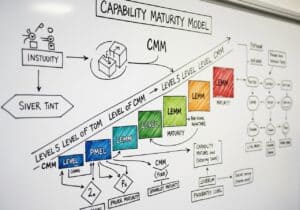
The five maturity levels of the Capability Maturity Model Integration (CMMI) framework serve as a structured path for organizations aiming to improve their processes. Each level builds upon the previous one, representing a progression towards enhanced process capability and institutionalization. The characteristics of each stage are defined as follows:

Maturity Level 1: Initial
- Characteristics: processes at this level are typically ad hoc and chaotic. Work may get completed, but it’s often unpredictable, reactive, and frequently delayed and over budget. Success relies heavily on individual effort rather than defined processes.
- Organizational growth: the organization begins to recognize the need for process improvement but lacks established practices.
Maturity Level 2: Managed
- Characteristics: basic project management processes are established to track cost, schedule, and functionality. Projects are planned, performed, measured, and controlled at the project level, but not necessarily standardized across the organization. The discipline is in place to repeat earlier successes on similar projects.
- Organizational growth: the organization starts to manage projects with defined processes, leading to more predictable outcomes for individual projects. There are still issues to resolve at a broader organizational level.
Maturity Level 3: Defined
- Characteristics: processes are well-characterized, documented, standardized, and integrated into the organization’s standard processes. Organization-wide standards provide guidance across projects, programs, and portfolios. All projects use an approved, tailored version of the organization’s standard processes for developing and maintaining products and services. This level is proactive rather than reactive.
- Organizational growth: the organization establishes consistency and a common understanding of processes across different projects and departments. This leads to improved quality and efficiency.
Maturity Level 4: Quantitatively Managed
- Characteristics: the organization collects detailed measures of 过程性能 and product quality. Both processes and products are quantitatively understood and controlled using statistical and other quantitative techniques. Quantitative objectives for quality and process performance are established and used as criteria in managing processes.
- Organizational growth: the organization gains a deeper understanding of its process capabilities and can predict performance. This allows for data-driven decision-making and more effective control over outcomes.
Maturity Level 5: Optimizing
- Characteristics: this level focuses on continuous process improvement. Improvement is enabled by quantitative feedback from the process and from piloting innovative ideas and technologies. The organization is stable yet flexible, capable of adapting to changing business needs and improving its processes proactively.
- Organizational growth: the organization has a culture of continuous improvement and innovation. Processes are continually refined and adapted to meet evolving goals and to enhance performance.
It’s important to note that CMMI can be appraised using two approaches:
- The staged approach, which is described above, yields a maturity level rating from 1 to 5.
- The continuous approach allows an organization to focus on specific process areas and achieve capability levels for each.
提示: prioritize the engagement of cross-functional 团队 when implementing CMMI process areas. Having diverse perspectives can lead to richer insights and more effective adaptations of the processes, ultimately facilitating smoother transitions between maturity levels.
Appraisal Methods for CMMI Evaluation
Appraisal methods employed for Capability Maturity Model Integration (CMMI) compliance primarily fall into two categories: formal and informal appraisals. Formal appraisals, such as the CMMI Institute’s Standard Appraisal Method for Process Improvement (SCAMPI), offer a comprehensive evaluation of an organization’s processes against specific CMMI standards. SCAMPI is designed to provide a structured assessment, which can be beneficial for organizations seeking official recognition of their maturity level. Informal assessments, on the other hand, may utilize self-assessment tools that allow organizations to gauge their own maturity levels without the need for external validation.
SCAMPI In Short
The “Standard CMMI Appraisal Method for Process Improvement” (SCAMPI) works by evaluating an organization’s processes against the Capability Maturity Model Integration (CMMI) framework. It involves a defined process that includes preparation, on-site activities, analysis of objective evidence, generation of findings, and reporting. During the appraisal, a representative sample of an organization’s projects and process instantiations are examined to determine the extent to which CMMI best practices are implemented. This involves identifying and analyzing objective evidence, such as documents and artifacts, and conducting interviews with personnel.
The SCAMPI method has different classes of appraisals (A, B, and C) that vary in rigor and purpose:
- A SCAMPI Class A appraisal is the most formal and is the only one that can result in an official CMMI maturity level rating, which is often used for benchmarking or to meet specific requirements, such as those from the U.S. Department of Defense.
- SCAMPI B appraisals are less rigorous and are often used to gauge progress in process improvement or to prepare for a Class A appraisal, requiring less data and smaller teams.
- SCAMPI C appraisals are the most flexible, can be tailored to specific organizational needs like a quick gap analysis, and can be conducted by a single lead appraiser.
Regardless of the class, the core principle is to compare existing processes to the CMMI model, identify strengths and weaknesses, and provide a basis for process improvement.
For very detailed SCAMPI methodology, we recommend our dedicated article:

The selection of an appropriate appraisal method depends on several factors, including the organization’s current maturity level, project size, and specific compliance needs. This process is often guided by a clear understanding of the organization’s goals and the resources available for appraisal. For instance, a government defense contractor may prioritize SCAMPI A for compliance with federal contracting requirements, while a smaller IT service company may choose a self-assessment pathway to gauge readiness for CMMI adoption.
提示: it is advisable for organizations to perform periodic self-assessments prior to formal appraisals to identify gaps and areas for improvement. This proactive approach allows teams to prepare adequately and maximize the benefits realized from formal evaluations.
The implementation of CMMI can drive significant change in organizational culture.
Employees may initially perceive the model as bureaucratic and restrictive; however, once embedded within the company, it can promote a culture of continuous improvement.
提示: 从事 stakeholders from all levels early in the CMMI adoption process to promote buy-in and alleviate apprehensions regarding changes.
Technological Readiness Levels (TRL) vs CMMI Levels
Technological Readiness Levels (TRL) and CMMI Levels are distinct frameworks used for different assessment purposes.
These are two different beasts not to be confused: TRLs, developed by NASA, measure the maturity of a specific technology, ranging from initial scientific research (TRL 1) to a flight-proven system (TRL 9). This scale helps in evaluating how ready a particular technology is for deployment within a system. In contrast, CMMI, describe in this article, focuses on the maturity of an organization’s processes for developing, delivering, and acquiring products or services.
TRL assesses the maturity of a technology, while CMMI assesses the maturity of an organization’s processes.
技术就绪水平(TRL) A method for estimating the maturity of technologies during the acquisition phase of a program. | CMMI Levels A process improvement methodology providing organizations with a framework to enhance their ability to develop and maintain quality products and services | |
|---|---|---|
| 优点 | Provides a common understanding of technology status; assists in risk management; used for decisions on technology funding and transition. | Increases efficiency and productivity; enhances product and service quality; improves customer satisfaction; helps in risk management and cost reduction. |
| 缺点 | Readiness does not always align with appropriateness or technology maturity; a mature product may have different readiness for a specific system context; numerous factors like operational environment relevance and architectural mismatch need consideration. | Can face cultural resistance to change; requires strong management support and significant resources (time, budget, personnel); can be complex to understand and implement. |
| Use Cases | Assessing technology maturity for research, development, and deployment; making decisions on advancing and integrating technology. | Improving processes in product development, service delivery, and system management; benchmarking capabilities. |
| 最适合 | Organizations managing research and development of new technologies, particularly in early stages of development and integration. | Organizations seeking to standardize and optimize processes, improve quality, and achieve higher levels of process maturity across various domains. |

CMMI Pro Tips

- Quantitative process management: implement statistical methods to monitor and control process performance. Use control charts and process capability indices (like Cp and Cpk) to evaluate process stability and capability: [latex]Cp = \frac{USL – LSL}{6\sigma}[/latex] and [latex]Cpk = \min\left(\frac{USL – \mu}{3\sigma}, \frac{\mu – LSL}{3\sigma}\right)[/latex]
- Integrate Agile with CMMI: when incorporating Agile methodologies, ensure that Agile practices align with CMMI requirements. Use iterative cycles to gather data and improve processes continuously.
- Process Asset Library: create and maintain a Process Asset Library (PAL) that includes templates, guidelines, and lessons learned. This library serves as a repository for continuous improvement and reference.
- Stakeholder engagement: engage stakeholders throughout the process improvement lifecycle. Regular feedback loops and stakeholder assessments ensure alignment with organizational goals and enhance buy-in.
- Measurement and analysis: define key performance indicators (KPIs) for each process area. Use the following formula for calculating the overall process performance index (PPI): [latex]PPI = \frac{\text{Sum of all 关键绩效指标 scores}}{\text{Number of KPIs}}[/latex]
结论
In closing, the Capability Maturity Model Integration (CMMI) stands as a critical tool for organizations aiming to refine their processes and boost performance across various sectors, including software development, systems engineering, and IT service management. By progressing through its five maturity levels, organizations can not only enhance their project performance but also improve stakeholder satisfaction, as substantiated by the statistic indicating that 72% of CMMI adopters report notable benefits
常问问题
What is the definition and purpose of Capability Maturity Model Integration (CMMI)?
CMMI is a process improvement framework that provides organizations with essential elements for effective processes. Its purpose is to improve organizational performance by offering a structured approach to process improvement and compliance.
What is the evolution from the Capability Maturity Model (CMM) to CMMI?
CMM was developed in the late 1980s to assess software development processes. CMMI was introduced in the early 2000s as a more comprehensive approach, integrating multiple CMM models into a single framework for broader application across various disciplines.
What are the five maturity levels of the CMMI framework?
The five maturity levels are: Initial, where processes are unpredictable; Managed, which focuses on project management; Defined, emphasizing standardized processes; Quantitatively Managed, using metrics to manage processes; and Optimizing, focusing on continuous improvement.
What are process areas in CMMI and their relationship to maturity levels?
Process areas are specific areas that organizations must address to improve their processes. Each maturity level incorporates a set of process areas that must be addressed before moving to the next maturity level, ensuring structured development.
What appraisal methods are used for CMMI compliance and evaluation?
The Standard CMMI Appraisal Method for Process Improvement (SCAMPI) is the primary method for assessing CMMI compliance. SCAMPI provides structured evaluations and ensures organizations meet required improvement standards through different appraisal types.
相关话题
- Integration with Agile methodologies: understanding how CMMI can coexist with Agile practices to enhance project performance.
- 变更管理 Strategies: techniques for managing changes in processes and practices aligned with CMMI implementation.
- Measurement and Metrics: establishing effective metrics to assess process performance and maturity.
- Customer Involvement: understanding how engaging customers can influence processes aligned with CMMI.
- Impact on Project Management: how CMMI enhances project management capabilities and outcomes.
- CMMI and Organizational Culture: the alignment of an organization’s culture with CMMI goals for better integration.
- Global Perspectives on CMMI: how CMMI practices are adapted and implemented in different cultural contexts globally.
常用术语表
Capability Maturity Model Integration (CMMI): 这是一个流程改进框架,为组织提供有效流程改进的基本要素,重点关注软件开发和服务交付等各个领域的性能、质量和效率。它包含五个成熟度级别,用于指导组织发展。
Computer Aided Manufacturing (CAM): 一种使用软件和计算机控制机械来自动化制造过程的技术,可实现各个行业的精确生产、设计修改和高效的资源管理。
Computer-Aided Manufacturing (CAM): 利用软件和计算机控制的机械设备实现制造流程自动化,从而提高精度、效率和生产速度。它整合了设计和制造工作流程,实现了数字模型与实体产品的直接转化。
Contract Manufacturer (CM): 一家公司代表另一家公司生产产品,通常遵循特定的设计和质量规范。这种安排使委托方公司能够专注于市场营销和产品开发等核心竞争力,同时将制造流程外包。
Key Performance Indicator (KPI): 一个可衡量的值,表明组织实现关键业务目标的效率,通常用于评估实现目标的成功程度。
Network-attached storage (NAS): 一种连接到网络的存储设备,允许多个用户和设备访问和共享数据,通常提供集中式文件存储、备份和管理功能。它独立于计算机运行,可通过标准网络协议访问。
Personnel Airlock (PAL): 一种密封入口,旨在允许人员在不同压力环境之间转换,同时最大限度地减少污染并保证安全,通常用于空间站、实验室或洁净室。其特点是门互锁,防止同时开启。
Process Capability Index (Cpk): 一种统计测量方法,用于量化过程在指定限制内产生输出的能力,指示过程平均值与最接近的规格限制之间的关系,并根据过程变化进行调整。
Process Performance Index (Ppk): 一种统计指标,用于量化过程符合规格限值的程度,使用过程平均值和标准差计算得出。它表示过程在规定限值范围内产生输出的能力,同时考虑了变异性和中心性。
Technological Readiness Levels (TRL): 用于评估技术成熟度的量表,涵盖从基础研究和开发到全面部署的阶段,通常分为 1(概念)到 9(操作使用),以促进技术开发过程中的评估和决策。