
The Capability Maturity Model Integration (CMMI) has emerged as an important framework for organizations striving to enhance their process efficiency, particularly in fields like software development, systems engineering, and IT service management. Originating from the Capability Maturity Model (CMM), CMMI offers a comprehensive roadmap for organizations to achieve higher performance through five distinct maturity levels: Initial, Managed, Defined, Quantitatively Managed, and Optimizing.
Key Takeaways
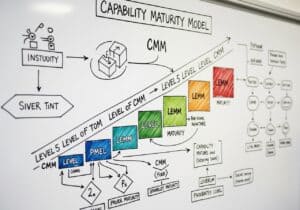
- CMMI improves process capability for organizations
- Five maturity levels guide progressive organizational growth
- Process areas align with maturity for enhanced performance
- Appraisal methods evaluate compliance and improvement status
- Adopting CMMI yields better quality and predictability
Definition and Purpose of Capability Maturity Model Integration CMMI
The Capability Maturity Model Integration (CMMI) serves as a structured framework aimed at improving organizational processes. CMMI provides organizations with the essential tools necessary to enhance their software development, systems engineering, IT service management, and other related areas. Its implementation leads to the establishment of standardized practices, ensuring consistency and predictability across multiple projects.

A primary purpose of CMMI is to delineate a clear pathway for organizations to evolve from their current practices towards more mature and efficient processes. The model offers a series of best practices that organizations can adopt step-by-step, fostering continuous improvement.
CMMI is divided into different constellations, each tailored to address specific industry needs.
- CMMI for Development (CMMI-DEV)
- CMMI for Services (CMMI-SVC)
- CMMI for Acquisition (CMMI-ACQ)
This adaptability allows organizations to select the appropriate CMMI constellation that aligns with their operational goals and challenges. The framework emphasizes the importance of establishing a culture centered around process-oriented thinking and organizational learning.
Tip: consider conducting a “Process Discovery” exercise within your organization prior to CMMI adoption. This involves mapping your existing processes to identify gaps and areas for improvement. This preparation can streamline subsequent CMMI implementation and bolster stakeholder buy-in through greater clarity on present capabilities and future needs.
The rest of this article is reserved for members
To limit scraping bots (currently 40,000 hits per day!),
we had to restrict access to full articles and tools to registered members only.
to access all the rest.