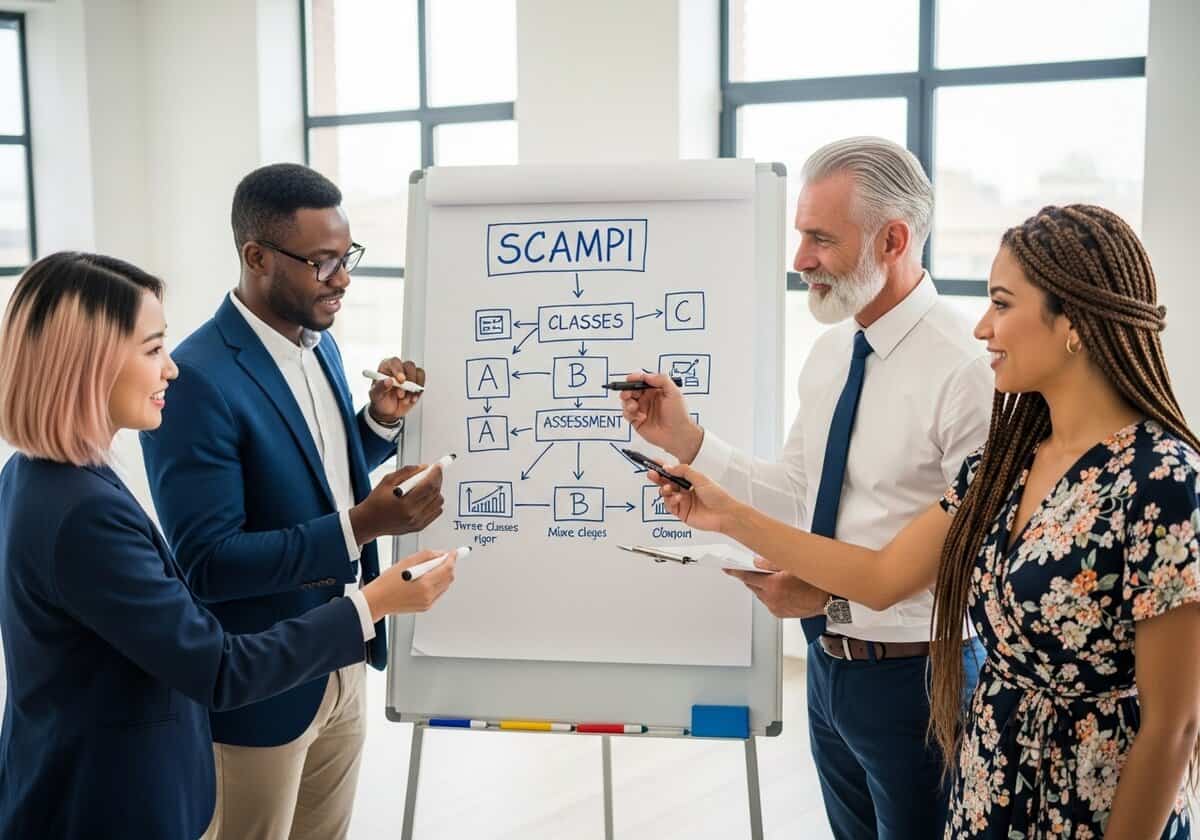
The SCAMPI methodology, or Standard CMMI Appraisal 方法 for Process Improvement, is the method in enhancing organizational capabilities through rigorous evaluation and continuous improvement. According to the Carnegie Mellon Software Engineering Institute, organizations that implement CMMI frameworks experience a 35% improvement in process performance over time, demonstrating the tangible benefits of structured appraisal processes. This article thoroughly explores the SCAMPI フレームワーク, detailing its objectives, classification of appraisal types (Classes A, B, and C), the key phases involved in the SCAMPI appraisal process, and the essential roles required for effective evaluations.
主なポイント

- SCAMPI provides a structured approach for process improvement.
- Evaluation identifies strengths and weaknesses of processes.
- Three classes (A, B, C) define assessment rigor.
- Key phases include preparation, execution, and reporting.
- Lead appraisers guide the appraisal チーム efficiently.
- Promotes organizational maturity across various sectors.
Definition of SCAMPI and its Framework
SCAMPI, which stands for Standard CMMI Appraisal Method for Process Improvement, is a structured assessment approach designed to evaluate and enhance プロセス能力 within organizations. It is rooted in the Capability Maturity Model Integration (CMMI), a proven framework used for process improvement in software engineering and systems engineering.
The SCAMPI methodology facilitates organizations in identifying strengths and areas needing enhancement by conducting thorough evaluations that align with predefined maturity levels, which range from Level 1 (Initial) to Level 5 (Optimizing).
The detailed CMMI Framework can be found here (recommended before this detailed SCAMPI):

The SCAMPI framework comprises various components, including appraisal protocols, guidelines, and a set of objectives that drive the evaluation process. Within this framework, three classes of appraisals are distinctly identified, an organization being able to choose a specific class based on its goals, size, and specific industry requirements:
- Class A provides the most rigorous assessment, involving comprehensive data collection and analysis
- Classes B and C offer varying degrees of depth and focus.
Additionally, the methodology serves as a mechanism for ensuring compliance with industry 基準 and government 規則. Organizations involved in defense contracting or quality assurance must adhere to strict guidelines, making SCAMPI crucial in demonstrating accountability and reliability. Appraisals can uncover areas needing corrective actions, enabling organizations to maintain compliance while improving their operational readiness.
ヒント: organizations should integrate SCAMPI objectives into their strategic planning to ensure alignment between resource allocation and process improvement initiatives. This alignment can lead to optimized investments in training and technology, further amplifying the impact of the SCAMPI methodology in details across all levels of the organization.
SCAMPI Classes and Their Specific Applications
SCAMPI (Standard CMMI Appraisal Method for Process Improvement) exists in three distinct classes, each designed to serve different appraisal needs and contexts.
- Class A appraisals: are the most comprehensive, requiring a full evaluation of an organization’s processes against the CMMI model. This class is utilized to assess an organization’s capability for achieving maturity levels and is critical for large-scale projects where compliance and risk management are paramount. For instance, a defense contractor may undergo a Class A appraisal to ensure that their processes meet strict DOD standards for program management, leading to improved project success rates and reduced life-cycle costs. Typical total duration: 6-8 weeks.
- Class B appraisals: offer an intermediate approach, typically conducted with less rigor than Class A. This class is suitable for organizations looking to gain insight into their process strengths and weaknesses without committing to a full assessment. The findings can guide targeted improvements, which can lead to an increase in both efficiency and customer satisfaction. Typical total duration: 4-6 weeks.
- Class C appraisals: are the least formal and are commonly used for internal assessments or benchmarking against industry standards. They help organizations identify process areas needing improvement without the associated costs of higher classes. Frequently, small businesses adopt this class to establish foundational practices that support future growth. A notable benefit is that Class C appraisals can reveal quick wins in process improvement, enabling rapid feedback loops for ongoing enhancement. Typical total duration: 2-4 weeks.
The choice among these classes depends on several factors including organizational goals, current 成熟度, and regulatory requirements. Organizations might consider utilizing a Class A for formal recognition by external stakeholders, while opting for Class B or C for internal audits or pilot projects.
The SCAMPI Appraisal Process
Essential Roles in the SCAMPI Evaluation
| The SCAMPI evaluation process relies on various roles that align to ensure an effective appraisal of an organization’s process maturity: | ![]() |
| The Appraisal Team Leader (ATL): directs the overall evaluation, functioning as a mediator between the organization and the SCAMPI team. The ATL must possess extensive experience in appraisal methodologies and should ideally have completed related training. A successful ATL streamlines コミュニケーション, coordinates schedules, and ensures that all team members possess the necessary skills to perform their roles efficiently. | The Appraisal Team Members (ATMs): who perform several tasks, including data collection, document review, and observation during interviews. ATMs bring subject matter expertise in specific domains, which is crucial for making informed judgments about the organization’s practices. These members are also responsible for verifying that evidence aligns with appraisal criteria laid out in the SCAMPI methodology in details. |
| Subject Matter Experts (SMEs): also play a significant part in the SCAMPI evaluation, providing targeted insights into areas such as technical practices, risk management, and quality assurance. SMEs enhance the appraisal accuracy, ensuring that findings are well-founded. | The Organization representative: this individual assists the appraisal team in understanding the organizational context, policies, and existing practices. He is responsible for facilitating meetings, actively engaging in discussions and offering organizational insights, he bridges the gap between the SCAMPI evaluation team and the internal processes. |
The SCAMPI Steps
The SCAMPI appraisal process consists of distinct phases designed to assess and improve organizational processes systematically:
| SCAMPI Class A Appraisals | SCAMPI Class B Appraisals | SCAMPI Class C Appraisals | |
|---|---|---|---|
| 1. Initiation & Purpose | Specific: sponsor authorizes for official maturity/capability level rating, benchmarking, or supplier qualification. SEI-Authorized Lead Appraiser is mandatory. Objectives and scope are formally defined and documented. | Specific: sponsor defines purpose, typically for internal process improvement, initial gap analysis, risk identification, or progress tracking between Class A appraisals. Lead Appraiser is CMMI knowledgeable but not necessarily SEI-authorized. Objectives and scope are more flexible. | Specific: sponsor defines a very specific, narrow focus (e.g., health check of a single process area, readiness for a minor change, or verifying a specific practice). Often conducted by internal personnel with CMMI knowledge. Emphasis on quick turnaround and targeted insight. |
| 2. Planning the Appraisal | Specific: requires a detailed, formal appraisal plan (schedule, resources, logistics, data needs, team roles). Rigorous team selection and formal training. Organizational Unit (OU) preparation is extensive, often including a readiness review. Formal identification of required objective evidence. | Specific: involves a less formal appraisal plan. Team selection is more flexible, based on knowledge and availability. OU preparation is less intensive. Focus on identifying key areas for data collection efficiently. | Specific: minimal formal planning. Quick identification of scope, participants, and data sources. Often utilizes opportunistic scheduling and existing resources. |
| 3. Preparing for Data Collection | Specific: involves development/tailoring of comprehensive data collection instruments (interview scripts, document review checklists based on all CMMI PIs). Appraisal team is formally trained on the CMMI model and the SCAMPI A method.Extensive review of preliminary objective evidence is mandatory. | Specific: involves development or adaptation of data collection instruments, which can be less structured or use standard templates. Team familiarization with relevant CMMI areas. Review of readily available documentation. Less emphasis on exhaustive preliminary evidence. | Specific: utilizes informal checklists or highly focused questions.Minimal specific preparation, relying on existing knowledge of the process area and the specific objective. |
| 4. Conducting Data Collection (On-site/Remote) | Specific: starts with a formal opening meeting. Involves extensive and rigorous data collection through interviews (practitioners, managers, process owners), thorough document reviews (direct and indirect evidence for all PIs in scope), and observation of demonstrations. Daily data consolidation and 検証 by the entire team. A rigorous evidence trail is maintained. | Specific: data collection through interviews (individual or group), document reviews, and potentially workshops. Focus is on identifying strengths and weaknesses broadly across selected areas. Data consolidation is less formal and iterative. Evidence trail is less rigorous. | Specific: highly targeted and rapid data collection (e.g., short, focused interviews with key personnel, review of specific artifacts or records). Can be very short in duration (hours to a few days). Focus is solely on the predefined specific objective. |
| 5. Consolidating & Validating Data / Analysis | Specific: involves rigorous corroboration of evidence from multiple sources (triangulation) for all PIs. Formal characterization of practice implementation (strengths, weaknesses, alternative practices) against CMMI goals and practices. Draft preliminary findings are documented and reviewed by the team for consensus against strict criteria. | Specific: consolidation of observations and collected data. Identification of key process strengths, weaknesses, and improvement opportunities/themes. Analysis is more qualitative and focused on identifying patterns and areas for improvement rather than formal characterization. | Specific: rapid analysis of collected information directly against the specific focus of the appraisal. Identification of key observations and immediately actionable items. |
| 6. Generating Ratings/Findings | Specific: formal determination of satisfaction for CMMI Specific Goals and Generic Goals based on collected, validated objective evidence. Leads to the generation of official Maturity Level rating (Staged representation) or Capability Level ratings (Continuous representation) by the SEI-Authorized Lead Appraiser. | Specific to Class B & C: No official ratings are produced. Class B Specific: findings focus on gaps against the CMMI model, areas of concern, potential risks, and detailed recommendations for improvement. Observations are often mapped to CMMI practices if applicable. Class C Specific: findings are typically direct observations related to the narrow scope and are presented as actionable feedback or quick wins. | |
| 7. Reporting Results | Specific: results in a formal, comprehensive appraisal report including scope, method, team, detailed findings (strengths, weaknesses per Process Area), supporting objective evidence, and the official ratings. Formal presentation to sponsor and OU. If rated, an Appraisal Disclosure Statement and data package are submitted to the CMMI Institute. Formal closing meeting. | Specific: report focuses on findings, observations, identified risks, and detailed recommendations for process improvement. Format can be less formal than Class A. Presentation to sponsor and relevant stakeholders. Primarily for internal distribution and use. | Specific: often an informal report, email summary, or brief presentation summarizing key observations and suggested immediate actions. Emphasis is on quick, practical feedback to the target audience. |
| Resource Intensity & Duration | High resource intensity (larger team size, significant effort from OU personnel, cost). Typically 1-3 weeks for the on-site/data collection phase, plus significant preparation (weeks/months) and reporting time (weeks). | Medium resource intensity. Duration varies, often 3-10 days for data collection and analysis, with less preparation and reporting overhead than Class A. | Low resource intensity. Typically 1-3 days, including preparation and reporting. Very focused effort on a small scale. |
| Typical examples | ![]() A large defense contractor requires an official CMMI Maturity Level 3 rating to bid on a government contract. | ![]() A software development department wants to assess its current process maturity against CMMI Level 2 practices to identify key areas for improvement before considering a formal Class A appraisal. | ![]() A project team manager wants a quick check on whether the team is consistently following the newly implemented peer review process for critical software modules. |
| ヒント |
|
|
|
Bonus: SCAMPI parameters vs CMMI Maturity Levels
Our industry-unique technical, quality, legal, quality, control parameters suggested per each CMMI Maturity Level and SCAMPI Class Appraisals (big screen strongly recommended).
| CMMI Maturity Level | SCAMPI Class A Appraisals | SCAMPI Class B Appraisals | SCAMPI Class C Appraisals |
|---|---|---|---|
| ML1: Initial | Specific: while ML1 is not a target to achieve (it’s the starting point), a Class A appraisal indirectly assesses it. If an organization fails to meet the goals of ML2 Process Areas (PAs), it is, by default, appraised at ML1.
| Specific to Class B & C: generally not a direct focus for a “ML1 inspection” itself, as the goal is usually improvement towards higher levels. If assessing an organization suspected to be at ML1:
| |
| ML2: Managed | Specific: rigorous inspection of all ML2 Process Areas (REQM, PP, PMC, SAM, MA, PPQA, CM). Requires objective evidence for institutionalization via Generic Practices (GP 2.1 to GP 2.10) at the project level.
Evidence of project-level process discipline is mandatory for an ML2 rating. | Specific: reviews practices related to ML2 PAs to identify strengths, weaknesses, and improvement opportunities. Less formal evidence collection and validation than Class A.
Aims to provide a gap analysis against ML2 PAs for internal improvement or Class A readiness. | Specific: highly focused deep dive into one or two specific ML2 practices, a single PA, or an aspect of a PA on a specific project (e.g., “Effectiveness of requirements traceability on Project X” or “Is the change control process for Project Y being followed?”).
Provides quick, targeted feedback on a limited aspect of ML2. |
| ML3: Defined | Specific: rigorous inspection of all ML3 Process Areas (e.g., RD, TS, PI, VER, VAL, OPF, OPD, OT, IPM, RSKM, DAR) in addition to ML2 PAs. Requires evidence of an organizational standard set of processes and supporting assets, and that projects tailor from these. Institutionalization via GPs up to GP 3.2.
Evidence of organizational standardization, tailoring, and process asset deployment is mandatory for an ML3 rating. | Specific: explores the existence, adequacy, deployment, and use of organizational standard processes and assets.
Assesses the maturity of organizational process infrastructure and consistency of its use. | Specific: could investigate a specific organizational process, asset, or ML3 practice (e.g., “How effectively is the organizational standard risk management process being tailored and used by Project Z?” or “Usability of the new requirements specification template from the PAL”).
Checks health, adoption, or effectiveness of a very specific part of the ML3 infrastructure. |
| ML4: Quantitatively Managed | Specific: rigorous inspection of ML4 PAs (OPP, QPM) in addition to ML2 & ML3 PAs. Requires objective evidence of statistical and quantitative management of selected subprocesses.
Deep dive into data validity, statistical methods, criteria for subprocess selection, and how quantitative insights drive project and process management is mandatory for an ML4 rating. | Specific: explores initial efforts towards or readiness for quantitative management. Does not verify statistical validity deeply.
Identifies opportunities for, and readiness towards, implementing quantitative management. | Specific: could look at a specific subprocess to assess its stability or data richness for potential quantitative management. Or, review the application of a pilot quantitative technique on a project.
Assesses feasibility or early results of a very limited quantitative effort for a narrow scope. |
| ML5: Optimizing | Specific: rigorous inspection of ML5 PAs (OPM, CAR) in addition to ML2, ML3 & ML4 PAs. Requires objective evidence of continuous, data-driven process improvement and innovation.
Evidence of a sustained, data-driven continuous improvement culture and tangible performance benefits is mandatory for an ML5 rating. | Specific: identifies opportunities for innovation or more systematic causal analysis and problem prevention. Does not verify deep statistical impact or institutionalization of improvements.
Assesses potential for or early stages of establishing an optimizing culture and systematic improvement mechanisms. | Specific: could assess the effectiveness of a specific pilot improvement initiative or the application of a specific causal analysis technique for a recurring problem.
Evaluates a single instance of an improvement, problem-solving activity, or innovation effort. |
ヒント: regularly revisiting SCAMPI appraisal results can cultivate an environment of sustained improvement, helping organizations stay ahead of regulatory changes and competitive pressures.
結論
The SCAMPI methodology serves as a cornerstone for organizations aiming to enhance their process maturity through systematic evaluation and targeted improvement strategies. By adhering to structured phases and clearly defined roles, organizations can effectively implement the CMMI framework and witness substantial performance enhancements. The significant statistic from the Carnegie Mellon Software Engineering Institute—that organizations leveraging CMMI frameworks achieve a 35% improvement in process performance—speaks volumes about the tangible benefits derived from rigorous appraisal practices such as those found within the SCAMPI methodology in details.

Frequently Asked Questions
What is the SCAMPI methodology?
What are the different classes of SCAMPI and their specific applications?
How does SCAMPI impact organizational process maturity?
How does SCAMPI relate to CMMI models?
関連トピック
- Benchmarking practices: a method for comparing organization’s processes with those of industry leaders to identify gaps.
- Root Cause Analysis (RCA): a technique for finding the underlying reasons for process deficiencies or failures.
- Process Mapping: visual representation of workflows to analyze and improve organizational processes.
- Continuous improvement models: frameworks like PDCA または シックスシグマ that facilitate ongoing enhancements in processes.
- Capability Maturity Model Integration (CMMI) Frameworks: detailed guides designed to improve process efficiencies across organizations.
- Change management strategies: structured approaches to managing change in processes and organizational culture.
- Quality Management Systems (QMS): a set of coordinated activities to direct and control an organization to consistently improve quality.
- Stakeholder engagement techniques: strategies for involving all relevant parties in the improvement process to ensure success.
- Risk management frameworks: structured methodologies for identifying and managing potential risks in projects and processes.
- Performance measurement systems: frameworks for assessing the efficiency and effectiveness of processes and practices.
用語集
Asynchronous Transfer Mode (ATM): 固定サイズのセルを用いてデータ伝送を行う高速ネットワーク技術であり、様々なメディアタイプ間での効率的かつ柔軟な通信を可能にする。音声、ビデオ、データなど複数のサービスタイプをサポートし、サービス品質(QoS)管理を容易にする。
Capability Maturity Model Integration (CMMI): 組織が効果的なプロセス改善を行うための必須要素を提供するプロセス改善フレームワークであり、ソフトウェア開発やサービス提供など、さまざまな領域におけるパフォーマンス、品質、効率性に焦点を当てています。組織の成長を導くための5つの成熟度レベルで構成されています。
Computer Aided Manufacturing (CAM): ソフトウェアとコンピュータ制御の機械を用いて製造工程を自動化し、様々な産業において精密な生産、設計変更、効率的な資源管理を可能にする技術。
Contract Manufacturer (CM): 他社に代わって製品を製造する会社で、通常は特定の設計および品質仕様に従って製造を行う。この仕組みにより、依頼企業はマーケティングや製品開発といった中核事業に集中できる一方、製造工程は外部委託することができる。
Performance Qualification (PQ): a process that verifies a system or equipment operates according to specified requirements under real-world conditions, ensuring it consistently performs its intended function within predetermined limits.
Personnel Airlock (PAL): a sealed entryway designed to allow personnel to transition between different pressure environments while minimizing contamination and maintaining safety, typically used in space stations, laboratories, or cleanrooms. It features interlocking doors that prevent simultaneous opening.
Plan Do Check Act (PDCA): 目標の計画、計画の実行、期待値に対する結果の評価、パフォーマンスとプロセスを改善するための是正措置の実施という4つの反復的なステップからなる継続的改善モデル。
Qualified Person (QP): an individual with the necessary education, experience, and authority to oversee and ensure compliance with regulatory requirements in the preparation and submission of technical documents, particularly in the mining and resource sectors, as defined by relevant industry standards.
Quality Management System (QMS): 製品およびサービスの一貫した品質を確保し、継続的な改善を促進し、顧客および規制要件を満たすことを目的とした、プロセス、手順、および責任の構造化されたシステム。
Statistical Process Control (SPC): a method of quality control that employs statistical techniques to monitor and control a process, ensuring it operates at its full potential by identifying variations and maintaining consistent output within specified limits.
Value Engineering (VE): プロジェクトの機能分析、コスト削減、パフォーマンス向上を通じて、品質や信頼性を損なうことなくプロジェクトの価値を高めるための体系的な手法。費用対効果の高い代替案を特定し、実行するために、学際的なチームワークが不可欠である。
Verification and Validation (V&V): システムが仕様を満たし、意図された目的を達成していることを保証するプロセスであり、2つの異なる活動が含まれる。検証は製品が設計仕様を満たしているかどうかをチェックし、妥当性確認はそれがユーザーのニーズと要件を満たしているかどうかを評価する。