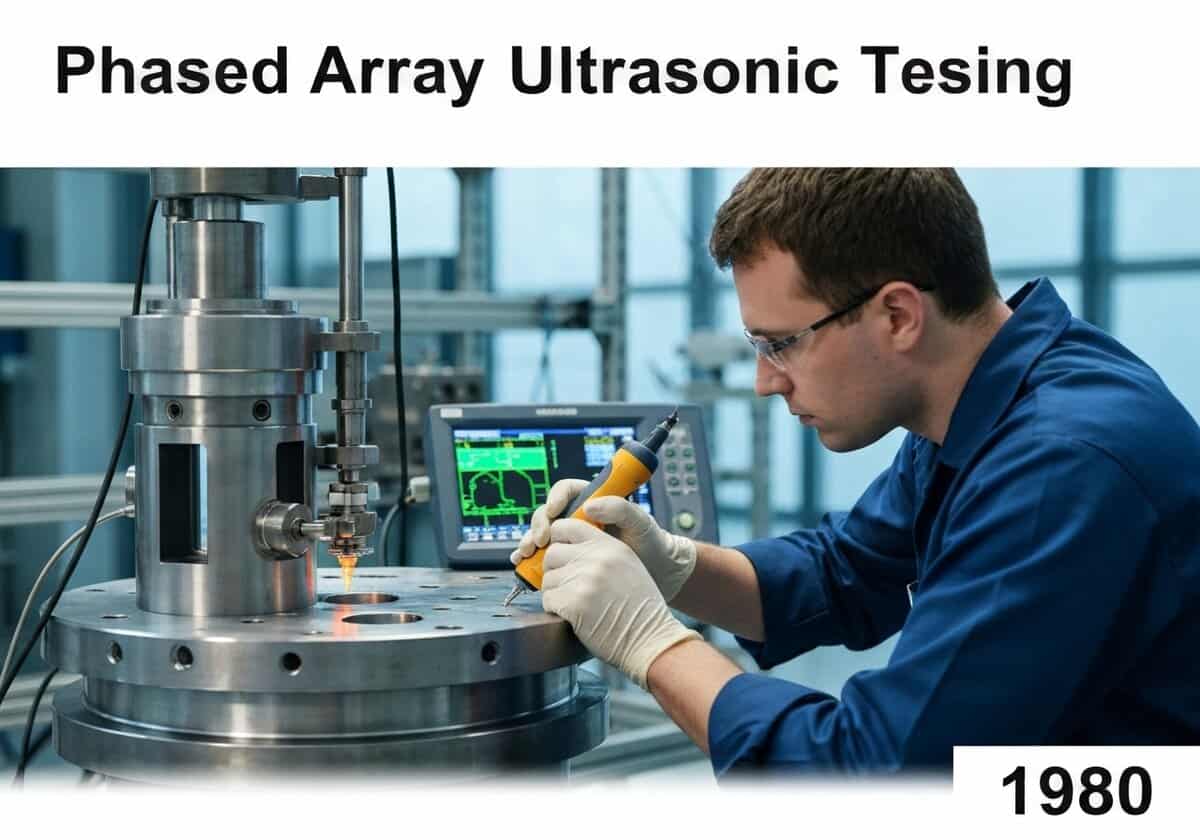
フェーズドアレイ 超音波 PAUT(パルス超音波探傷検査)では、複数の素子からなるトランスデューサを使用し、各素子はコンピュータで計算された正確な時間遅延で独立してパルス発振されます。この位相制御により、プローブを物理的に動かすことなく、超音波ビームを電子的に操縦、集束、走査することが可能です。これにより、特に複雑な形状の欠陥を迅速かつ詳細に画像化でき、従来の単一素子技術を凌駕します。


(画像はイメージです)
フェーズドアレイ 超音波 PAUT(パルス超音波探傷検査)では、複数の素子からなるトランスデューサを使用し、各素子はコンピュータで計算された正確な時間遅延で独立してパルス発振されます。この位相制御により、プローブを物理的に動かすことなく、超音波ビームを電子的に操縦、集束、走査することが可能です。これにより、特に複雑な形状の欠陥を迅速かつ詳細に画像化でき、従来の単一素子技術を凌駕します。

The core principle behind PAUT is the constructive and destructive interference of wavelets, as described by Huygens’ principle. A PAUT probe consists of an array of small, individual transducer elements (from 16 to 256 or more). A computer-controlled instrument sends out precisely timed electrical pulses to each element. If all elements are pulsed simultaneously, they produce a standard, straight 超音波 beam. However, by introducing minute time delays between the firing of adjacent elements, a phase shift is created across the probe’s aperture.
この位相シフトにより、個々の波面が干渉し、合成された波面が特定の角度で方向転換されたり、特定の深さに集束されたりします。例えば、アレイの一端から他端までパルスを徐々に遅延させることで、ビームを様々な角度に走査し、「セクタースキャン」またはSスキャンを実現できます。これにより、単一のプローブ位置から広範囲の材料を検査することが可能になります。同様に、放物線状のタイミングパターンを適用することで、ビームを集束させ、特定の深さにおける強度を高め、解像度を向上させることができます。
This electronic control offers immense flexibility and speed. An entire weld can be inspected rapidly by combining electronic scanning along the array’s length with the angular sweep. The data is often presented in easy-to-interpret 2D or 3D color-coded images (S-scans, C-scans), which provide a more intuitive representation of flaw location and size compared to the simple A-scan of conventional UT.
フェーズドアレイ超音波探傷試験(PAUT)
(日付が不明または関連性がない場合、例えば「流体力学」などでは、その注目すべき出現時期の概算値が提示されます。)

フルサイズの画像とダウンロードは、登録会員のみが100%無料で利用できます。
> ログイン <