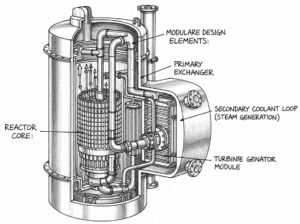
小型モジュール式原子炉は、通常1基あたり300メガワット以下の電力出力容量を持つ核分裂発電システムであり、標準化されたモジュールの工場製造、現場への道路または鉄道輸送、および建設スケジュールの短縮を当初から想定して設計されている。これは、1980年代以降、資本コストの超過と10年に及ぶ建設期間のために西側市場における新たな原子力発電所の導入を事実上停止させたギガワット規模の特注原子力発電所とは、意図的に構造的に逆転したものである。
原子炉の物理特性と冷却材の化学組成は、設計ポートフォリオ全体で大きく異なっている。例えば、実績のある加圧水技術を縮小した先進軽水炉、フッ化物または塩化物冷却材に燃料を直接溶解する溶融塩炉、ヘリウムおよびTRISO燃料粒子を使用する高温ガス冷却炉、ナトリウム冷却および鉛冷却の高速スペクトル設計、そして10MWe未満の遠隔地の産業施設や軍事施設を対象とした熱マイクロリアクターなどがある。
The publications and patents indexed below address reactor physics, thermal hydraulics, passive safety validation, fuel assembly design, materials qualification under irradiation, factory manufacturing processes, licensing 方法論, and techno-economic assessments across this full design spectrum.
これは、小型モジュール炉(SMR)に関する英語の世界中の出版物と特許の最新のセレクションです。多数の科学オンラインジャーナルから、小型モジュール炉、SMR、原子力マイクロリアクター、先進軽水炉、溶融塩、高温ガス冷却炉、鉛冷却高速炉、ナトリウム冷却高速炉、SMR受動安全システム、SMRコジェネレーション、SMR地域暖房、HALEU燃料SMR、SMR格納容器設計、SMR廃止措置といったキーワードで分類・焦点化されています。
Heated base for salt tank
Patent published on the 2026-10-15 in US under Ref US20260323779 by TERRAPOWER LLC [US] (Stuart Joshua [us])
Abstract: A heated foundation system for supporting a molten salt thermal storage tank comprises a concrete ring wall, cellular glass insulation blocks disposed within the concrete ring wall, a layer of fire bricks arranged on top of the cellular glass insulation blocks, and a plurality of doped fire bricks positioned within the layer of fire bricks proximate an outer perimeter of the foundation. The doped fire bricks include a conductive coating or dopant, which enables them to generate heat via electric[...]
Our summary: The system features a concrete ring wall and cellular glass insulation. Doped fire bricks generate heat through electrical resistance. A control system manages heating zones for uniform temperature distribution.
thermal storage, heated foundation, doped fire bricks, temperature control
Patent
Molten salt synthesis of uranium nitride
Patent published on the 2026-10-15 in US under Ref US20260317172 by OREGON STATE UNIV [US] (Augustine Victoria Lee [us], Chemey Alexander Theodore [us], Mcglamery Devin Gray [us])
Abstract: A method for producing uranium nitride, the method including: heating a vessel containing a blend including a uranium source, a chloride salt, a metal nitride, and a reductant under a non-participating cover gas, wherein the vessel is maintained at a reaction temperature and for a reaction time sufficient to produce a molten reaction mixture including the uranium nitride; and isolating the uranium nitride, wherein the uranium source is a uranium oxide or a uranium halide. A system for producing [...]
Our summary: The method involves heating a blend of uranium source, chloride salt, metal nitride, and reductant in a vessel. A non-participating cover gas is used while maintaining a specific reaction temperature. The process results in a molten mixture from which uranium nitride is isolated.
Uranium nitride, Molten salt synthesis, Non-participating cover gas, Reaction temperature
Patent
Molten salt synthesis of uranium carbide
Patent published on the 2026-10-15 in US under Ref US20260317178 by OREGON STATE UNIV [US] (Mcglamery Devin Gray [us], Chemey Alexander Theodore [us], Augustine Victoria Lee [us])
Abstract: [0000] A method for producing uranium carbide, the method including: heating a vessel containing a blend including a uranium source, a chloride salt, a carbon source, and a reductant under a non-participating cover gas, wherein the vessel is maintained at a reaction temperature and for a reaction time sufficient to produce a molten reaction mixture including the uranium carbide; and isolating the uranium carbide, wherein the uranium source is a uranium oxide or a uranium halide. A system for pro[...]
Our summary: The method involves heating a blend of uranium source, chloride salt, carbon source, and reductant in a vessel. The process produces a molten reaction mixture containing uranium carbide. The system includes a heating element and a processing zone for isolating the uranium carbide.
uranium carbide, molten salt synthesis, reaction temperature, non-participating cover gas
Patent
Method for producing metal carbide, carbide composition, and electrolysis device
Patent published on the 2026-10-08 in WO under Ref WO2026211117 by THE DOSHISHA [JP] (Isogai Tomohiro [jp], Tsuchii Takane [jp], Yamauchi Akiyoshi [jp], Kishikawa Yosuke [jp], Goto Takuya [jp], Suzuki Yuta [jp], Tanaka Seiya [jp], Watanabe Takashi [jp])
Abstract: According to the present invention, substantial current efficiency can be further improved when a metal carbide is produced by means of a method for producing a metal carbide which includes: preparing a molten salt that contains first metal ions and carbonate ions; arranging a working electrode and a counter electrode in an electrolytic cell and supplying a current between the working electrode and the counter electrode so as to obtain a carbide composition that contains a carbide of the first m[...]
Our summary: The method involves preparing a molten salt with metal and carbonate ions. An electrolytic cell is used to supply current between electrodes to produce metal carbide. The carbide composition is then recovered in a designated recovery unit.
metal carbide, electrolysis, molten salt, current efficiency
Patent
Conversion of used nuclear fuel to a soluble molten salt form using strongly reducing metal and contolled reoxidation for uranium and transuranic sepa
Patent published on the 2026-09-23 in GB under Ref GB2704839 by MOLTEX ENERGY CANADA INC [CA] (Jose Pablo Zuniga Villegas [ca])
Abstract: A method for processing spent nuclear fuel comprising uranium and one or more transuranic elements, and/or compounds thereof, the process comprising: converting the spent nuclear fuel into a fine powder, the powder containing uranium oxide, and oxides of the transuranic elements, by heating in oxygen (by a voloxidation or OREOX process); optionally reducing the powder by heating in a gas containing hydrogen followed by reoxidation with a gas containing oxygen with the cycle repeating one or more[...]
Our summary: This method processes spent nuclear fuel into a fine powder containing uranium and transuranic oxides. It involves converting the powder into a molten salt mixture with a reducing metal to solubilize uranium species. The process includes reoxidation to precipitate uranium oxides and separate insoluble materials.
Nuclear fuel processing, Molten salt, Reducing metal, Uranium separation
Patent
Controlled titration with strongly reducing metals for selective molten salt extraction and recovery of tranuranics elements from used nuclear fuel
Patent published on the 2026-09-23 in GB under Ref GB2704933 by MOLTEX ENERGY CANADA INC [CA] (Ian Richard Scott [gb], Jose Pablo Zuniga Villegas [ca])
Abstract: A titration-based process for selectively extracting transuranic elements from used nuclear fuel in a molten salt system. The process involves converting spent fuel into a fine powder, mixing it with a molten halide salt, and adding a precisely controlled amount of a strongly reducing metal. Real-time redox monitoring ensures optimal extraction of transuranics while limiting uranium dissolution, and can use the colour or electrochemical potential of the molten halide salt. This method improves s[...]
Our summary: This process enables selective extraction of transuranic elements from used nuclear fuel using a controlled titration method with reducing metals. It involves converting spent fuel to powder, mixing with molten halide salt, and real-time redox monitoring to optimize extraction. The method enhances separation efficiency, minimizes waste, and allows for the reuse of extracted materials in advanced reactors.
Titration, Transuranics, Molten Salt, Redox Monitoring
Patent
Study on Flow Field Excitation and Rotor Shaft Response of the High-Temperature Molten Salt Circulating Primary Pump
Published on 2026-01-31 by Xiongfa Gao, Xinyi Zhang, Weidong Shi, Daohong Wang, Ruijie Zhao, Zhiyu Zhu @MDPI
Abstract: This study examines the impact of fluid excitation forces on the dynamic response of high-temperature molten salt circulating primary pump rotor systems. Unsteady simulations were conducted in ANSYS CFX to characterize pressure pulsation and radial forces across all impeller stages. Critical speeds and vibration modes were subsequently analyzed using SAMCEF to evaluate transient responses under varying flow rates. Key findings: Numerical performance predictions align with experimental data withi[...]
Our summary: This study analyzes the impact of fluid excitation on the dynamic response of high-temperature molten salt pump rotors. Unsteady simulations in ANSYS CFX characterize pressure pulsations and radial forces, while critical speeds and vibration modes are evaluated using SAMCEF. Key findings indicate that numerical predictions align closely with experimental data, revealing significant variations in radial forces across impeller stages.
Fluid Excitation, Rotor Dynamics, Pressure Pulsation, ANSYS CFX
Publication
Multicriteria Assessment for Technological Readiness
Published on 2026-01-29 by Jorge Omar Gil Posada, Juan Carlos Quintero-Daz, Andrs A. Amell @MDPI
Abstract: In addressing the increasing global energy demand, this manuscript compares four distinct processes for hydrogen production from natural gas (NG): steam methane reforming (SMR), dry methane reforming (DMR), autothermal reforming (ATR), and catalytic methane decomposition (CMD). The comparison emphasizes their respective efficiencies and environmental impacts. Simulations were conducted using the Peng–Robinson model, implemented in the DWSIM 8.8.3 software package, considering comme[...]
Our summary: This manuscript compares four hydrogen production processes from natural gas: SMR, DMR, ATR, and CMD. It evaluates their efficiencies and environmental impacts using the TOPSIS method, identifying ATR as the best option. The study highlights Colombia s potential in the hydrogen economy based on its natural resources.
Hydrogen production, Multicriteria assessment, Environmental impact, TOPSIS method
Publication