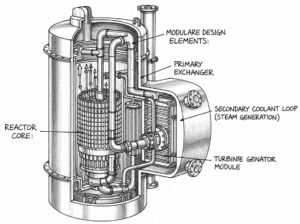
소형 모듈형 원자로는 일반적으로 단위당 300MWe 미만의 전기 출력 용량을 가진 핵분열 발전 시스템으로, 표준화된 모듈을 공장에서 제작하고 도로 또는 철도로 현장까지 운송하여 건설 일정을 단축하도록 처음부터 설계되었습니다. 이는 1980년대 이후 서구 시장에서 새로운 원자력 발전소 건설을 사실상 중단시킨 자본 비용 초과와 수십 년에 걸친 건설 기간을 초래한 기가와트급 맞춤형 원자력 발전소의 구조를 의도적으로 뒤집은 것입니다.
원자로의 물리적 특성과 냉각재 화학은 설계 포트폴리오 전반에 걸쳐 상당히 다양합니다. 여기에는 검증된 가압수 기술을 축소 규모로 확장한 첨단 경수로, 연료를 불화물 또는 염화물 냉각재에 직접 용해하는 용융염 원자로, 헬륨 및 TRISO 연료 입자를 사용하는 고온 가스 냉각 원자로, 나트륨 냉각 및 납 냉각 고속 스펙트럼 설계, 그리고 10MWe 미만의 용량으로 외딴 산업 또는 군사 시설을 대상으로 하는 열 마이크로 원자로가 포함됩니다.
The publications and patents indexed below address reactor physics, thermal hydraulics, passive safety validation, fuel assembly design, materials qualification under irradiation, factory manufacturing processes, licensing 방법론, and techno-economic assessments across this full design spectrum.
본 자료는 소형 모듈형 원자로(SMR)에 관한 전 세계 영문 논문 및 특허를 엄선하여 정리한 최신 자료입니다. 다양한 온라인 과학 저널에 게재된 자료들을 소형 모듈형 원자로(SMR), 핵 마이크로 원자로, 첨단 경수로, 용융염 원자로, 고온 가스 냉각 원자로, 납 냉각 고속 원자로, 나트륨 냉각 고속 원자로, SMR 수동 안전 시스템, SMR 열병합 발전, SMR 지역 난방, 고농축 우라늄 연료 SMR, SMR 격납 용기 설계 및 SMR 해체 등의 주제별로 분류하여 제공합니다.
Heated base for salt tank
Patent published on the 2026-10-15 in US under Ref US20260323779 by TERRAPOWER LLC [US] (Stuart Joshua [us])
Abstract: A heated foundation system for supporting a molten salt thermal storage tank comprises a concrete ring wall, cellular glass insulation blocks disposed within the concrete ring wall, a layer of fire bricks arranged on top of the cellular glass insulation blocks, and a plurality of doped fire bricks positioned within the layer of fire bricks proximate an outer perimeter of the foundation. The doped fire bricks include a conductive coating or dopant, which enables them to generate heat via electric[...]
Our summary: The system features a concrete ring wall and cellular glass insulation. Doped fire bricks generate heat through electrical resistance. A control system manages heating zones for uniform temperature distribution.
thermal storage, heated foundation, doped fire bricks, temperature control
Patent
Molten salt synthesis of uranium nitride
Patent published on the 2026-10-15 in US under Ref US20260317172 by OREGON STATE UNIV [US] (Augustine Victoria Lee [us], Chemey Alexander Theodore [us], Mcglamery Devin Gray [us])
Abstract: A method for producing uranium nitride, the method including: heating a vessel containing a blend including a uranium source, a chloride salt, a metal nitride, and a reductant under a non-participating cover gas, wherein the vessel is maintained at a reaction temperature and for a reaction time sufficient to produce a molten reaction mixture including the uranium nitride; and isolating the uranium nitride, wherein the uranium source is a uranium oxide or a uranium halide. A system for producing [...]
Our summary: The method involves heating a blend of uranium source, chloride salt, metal nitride, and reductant in a vessel. A non-participating cover gas is used while maintaining a specific reaction temperature. The process results in a molten mixture from which uranium nitride is isolated.
Uranium nitride, Molten salt synthesis, Non-participating cover gas, Reaction temperature
Patent
Molten salt synthesis of uranium carbide
Patent published on the 2026-10-15 in US under Ref US20260317178 by OREGON STATE UNIV [US] (Mcglamery Devin Gray [us], Chemey Alexander Theodore [us], Augustine Victoria Lee [us])
Abstract: [0000] A method for producing uranium carbide, the method including: heating a vessel containing a blend including a uranium source, a chloride salt, a carbon source, and a reductant under a non-participating cover gas, wherein the vessel is maintained at a reaction temperature and for a reaction time sufficient to produce a molten reaction mixture including the uranium carbide; and isolating the uranium carbide, wherein the uranium source is a uranium oxide or a uranium halide. A system for pro[...]
Our summary: The method involves heating a blend of uranium source, chloride salt, carbon source, and reductant in a vessel. The process produces a molten reaction mixture containing uranium carbide. The system includes a heating element and a processing zone for isolating the uranium carbide.
uranium carbide, molten salt synthesis, reaction temperature, non-participating cover gas
Patent
Method for producing metal carbide, carbide composition, and electrolysis device
Patent published on the 2026-10-08 in WO under Ref WO2026211117 by THE DOSHISHA [JP] (Isogai Tomohiro [jp], Tsuchii Takane [jp], Yamauchi Akiyoshi [jp], Kishikawa Yosuke [jp], Goto Takuya [jp], Suzuki Yuta [jp], Tanaka Seiya [jp], Watanabe Takashi [jp])
Abstract: According to the present invention, substantial current efficiency can be further improved when a metal carbide is produced by means of a method for producing a metal carbide which includes: preparing a molten salt that contains first metal ions and carbonate ions; arranging a working electrode and a counter electrode in an electrolytic cell and supplying a current between the working electrode and the counter electrode so as to obtain a carbide composition that contains a carbide of the first m[...]
Our summary: The method involves preparing a molten salt with metal and carbonate ions. An electrolytic cell is used to supply current between electrodes to produce metal carbide. The carbide composition is then recovered in a designated recovery unit.
metal carbide, electrolysis, molten salt, current efficiency
Patent
Conversion of used nuclear fuel to a soluble molten salt form using strongly reducing metal and contolled reoxidation for uranium and transuranic sepa
Patent published on the 2026-09-23 in GB under Ref GB2704839 by MOLTEX ENERGY CANADA INC [CA] (Jose Pablo Zuniga Villegas [ca])
Abstract: A method for processing spent nuclear fuel comprising uranium and one or more transuranic elements, and/or compounds thereof, the process comprising: converting the spent nuclear fuel into a fine powder, the powder containing uranium oxide, and oxides of the transuranic elements, by heating in oxygen (by a voloxidation or OREOX process); optionally reducing the powder by heating in a gas containing hydrogen followed by reoxidation with a gas containing oxygen with the cycle repeating one or more[...]
Our summary: This method processes spent nuclear fuel into a fine powder containing uranium and transuranic oxides. It involves converting the powder into a molten salt mixture with a reducing metal to solubilize uranium species. The process includes reoxidation to precipitate uranium oxides and separate insoluble materials.
Nuclear fuel processing, Molten salt, Reducing metal, Uranium separation
Patent
Controlled titration with strongly reducing metals for selective molten salt extraction and recovery of tranuranics elements from used nuclear fuel
Patent published on the 2026-09-23 in GB under Ref GB2704933 by MOLTEX ENERGY CANADA INC [CA] (Ian Richard Scott [gb], Jose Pablo Zuniga Villegas [ca])
Abstract: A titration-based process for selectively extracting transuranic elements from used nuclear fuel in a molten salt system. The process involves converting spent fuel into a fine powder, mixing it with a molten halide salt, and adding a precisely controlled amount of a strongly reducing metal. Real-time redox monitoring ensures optimal extraction of transuranics while limiting uranium dissolution, and can use the colour or electrochemical potential of the molten halide salt. This method improves s[...]
Our summary: This process enables selective extraction of transuranic elements from used nuclear fuel using a controlled titration method with reducing metals. It involves converting spent fuel to powder, mixing with molten halide salt, and real-time redox monitoring to optimize extraction. The method enhances separation efficiency, minimizes waste, and allows for the reuse of extracted materials in advanced reactors.
Titration, Transuranics, Molten Salt, Redox Monitoring
Patent
Study on Flow Field Excitation and Rotor Shaft Response of the High-Temperature Molten Salt Circulating Primary Pump
Published on 2026-01-31 by Xiongfa Gao, Xinyi Zhang, Weidong Shi, Daohong Wang, Ruijie Zhao, Zhiyu Zhu @MDPI
Abstract: This study examines the impact of fluid excitation forces on the dynamic response of high-temperature molten salt circulating primary pump rotor systems. Unsteady simulations were conducted in ANSYS CFX to characterize pressure pulsation and radial forces across all impeller stages. Critical speeds and vibration modes were subsequently analyzed using SAMCEF to evaluate transient responses under varying flow rates. Key findings: Numerical performance predictions align with experimental data withi[...]
Our summary: This study analyzes the impact of fluid excitation on the dynamic response of high-temperature molten salt pump rotors. Unsteady simulations in ANSYS CFX characterize pressure pulsations and radial forces, while critical speeds and vibration modes are evaluated using SAMCEF. Key findings indicate that numerical predictions align closely with experimental data, revealing significant variations in radial forces across impeller stages.
Fluid Excitation, Rotor Dynamics, Pressure Pulsation, ANSYS CFX
Publication
Multicriteria Assessment for Technological Readiness
Published on 2026-01-29 by Jorge Omar Gil Posada, Juan Carlos Quintero-Daz, Andrs A. Amell @MDPI
Abstract: In addressing the increasing global energy demand, this manuscript compares four distinct processes for hydrogen production from natural gas (NG): steam methane reforming (SMR), dry methane reforming (DMR), autothermal reforming (ATR), and catalytic methane decomposition (CMD). The comparison emphasizes their respective efficiencies and environmental impacts. Simulations were conducted using the Peng–Robinson model, implemented in the DWSIM 8.8.3 software package, considering comme[...]
Our summary: This manuscript compares four hydrogen production processes from natural gas: SMR, DMR, ATR, and CMD. It evaluates their efficiencies and environmental impacts using the TOPSIS method, identifying ATR as the best option. The study highlights Colombia s potential in the hydrogen economy based on its natural resources.
Hydrogen production, Multicriteria assessment, Environmental impact, TOPSIS method
Publication