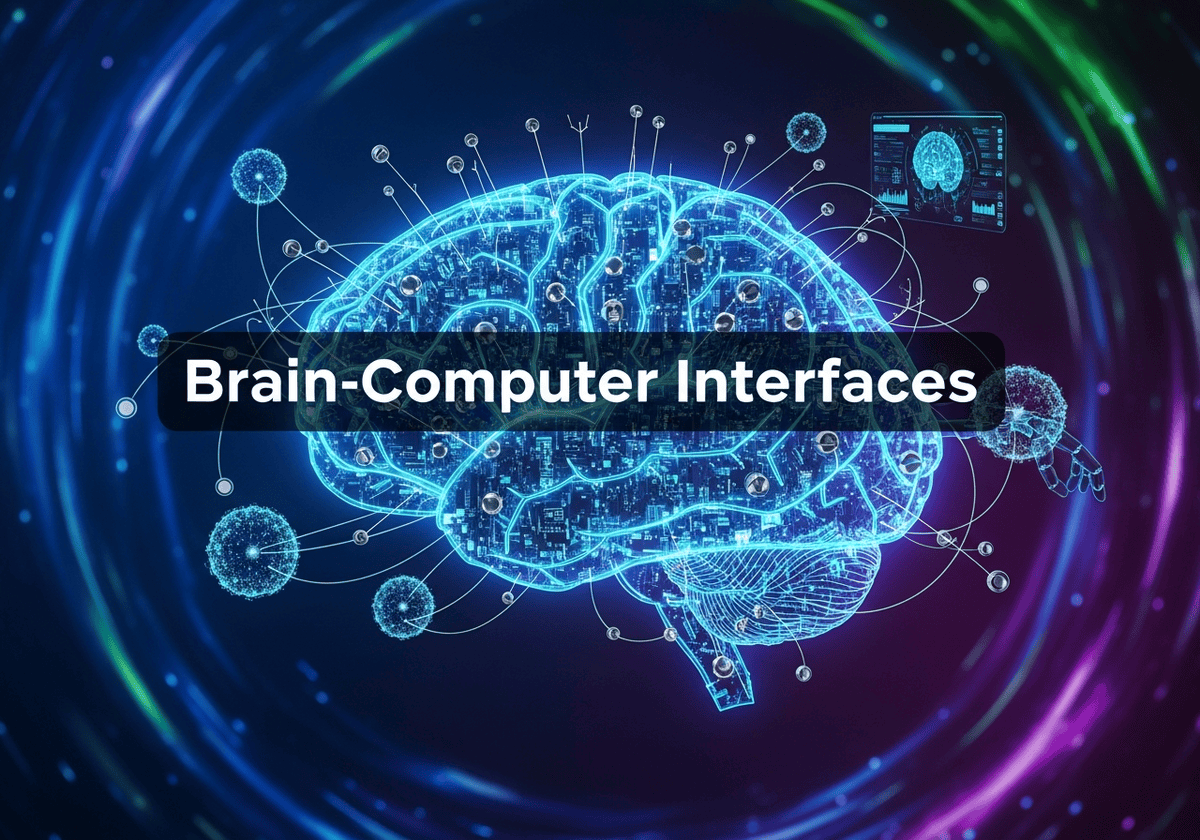

脳コンピュータインターフェースとは、神経組織と外部の計算システムとの間の直接的な通信経路であり、従来の神経筋出力経路を迂回して、記録された脳活動をデバイスコマンド、合成音声、または復元された感覚フィードバックにリアルタイムで変換するものである。
The field divides along an invasiveness axis: non-invasive modalities — scalp EEG, functional near-infrared spectroscopy — offer signal acquisition without surgical risk but at severely limited spatial resolution and signal-to-noise ratio; electrocorticography grids placed on the cortical surface occupy a middle tier; and fully intracortical approaches, typified by the Utah array and Neuralink’s flexible thread electrode system, record single-unit spikes from hundreds to thousands of neurons simultaneously at the cost of surgical implantation, foreign body response, and long-term electrode stability degradation.
Signal processing pipelines — spike sorting, local field potential decomposition, and increasingly deep learning decoders trained on neural population dynamics — translate raw electrophysiology into high-dimensional control signals, with motor cortex decoding for cursor control and robotic limb actuation and speech area decoding for imagined or attempted speech synthesis representing the two most clinically advanced application tracks. Closed-loop architectures that combine neural recording with precisely timed cortical or peripheral neurostimulation are advancing stroke rehabilitation, treatment-resistant depression, and epilepsy management simultaneously.
The publications and patents indexed below span electrode materials science, ASIC front-end amplifier design, decoder algorithms, wireless neural telemetry, biocompatibility studies, and clinical trial results across the full invasiveness spectrum:
これは、脳コンピュータインターフェース(BCI)に関する英語の世界中の出版物と特許の最新のセレクションです。多くの科学オンラインジャーナルから、BCI、脳コンピュータインターフェース、ニューラルインターフェース、皮質脳波記録、皮質内電極アレイ、ユタアレイ、ニューラリンクインプラント、ステントロードBCI、EEGベースBCI、運動皮質デコーディング、ニューラルスパイクソーティング、局所電場電位BCI、スパイクニューラルネットワークデコーダ、ニューラル信号増幅器、閉ループ神経刺激、BCI運動神経補綴、音声BCI、想像音声デコーディング、BCIカーソル制御、BCI通信デバイス、ニューラルデコーダアルゴリズム、BCIアーティファクト除去、フレキシブルニューラルプローブ、生体適合性ニューラル電極、BCI長期安定性などに分類され、焦点を絞っています。
System and method for reducing miller effect and crosstalk in silicon carbide mosfets via injection of nonlinear current
Patent published on the 2026-10-15 in US under Ref US20260322374 by UNIV OF FLORIDA RESEARCH FOUNDATION INCORPORATED [US] (Wang Shuo [us], Yang Yirui [us], Zhang Zhijie [us], Smith Daniel D [us])
Abstract: A system comprising a current injection network that is coupled to a main circuit. The main circuit comprises a metal-oxide-semiconductor field-effect transistor (MOSFET), wherein the current injection network (i) is configured to provide a cancelation current to the MOSFET and (ii) comprises a gain stage subcircuit that is configured to (a) scale a drain-to-source voltage of the MOSFET, (b) provide an injection capacitor comprising a nonlinearity that matches a magnitude of a gate-to-drain capa[...]
Our summary: The system reduces Miller effect and crosstalk in silicon carbide MOSFETs. It utilizes a current injection network to provide a cancelation current. The network includes a gain stage and an inversion stage to optimize performance.
current injection, MOSFET, crosstalk reduction, nonlinear current
Patent
Brain-computer interface (bci) systems with magnetic arrangement for alignment
Patent published on the 2026-10-08 in WO under Ref WO2026213614 by ECHO NEUROTECHNOLOGIES CORP [US] (Chung Jason [us], Bauer Ryan [us], Allen Michael [us], Shah Kedar [us], Holzbaur Michael [us], Vancaillie Pierre [us])
Abstract: A cranial implant device comprises a frame that is configured to be anchored to a skull of a patient. The frame includes one or more channels positioned along one or more sides of the frame. The one or more channels are configured to hold a plurality of first magnets. The frame includes a mating area configured to mate with a hermetically sealed package. The hermetically sealed package is configured to be inserted through an opening in the skull and positioned in the mating area.[...]
Our summary: The cranial implant device features a frame anchored to the skull. It includes channels for magnets and a mating area for a sealed package. This package is inserted through an opening in the skull for alignment.
Brain-computer interface, cranial implant, magnetic arrangement, hermetically sealed package
Patent
Antenna design for ultra-wideband communication on an implanted device
Patent published on the 2026-10-08 in US under Ref US20260310295 by ECHO NEUROTECHNOLOGIES CORP [US] (Tavakoli Hosseinabadi Ahmad Reza [us], Gilpin Kyle William [us])
Abstract: [0000] Some embodiments are directed to brain computer interface (BCI) systems that include antennas for ultra-wideband (UWB) communication. In one aspect, a cranial implant device comprises a hermetically sealed enclosure that includes a lid having a first biocompatible material and a main body having a second biocompatible material different from the first biocompatible material. A set of components is enclosed in the hermetically sealed enclosure. The set of components includes a power delive[...]
Our summary: The content discusses antenna design for ultra-wideband communication in implanted devices. It describes a cranial implant with a hermetically sealed enclosure made from biocompatible materials. The implant includes components for power delivery and communication with external devices.
Antenna design, ultra-wideband communication, brain-computer interface, implanted device
Patent
In conversation with Edward Chang
Published on 2026-10-01 by Henrietta Howells @NATURE
Abstract: Nature Neuroscience, Published online: 01 October 2026; doi:10.1038/s41593-026-02453-3As part of our special issue on neurotechnology, we spoke with Edward Chang, Margaret Liu Collins and Edward B. Collins distinguished Professor and Chair of neurosurgery at the University of California, San Francisco, about the evolution of speech brain–computer interfaces (BCIs). He discusses how advances in AI are accelerating the translation of BCIs into the clinic, the challenge of restoring natural commu[...]
Our summary: Edward Chang discusses the evolution of speech brain-computer interfaces (BCIs). He highlights how AI advancements are facilitating clinical applications of BCIs. Chang emphasizes the importance of large-scale neural datasets for developing computational models of the human brain.
neurotechnology, brain-computer interfaces, artificial intelligence, neural datasets
In conversation with Miguel Nicolelis
Published on 2026-10-01 by Henrietta Howells @NATURE
Abstract: Nature Neuroscience, Published online: 01 October 2026; doi:10.1038/s41593-026-02467-xAs part of our special issue on neurotechnology, we spoke with Miguel Nicolelis, Professor Emeritus at Duke University and founder of the Edmond and Lily Safra International Neuroscience Institute, about the bold ideas that have defined his career, from helping to pioneer brain–machine interfaces to establishing a neuroscience institute in northeastern Brazil with the goal of driving social transformation. He[...]
Our summary: Miguel Nicolelis discusses his pioneering work in brain-machine interfaces and their impact on neuroscience. He emphasizes the importance of addressing ethical questions in neurotechnology. Nicolelis also highlights his efforts to drive social transformation through neuroscience in Brazil.
neurotechnology, brain-machine interfaces, neural interfaces, neurorehabilitation
Publication
Systems and methods for resolving speech ambiguity with visualization
Patent published on the 2026-10-01 in US under Ref US20260301739 by ADEIA GUIDES INC [US] (Xu Ning [us], Li Zhiyun [us], Sipolins Aldis [us], Chen Tao [us])
Abstract: Methods and systems are described herein for generating content corresponding to an ambiguous term in speech. In an example system, speech data is received via a microphone, such as of a head-mounted display (HMD). The system determines text data from the speech data, identifies an ambiguous term in the text data, and determines a weight for each of a plurality of interpretations for the ambiguous term based at least in part on biometric data, such as a brain-computer interface (BCI) signal, and[...]
Our summary: The system processes speech data to identify ambiguous terms. It uses biometric data to weigh interpretations of these terms. Finally, it generates visual options for selected interpretations to display on a head-mounted display.
speech ambiguity, visualization, biometric data, generative model
Patent
System and method for bilateral communication between humans and non-human animals using neural interfaces
Patent published on the 2026-10-01 in US under Ref US20260294321 by QOMPLX LLC [US] (Crabtree Jason [us], Kelley Richard [us], Hopper Jason [ca], Park David [us])
Abstract: [0000] Disclosed embodiments provide a system and method for enabling real-time bilateral neural communication between humans and non-human animals using a combination of non-invasive neural interfaces with optional implantable neural enhancements. Advanced multi-modal pattern recognition algorithms are utilized for real-time neural signal processing, incorporating surface-level sensors and/or enhanced neural monitoring capabilities. These signals are processed through a sophisticated translatio[...]
Our summary: The system enables real-time bilateral communication between humans and animals through neural interfaces. It utilizes advanced algorithms for processing neural signals and translating them into meaningful interactions. Feedback mechanisms provide reinforcement via haptic, auditory, or neural stimulation.
neural communication, non-invasive interfaces, pattern recognition, signal processing
Patent
Computer-implemented system and method for providing vr/ar visual experiences to users by pupil-directed retinal projection in near-eye displays
Patent published on the 2026-09-23 in EP under Ref EP4811017 by MIZANI OSKUI ALI [CH] (Mizani Oskui Ali [ch])
Abstract: A computer-implemented system and method for pupil-directed retinal projection in near-eye displays are disclosed. The computer-implemented system provides smart glasses with directed physical pixels that project light beams/signals directly onto a user s retina based on pupil position and size. The glasses comprise a frame, lenses with directed pixel layers, and sensors for tracking pupil movement. Each directed pixel may generate multiple virtual pixels by rapidly changing its emission angle. [...]
Our summary: A computer-implemented system enables pupil-directed retinal projection in smart glasses. The glasses project light directly onto the retina based on pupil position and size. They support immersive virtual and augmented reality experiences with intuitive control methods.
pupil-directed projection, near-eye displays, augmented reality, virtual reality
Patent