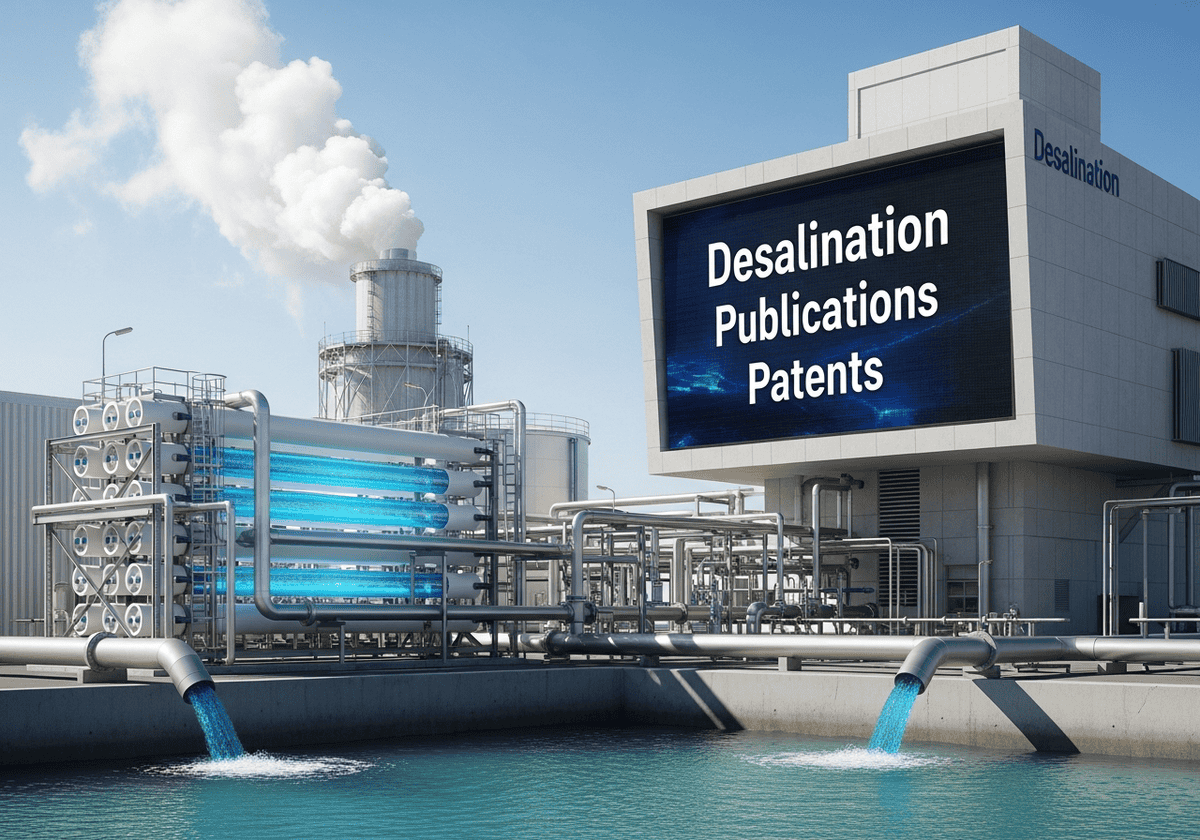
脱塩とは、海水や汽水地下水から溶解した塩分やミネラルを除去して、飲料水や灌漑用水として利用できる淡水を生成する産業および工学分野であり、現在では中東、北アフリカ、アジア沿岸部、そして近年では南ヨーロッパやアメリカ大陸など、水不足に悩む地域で1億人以上の人々に水を供給している。
逆浸透(RO)は現在設置容量の大部分を占めており、塩分を含む原水を高圧で薄膜複合ポリアミド膜に通す方式ですが、その選択性、汚染耐性、ホウ素除去率は依然として活発な材料科学研究の最前線となっています。多段フラッシュ蒸留や多重効果蒸留といった熱プロセスは、発電からの廃熱が無料でエネルギー入力として利用できる場所では依然として有効です。この分野における主要な工学的制約は比エネルギー消費量です。圧力交換器によるエネルギー回収を備えた最先端のROプラントは、海水淡水化の熱力学的最小値に近づいており、競争上の差別化は膜の寿命、取水設計、濃縮塩水管理へとシフトしています。これらの分野では、排出毒性や海洋生態系への影響が規制当局の厳しい監視の対象となっています。
順浸透、膜蒸留、容量性脱イオン、酸化グラフェン膜またはアクアポリン膜といった新たなプロセスアーキテクチャは、従来の逆浸透(RO)の経済性が成り立たないような、ニッチな原水化学組成や、電力網から独立した再生可能エネルギー駆動の構成を対象としている。
以下に索引付けされた出版物および特許は、膜合成やモジュール工学から、システム熱力学、塩水利用、再生可能エネルギーとの連携、そしてプラントの存続可能性を左右する水文地質学的サイト評価に至るまで、この全領域を網羅しています。
海水から淡水を得るには、膜、エネルギー、そして巧妙な化学反応が必要です。膜物理学は 浸透多孔質吸着剤 ゼオライト信頼できる電力は ソーラーパネル または 小型モジュール式原子炉規制対象汚染物質は以下で追跡されます PFAS.
これは、多くの科学オンラインジャーナルの中から、逆浸透、脱塩、海水脱塩、汽水脱塩、RO膜の汚染、薄膜複合膜、ROエネルギー回収装置、圧力交換式脱塩、多段フラッシュ蒸留、多重効果蒸留、電気透析脱塩、順浸透、膜蒸留、容量性脱イオン、脱塩濃縮塩水処理、濃縮塩水管理、太陽光発電RO、風力発電脱塩、原子力脱塩、脱塩エネルギー消費、RO比エネルギー消費、ホウ素除去RO膜、RO透過液回収率など、脱塩に関する英語の世界中の出版物と特許の最新のセレクションです。
Water purification apparatus and flushing method for water purification apparatus
Patent published on the 2026-11-19 in WO under Ref WO2026238134 by QINGDAO HAIER STRAUSS WATER CO LTD [CN] (Zhang Penghui [cn], Liu Jie [cn], Tan Jun [cn], Sheng Xunning [cn])
Abstract: A water purification apparatus and a flushing method for the water purification apparatus. The water purification apparatus comprises a filter assembly, a pressure tank, and a flushing water path assembly. The filter assembly comprises a reverse osmosis membrane element and a filtrate outlet. The pressure tank is configured to store pure water. The flushing water path assembly comprises a water flow channel and a flushing flow channel, wherein the water flow channel is capable of communicating t[...]
Our summary: The water purification apparatus includes a filter assembly with a reverse osmosis membrane and a pressure tank for storing pure water. It features a flushing water path assembly that allows for selective communication between the filtrate outlet and the reverse osmosis membrane. The flushing method enhances the cleaning of the membrane element to maintain efficiency.
water purification, reverse osmosis, flushing method, pressure tank
Patent
Lithium recovery from rechargeable batteries
Patent published on the 2026-11-19 in WO under Ref WO2026241702 by LIEN LARRY [US] (Lien Larry [us])
Abstract: Methods of recovering lithium from a lithium containing material, such as a lithium battery, using water leaching to recover lithium hydroxide in an alkaline solution, concentrating the lithium hydroxide using one or more of a semipermeable membrane, an optional ion-exchange membrane, and/or a reverse osmosis membrane to form a concentrated lithium solution, and then exposing the concentrated lithium solution to carbon dioxide to form lithium carbonate.[...]
Our summary: This process involves recovering lithium from batteries using water leaching to extract lithium hydroxide. The lithium hydroxide is concentrated through membrane techniques, including semipermeable and reverse osmosis membranes. Finally, carbon dioxide is introduced to convert the concentrated lithium solution into lithium carbonate.
Lithium recovery, water leaching, membrane filtration, lithium carbonate
Patent
Purification of evaporator condensate
Patent published on the 2026-11-19 in US under Ref US20260365555 by LUCASE3 L C [US] (Lucas Scott A [us])
Abstract: Systems, methods, and devices for purifying evaporator condensate from one or more evaporators, such as evaporators of an ethanol distillation process. The evaporator condensate is fed to one or more separators to remove at least a portion of contaminants from the evaporator condensate. The one or more separators include at least one reverse osmosis system for removing at least a portion of the contaminants from the evaporator condensate to form a clean water stream. The clean water stream is th[...]
Our summary: Systems and methods are designed to purify evaporator condensate from ethanol distillation processes. Contaminants are removed using separators, including reverse osmosis systems. The resulting clean water stream is recycled for use in the distillation process.
evaporator condensate, purification, reverse osmosis, ethanol distillation
Patent
Gravity motor
Patent published on the 2026-11-19 in WO under Ref WO2026240710 by JMAI KAIES [TN] (Jmai Kaies [tn])
Abstract: The application relates to a gravity motor which is easy to manufacture industrially or in terms of cost and transforms the available sustainable energy coming from the Earth s gravity into consistent and continuous kinetic energy of rotation via the effect of the pressure and counter-pressure caused by the rotating weights, resulting from a function of injection on one side and suction on the other side causing a displacement of the liquid, providing a difference in weight between the two sides[...]
Our summary: The gravity motor converts Earth s gravity into continuous rotational kinetic energy using pressure differences. It is cost-effective, sustainable, and environmentally friendly, producing no waste or pollution. Potential applications include powering electric generators, illuminating cities, and desalinating seawater.
gravity motor, sustainable energy, kinetic energy, environmental impact
Patent
Membrane separation system and method for operating same
Patent published on the 2026-11-19 in WO under Ref WO2026239714 by KURITA WATER IND LTD [JP] (Kawakatsu Takahiro [jp], Gotou Hideki [jp])
Abstract: The disclosure provides a membrane separation system comprising: a membrane separation device having a nanofiltration membrane or a reverse osmosis membrane; and a pressure recovery device for pressurizing raw water to be supplied to the membrane separation device by means of pressure from concentrated water from the membrane separation device, said system being characterized in that, on the basis of the following formula, the quantity of concentrated water received by the pressure recovery devi[...]
Our summary: The membrane separation system includes a nanofiltration or reverse osmosis membrane and a pressure recovery device. The system operates by pressurizing raw water using concentrated water from the membrane device. The quantity of concentrated water received is determined by a specific formula based on operating pressure and recovery efficiency.
membrane separation, nanofiltration, reverse osmosis, pressure recovery
Patent
Subsea desalination systems and methods using fluid displacement
Patent published on the 2026-11-19 in US under Ref US20260365550 by INNOVATOR ENERGY LLC [US] (Novek Ethan [us])
Abstract: The present application pertains to systems and methods for desalination. In one embodiment the system employs a first storage reservoir configured to be near the surface of a body of water and configured to store a low density fluid. A second storage reservoir is configured to be located below the surface of the body of water. A desalination system is operably connected to the second reservoir. Desalinated water is produced by allowing desalination permeate to displace low density fluid in the [...]
Our summary: The system utilizes a first storage reservoir near the surface and a second reservoir below water. Desalination occurs by displacing low density fluid in the second reservoir. Desalinated water is exported by transferring fluid between the reservoirs.
Desalination, Subsea systems, Fluid displacement, Reservoirs
Patent
Carbon dioxide emissions elimination for reverse osmosis desalination units of remote islands via photovoltaic and battery solution. The case of Karpathos Island
Published on 2026-06-06 by @OXFORD
Abstract: AbstractRecently, the imperative water demand problem of small islands in the South-East Mediterranean area is being faced with the development and operation of new reverse osmosis (RO) desalination plants at high operational and environmental cost. One of the most serious RO desalination unit’s problems is their high-energy demand. This water demand coincides with the electricity demand, both peaked during the summer imposing the existing local electrical power stations to operate near their [...]
Our summary: This study explores the integration of photovoltaic systems and battery storage to power reverse osmosis desalination units on Karpathos Island. It addresses high energy demands and carbon emissions associated with traditional diesel power. The proposed solution aims to enhance clean energy autonomy while minimizing operational costs and environmental impact.
photovoltaic, desalination, carbon emissions, battery storage
Publication
PSS composite sponge for solar-driven water purification and dye removal for environmental sustainability
Published on 2026-05-21 by Chung-Wei Huang, Wei-Cheng Jhao, Yu-Jen Liang, Meng-Fang Lin, Yu-Sheng Hsiao @NATURE
Abstract: Polymer Journal, Published online: 21 May 2026; doi:10.1038/s41428-026-01188-zA 3D macroporous MWCNT/PEDOT: PSS composite sponge, fabricated via freeze-drying, enables efficient solar-driven interfacial water evaporation (SIWE) through optimized light absorption, wettability, and water transport. The engineered porous architecture enhances solar–thermal management while facilitating rapid water uptake. Simultaneously, the sponge exhibits high adsorption capacities for organic dyes and strong a[...]
Our summary: A 3D macroporous MWCNT/PEDOT: PSS composite sponge enables efficient solar-driven interfacial water evaporation. It enhances solar–thermal management and facilitates rapid water uptake. The sponge also demonstrates high dye adsorption capacities and strong antifouling properties for sustainable water purification.
PSS, composite sponge, solar-driven purification, environmental sustainability
Publication