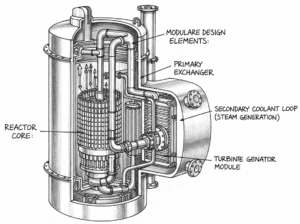
Les petits réacteurs modulaires sont des systèmes de production d'énergie nucléaire à fission dont la capacité de production électrique est généralement inférieure à 300 MWe par unité, conçus dès le départ pour la fabrication en usine de modules standardisés, leur transport par route ou par rail jusqu'au site et des calendriers de construction accélérés — une inversion structurelle délibérée par rapport aux centrales nucléaires sur mesure à l'échelle du gigawatt dont les dépassements de coûts d'investissement et les délais de construction de plusieurs décennies ont effectivement stoppé le déploiement de nouvelles centrales nucléaires sur les marchés occidentaux après les années 1980.
La physique des réacteurs et la chimie du fluide de refroidissement varient considérablement selon les modèles : réacteurs à eau légère avancés étendant la technologie éprouvée de l’eau pressurisée à une échelle réduite, réacteurs à sels fondus dissolvant le combustible directement dans un fluide de refroidissement fluorure ou chlorure, réacteurs à haute température refroidis par gaz utilisant de l’hélium et des particules de combustible TRISO, conceptions à spectre rapide refroidies au sodium et au plomb, et microréacteurs thermiques destinés à des sites industriels ou militaires éloignés de moins de 10 MWe.
Les publications et brevets répertoriés ci-dessous traitent de la physique des réacteurs, de la thermohydraulique et de la sécurité passive. validation, conception d'assemblages combustibles, qualification des matériaux sous irradiation, usine fabrication processus, méthodologie d'octroi de licences et évaluations technico-économiques couvrant l'ensemble de ce spectre de conception.
Il s'agit de notre dernière sélection de publications et de brevets mondiaux en anglais sur les petits réacteurs modulaires (SMR), parmi de nombreuses revues scientifiques en ligne, classées et axées sur le petit réacteur modulaire, le SMR, le microréacteur nucléaire, le réacteur avancé à eau légère, le sel fondu, le réacteur à haute température refroidi au gaz, le réacteur rapide refroidi au plomb, le réacteur rapide refroidi au sodium, le système de sécurité passive du SMR, la cogénération du SMR, le chauffage urbain du SMR, le combustible HALEU du SMR, la conception de l'enceinte de confinement du SMR et le démantèlement du SMR.
Articles for containing a molten material and methods of producing the same
Patent published on the 2026-06-04 in US under Ref US20260151829 by BATTELLE ENERGY ALLIANCE LLC [US] (Tripathy Prabhat K [us], Marsden Kenneth C [us], King James A [us], Tolman David D [us], Tolman Kevin R [us])
Abstract: [0000] An article comprises a crucible and a composite coating having a first surface adjacent an inner surface of the crucible and a second surface opposite the first surface. The second surface of the composite coating defines an exposed interior surface of the article. The composite coating comprises at least one carbide of a transition metal. The composite coating includes a gradient of carbon across a thickness of the composite coating between the first surface and the second surface of the[...]
Our summary: The article describes a crucible with a composite coating featuring a gradient of carbon. It includes a method for producing the crucible through electroplating and annealing. The composite coating consists of at least one carbide of a transition metal.
crucible, composite coating, transition metal, electroplating
Patent
Control rod assembly with enhanced control rod worth using 28 neutron absorber rods
Patent published on the 2026-05-27 in EP under Ref EP4749658 by KEPCO NUCLEAR FUEL CO LTD [KR] (Choi Dae Woon [kr], Ha Dong Geun [kr], Lee Shin Ho [kr], Kim Seong Soo [kr], Ryu Joo Young [kr], Kim Kyounghong [kr], Lee Hak In [kr], Chun Joo Hong [kr], Kim Ba Leum [kr], Yoon Ju Yeob [kr], Cho Beom Hee [kr], Bae Gong Hoon [kr])
Abstract: [0001] Proposed is a control rod assembly with enhanced control rod worth suitable for a small modular reactor (SMR), wherein the control rod assembly includes a plurality of spider vanes provided radially on a plane perpendicular to a spider body and configured to support control rods, wherein the spider vanes includes four first spider vanes (Ixx and Iyy) arranged orthogonally to each other in principal-axis directions, four second spider vanes (Ixy) arranged in on-diagonal directions with res[...]
Our summary: The proposed control rod assembly enhances control rod worth for small modular reactors. It features a configuration of spider vanes supporting 28 neutron absorber rods. The arrangement includes first, second, and third spider vanes positioned in orthogonal and diagonal orientations.
control rod assembly, neutron absorber rods, small modular reactor, spider vanes
Patent
Control rod assembly with enhanced control rod worth
Patent published on the 2026-05-27 in EP under Ref EP4749657 by KEPCO NUCLEAR FUEL CO LTD [KR] (Choi Dae Woon [kr], Ha Dong Geun [kr], Lee Shin Ho [kr], Kim Seong Soo [kr], Ryu Joo Young [kr], Kim Kyounghong [kr], Lee Hak In [kr], Chun Joo Hong [kr], Kim Ba Leum [kr], Yoon Ju Yeob [kr], Song Han Seung [kr], Cho Beom Hee [kr], Yu Ho Sung [kr], Bae Go)
Abstract: [0001] Proposed is a control rod assembly with enhanced control rod worth suitable for a small modular reactor (SMR). The control rod assembly with enhanced control rod worth includes a plurality of spider vanes provided radially on a plane perpendicular to a spider body to support control rods, wherein the control rods consist of 28 shutdown group neutron absorbers in total made of BC comprising B-10 enriched to at least 70%.[...]
Our summary: The proposed control rod assembly is designed for small modular reactors. It features enhanced control rod worth through a configuration of spider vanes. The assembly includes 28 neutron absorbers made of B-10 enriched to at least 70%.
control rod assembly, enhanced control rod worth, small modular reactor, neutron absorbers
Patent
Method for steel production and corresponding installation network
Patent published on the 2026-05-20 in UA under Ref UA130827 by VERESHCHAK VIKTOR IVANOVYCH [UA] (Vereshchak Viktor Ivanovych [ua], Ivashchenko Valerii Petrovych [ua], Petrenko Vitalii Oleksandrovych [ua], Chaika Oleksii Leonidovych [ua], Loboda Petro Ivanovych [ua], Hryshchenko Serhii Heorhiiovych [ua], Vereshchak Denys Viktorovych [ua])
Abstract: Invention relates to ferrous metallurgy, specifically to production of steel from iron ore using iron oxide reduction method via network of installations. Method is proposed for producing steel from iron ore raw materials by reducing iron oxide, in which furnace with shaft chamber for preliminary reduction (A), horizontal chamber for final reduction (B), and liquid metal accumulation chamber (C) are used, all connected by transition channels. Pellets made from raw materials that do not contain c[...]
Our summary: The invention describes a method for steel production using iron oxide reduction with a network of installations. It employs a furnace system with multiple chambers and utilizes low-temperature plasma for heating and reduction. The method aims to lower costs and reduce CO2 emissions while improving environmental conditions.
ferrous metallurgy, steel production, iron oxide reduction, plasma torches
Patent
Fuelling a molten salt reactor
Patent published on the 2026-05-20 in EP under Ref EP4745993 by SALTFOSS ENERGY APS [DK] (Yoon Juhyeon [dk])
Abstract: [0001] The present invention relates to a fuel salt feeding apparatus for a molten salt reactor (MSR), comprising: a fuel container for holding fuel salt units; a feeding pipe connected to the fuel container for transferring fuel salt units from the fuel container to a molten salt container; a valve structure on the feeding pipe, said valve structure comprising: a bucket member (4, 14) having a fuel salt unit compartment for containing one or more fuel salt units, and a bucket member position de[...]
Our summary: The invention describes a fuel salt feeding apparatus for a molten salt reactor. It includes a fuel container, a feeding pipe, and a valve structure with a bucket member and position detectors. The system is designed to transfer fuel salt units efficiently to the molten salt container.
fuel salt, molten salt reactor, feeding apparatus, valve structure
Patent
A process for the preparation of a carbon product
Patent published on the 2026-04-22 in EP under Ref EP4729477 by YERRAWA B V [NL] (O'connor Paul [nl], Daamen Sjoerd [es], Babic Igor [nl])
Abstract: [0001] The invention relates generally to a process for the preparation of a carbon product having a high degree of graphitization in a high yield, comprising the steps of a) contacting a carbon containing starting material, preferably a carbohydrate or hydrocarbon, with a molten salt, b) Carbonising the carbon containing starting material to form a carbon product in mixture with the molten salt at temperatures between 100 and 300°C in an oven or by heating with microwaves, in an atmosphere fre[...]
Our summary: The process involves carbonizing a carbon-containing material with molten salt to achieve high graphitization. It operates at temperatures between 100 and 300°C in an oxygen-free atmosphere. The resulting carbon product has a yield of at least 40 wt% and is suitable for applications in carbon fibers and electronics.
carbonization, graphitization, molten salt, carbon product
Patent
Study on Flow Field Excitation and Rotor Shaft Response of the High-Temperature Molten Salt Circulating Primary Pump
Published on 2026-01-31 by Xiongfa Gao, Xinyi Zhang, Weidong Shi, Daohong Wang, Ruijie Zhao, Zhiyu Zhu @MDPI
Abstract: This study examines the impact of fluid excitation forces on the dynamic response of high-temperature molten salt circulating primary pump rotor systems. Unsteady simulations were conducted in ANSYS CFX to characterize pressure pulsation and radial forces across all impeller stages. Critical speeds and vibration modes were subsequently analyzed using SAMCEF to evaluate transient responses under varying flow rates. Key findings: Numerical performance predictions align with experimental data withi[...]
Our summary: This study analyzes the impact of fluid excitation on the dynamic response of high-temperature molten salt pump rotors. Unsteady simulations in ANSYS CFX characterize pressure pulsations and radial forces, while critical speeds and vibration modes are evaluated using SAMCEF. Key findings indicate that numerical predictions align closely with experimental data, revealing significant variations in radial forces across impeller stages.
Fluid Excitation, Rotor Dynamics, Pressure Pulsation, ANSYS CFX
Publication
Multicriteria Assessment for Technological Readiness
Published on 2026-01-29 by Jorge Omar Gil Posada, Juan Carlos Quintero-Daz, Andrs A. Amell @MDPI
Abstract: In addressing the increasing global energy demand, this manuscript compares four distinct processes for hydrogen production from natural gas (NG): steam methane reforming (SMR), dry methane reforming (DMR), autothermal reforming (ATR), and catalytic methane decomposition (CMD). The comparison emphasizes their respective efficiencies and environmental impacts. Simulations were conducted using the Peng–Robinson model, implemented in the DWSIM 8.8.3 software package, considering comme[...]
Our summary: This manuscript compares four hydrogen production processes from natural gas: SMR, DMR, ATR, and CMD. It evaluates their efficiencies and environmental impacts using the TOPSIS method, identifying ATR as the best option. The study highlights Colombia s potential in the hydrogen economy based on its natural resources.
Hydrogen production, Multicriteria assessment, Environmental impact, TOPSIS method
Publication