Product Design, Manufacturing & Innovation Resources
家 » ベイズ因子

ベイズ因子

1939
  • Harold Jeffreys
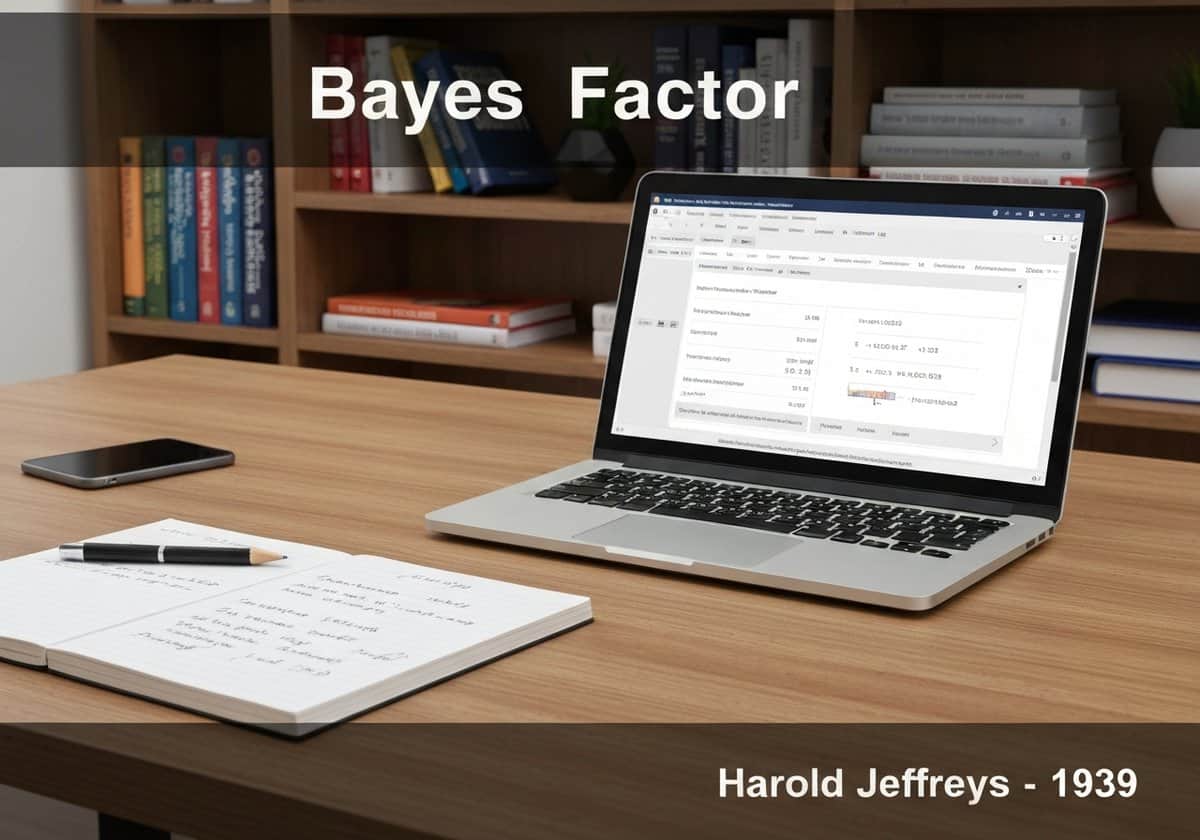
Office workspace with statistical software showing Bayes factor calculations and hypothesis testing notes.

(画像はイメージです)

の ベイズ 係数は、2 つの競合する仮説(多くの場合、帰無仮説([latex]M_1[/latex])と対立仮説([latex]M_2[/latex]))の周辺尤度の比です。これは、観測データ [latex]D[/latex] に基づいて、一方の仮説が他方の仮説よりもどれだけ支持されているかを定量化します。式は [latex]K = frac{P(D|M_1)}{P(D|M_2)}[/latex] です。K の値が 1 より大きい場合は、データが [latex]M_1[/latex] を [latex]M_2[/latex] よりも支持していることを示します。


の ベイズ factor is the Bayesian alternative to the frequentist p-value for hypothesis testing. Unlike a p-value, which only provides evidence against the null hypothesis, the Bayes factor can quantify evidence for the null, for the alternative, or indicate that the data is uninformative. The magnitude of the Bayes factor provides a continuous scale of evidence. For instance, a Bayes factor of 10 is often considered ‘strong’ evidence for one model over another, while a value between 1 and 3 is considered ‘anecdotal’ or ‘weak’ evidence.

The core component of the Bayes factor is the marginal likelihood, [latex]P(D|M) = \int P(D|\theta, M)P(\theta|M) d\theta[/latex]. This is the probability of the observed data averaged over the prior distribution of the parameters [latex]\theta[/latex] for a given model [latex]M[/latex]. This integral makes the Bayes factor sensitive to the choice of prior distributions, which is a point of contention and active research. It also makes it computationally challenging to calculate, often requiring numerical methods like MCMC あるいは、ベイズ情報量規準(BIC)のような近似的な手法もあります。こうした課題はあるものの、競合する仮説の証拠を評価できる能力は、科学的推論やモデル選択において強力なツールとなります。

UNESCO Nomenclature: 1208
統計

タイプ

抽象システム

混乱

実質的な

使用法

広く普及している

前駆物質

  • ベイズ推論
  • 尤度原理
  • 科学的証拠の本質に関する哲学的研究
  • 仮説検定のためのネイマン・ピアソン補題

アプリケーション

  • Hypothesis testing in 心理学, biology, and social sciences
  • 機械学習と統計学におけるモデル選択
  • 変更が実際に効果があるかどうかを判断するためのA/Bテスト
  • 証拠を鑑定するための法医学
  • 重要な遺伝子関連性を特定するためのゲノミクス

特許:

NA

潜在的なイノベーションのアイデア

  • Automated scientific research platforms that use Bayes factors to decide which of several competing theories is best supported by new data
  • A legal evidence evaluation system that calculates Bayes factors to determine how strongly a piece of evidence supports the prosecution vs. the defense
  • A ‘model selection as a service’ cloud platform for data scientists
  • 臨床試験 software that uses Bayes factors for continuous monitoring and early stopping if strong evidence for or against a treatment emerges
  • AI-driven peer review systems that use Bayes factors to assess the strength of evidence in submitted manuscripts
  • Personalized marketing engines that use Bayes factors to select the best advertising model for a specific user segment
  • Robotic explorers (e.g., Mars rovers) that use Bayes factors to autonomously decide which geological hypothesis to investigate next
  • Financial regulation software that uses Bayes factors to detect which model of market manipulation best explains anomalous trading patterns
  • Smart city planning tools that use Bayes factors to select the most effective urban intervention (e.g., new bus line vs. bike lanes)
  • サイバーセキュリティ systems that use Bayes factors to decide if network traffic better fits a ‘benign’ or ‘attack’ model
関連キーワード:ベイズ因子、仮説検定、モデル選択、周辺尤度、証拠、ベイズ統計学、ハロルド・ジェフリーズ、p値、統計的証拠、事前分布。

歴史的背景

ベイズ因子

1925
1930
1931
1939
1940
1950
1950
1925
1928
1930
1936
1940
1943
1950
1950

(日付が不明または関連性がない場合、例えば「流体力学」などでは、その注目すべき出現時期の概算値が提示されます。)

10年目 周年

フルサイズの画像とダウンロードは、登録会員のみが100%無料で利用できます。