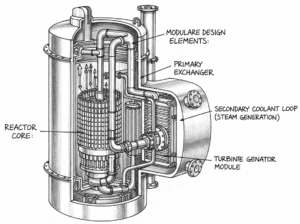
Los reactores modulares pequeños son sistemas de energía de fisión nuclear con una capacidad de producción eléctrica generalmente inferior a 300 MWe por unidad, diseñados desde el principio para la fabricación en fábrica de módulos estandarizados, el transporte por carretera o ferrocarril hasta el emplazamiento y plazos de construcción acelerados; una inversión estructural deliberada de las centrales nucleares a medida de escala de gigavatios, cuyos sobrecostes de capital y plazos de construcción de décadas de duración paralizaron de hecho el despliegue de nuevas centrales nucleares en los mercados occidentales después de la década de 1980.
La física de los reactores y la química de los refrigerantes varían sustancialmente en toda la gama de diseños: reactores avanzados de agua ligera que extienden la tecnología probada de agua a presión a escala reducida, reactores de sales fundidas que disuelven el combustible directamente en refrigerante de fluoruro o cloruro, reactores de alta temperatura refrigerados por gas que utilizan helio y partículas de combustible TRISO, diseños de espectro rápido refrigerados por sodio y por plomo, y microrreactores térmicos destinados a emplazamientos industriales o militares remotos con una potencia inferior a 10 MWe.
Las publicaciones y patentes indexadas a continuación abordan la física de los reactores, la termohidráulica, la seguridad pasiva validación, diseño de conjunto de combustible, calificación de materiales bajo irradiación, fábrica fabricación procesos, metodología de concesión de licencias y evaluaciones tecnoeconómicas en todo este espectro de diseño.
Esta es nuestra última selección de publicaciones y patentes mundiales en inglés sobre reactores modulares pequeños (SMR), entre muchas revistas científicas en línea, clasificadas y centradas en reactor modular pequeño, SMR, microrreactor nuclear, reactor avanzado de agua ligera, sales fundidas, reactor de alta temperatura refrigerado por gas, reactor rápido refrigerado por plomo, reactor rápido refrigerado por sodio, sistema de seguridad pasiva SMR, cogeneración SMR, calefacción urbana SMR, combustible HALEU SMR, diseño de contención SMR y desmantelamiento SMR.
A molten salt reactor system
Patent published on the 2026-06-24 in EP under Ref EP4765161 by SALTFOSS ENERGY APS [DK] (Bures Lubomir [dk], Ruscoe Timothy [dk], Yoon Juhyeon [dk], Nilsson Per [dk], Bergamasco Luca [dk], Hovdinghoff Jannik [dk])
Abstract: [0001] The present invention relates to a molten salt reactor system comprising a reactor vessel comprising a reactor core in an upper compartment, and one or more drain tanks situated in a lower compartment below the upper compartment, and a molten fuel salt pump, and a heat exchanger, wherein a molten fuel salt flow direction is provided in a fuel salt loop, said fuel salt loop comprising the reactor core, the one or more drain tanks, the molten fuel salt pump, and the heat exchanger, the dire[...]
Our summary: The invention describes a molten salt reactor system with a reactor core and drain tanks. It includes a molten fuel salt pump and a heat exchanger for fuel salt flow. The system features a passive decay heat removal mechanism in the lower compartment.
molten salt reactor, reactor core, heat exchanger, fuel salt pump
Patent
System and method for providing personalized stimuli based on bio-signals
Patent published on the 2026-06-18 in US under Ref US20260166259 by NEUROTX CO LTD [KR] (Jo Donghyeok [kr], Kim Dong-joo [kr], Kim Goeun [kr])
Abstract: [0000] According to an example embodiment, the invention relates to a personalized stimulus delivery system and method, which collects real-time biometric signal data from users, analyzes it, and provides optimized stimuli. More specifically, it involves a technology that collects ECG (electrocardiogram), EEG (electroencephalogram), SPO(blood oxygen saturation), Actigraphy (physical activity), and environmental noise data, then evaluates the user s stress level, sleep quality, and physical fatig[...]
Our summary: The invention provides a system that collects and analyzes real-time biometric data to deliver personalized stimuli. It evaluates user stress, sleep quality, and fatigue, offering tailored stimuli like binaural beats. The system continuously improves based on user feedback to enhance health and well-being.
biometric signals, personalized stimuli, artificial intelligence, health management
Patent
Articles for containing a molten material and methods of producing the same
Patent published on the 2026-06-04 in US under Ref US20260151829 by BATTELLE ENERGY ALLIANCE LLC [US] (Tripathy Prabhat K [us], Marsden Kenneth C [us], King James A [us], Tolman David D [us], Tolman Kevin R [us])
Abstract: [0000] An article comprises a crucible and a composite coating having a first surface adjacent an inner surface of the crucible and a second surface opposite the first surface. The second surface of the composite coating defines an exposed interior surface of the article. The composite coating comprises at least one carbide of a transition metal. The composite coating includes a gradient of carbon across a thickness of the composite coating between the first surface and the second surface of the[...]
Our summary: The article describes a crucible with a composite coating featuring a gradient of carbon. It includes a method for producing the crucible through electroplating and annealing. The composite coating consists of at least one carbide of a transition metal.
crucible, composite coating, transition metal, electroplating
Patent
Control rod assembly with enhanced control rod worth using 28 neutron absorber rods
Patent published on the 2026-05-27 in EP under Ref EP4749658 by KEPCO NUCLEAR FUEL CO LTD [KR] (Choi Dae Woon [kr], Ha Dong Geun [kr], Lee Shin Ho [kr], Kim Seong Soo [kr], Ryu Joo Young [kr], Kim Kyounghong [kr], Lee Hak In [kr], Chun Joo Hong [kr], Kim Ba Leum [kr], Yoon Ju Yeob [kr], Cho Beom Hee [kr], Bae Gong Hoon [kr])
Abstract: [0001] Proposed is a control rod assembly with enhanced control rod worth suitable for a small modular reactor (SMR), wherein the control rod assembly includes a plurality of spider vanes provided radially on a plane perpendicular to a spider body and configured to support control rods, wherein the spider vanes includes four first spider vanes (Ixx and Iyy) arranged orthogonally to each other in principal-axis directions, four second spider vanes (Ixy) arranged in on-diagonal directions with res[...]
Our summary: The proposed control rod assembly enhances control rod worth for small modular reactors. It features a configuration of spider vanes supporting 28 neutron absorber rods. The arrangement includes first, second, and third spider vanes positioned in orthogonal and diagonal orientations.
control rod assembly, neutron absorber rods, small modular reactor, spider vanes
Patent
Control rod assembly with enhanced control rod worth
Patent published on the 2026-05-27 in EP under Ref EP4749657 by KEPCO NUCLEAR FUEL CO LTD [KR] (Choi Dae Woon [kr], Ha Dong Geun [kr], Lee Shin Ho [kr], Kim Seong Soo [kr], Ryu Joo Young [kr], Kim Kyounghong [kr], Lee Hak In [kr], Chun Joo Hong [kr], Kim Ba Leum [kr], Yoon Ju Yeob [kr], Song Han Seung [kr], Cho Beom Hee [kr], Yu Ho Sung [kr], Bae Go)
Abstract: [0001] Proposed is a control rod assembly with enhanced control rod worth suitable for a small modular reactor (SMR). The control rod assembly with enhanced control rod worth includes a plurality of spider vanes provided radially on a plane perpendicular to a spider body to support control rods, wherein the control rods consist of 28 shutdown group neutron absorbers in total made of BC comprising B-10 enriched to at least 70%.[...]
Our summary: The proposed control rod assembly is designed for small modular reactors. It features enhanced control rod worth through a configuration of spider vanes. The assembly includes 28 neutron absorbers made of B-10 enriched to at least 70%.
control rod assembly, enhanced control rod worth, small modular reactor, neutron absorbers
Patent
Method for steel production and corresponding installation network
Patent published on the 2026-05-20 in UA under Ref UA130827 by VERESHCHAK VIKTOR IVANOVYCH [UA] (Vereshchak Viktor Ivanovych [ua], Ivashchenko Valerii Petrovych [ua], Petrenko Vitalii Oleksandrovych [ua], Chaika Oleksii Leonidovych [ua], Loboda Petro Ivanovych [ua], Hryshchenko Serhii Heorhiiovych [ua], Vereshchak Denys Viktorovych [ua])
Abstract: Invention relates to ferrous metallurgy, specifically to production of steel from iron ore using iron oxide reduction method via network of installations. Method is proposed for producing steel from iron ore raw materials by reducing iron oxide, in which furnace with shaft chamber for preliminary reduction (A), horizontal chamber for final reduction (B), and liquid metal accumulation chamber (C) are used, all connected by transition channels. Pellets made from raw materials that do not contain c[...]
Our summary: The invention describes a method for steel production using iron oxide reduction with a network of installations. It employs a furnace system with multiple chambers and utilizes low-temperature plasma for heating and reduction. The method aims to lower costs and reduce CO2 emissions while improving environmental conditions.
ferrous metallurgy, steel production, iron oxide reduction, plasma torches
Patent
Study on Flow Field Excitation and Rotor Shaft Response of the High-Temperature Molten Salt Circulating Primary Pump
Published on 2026-01-31 by Xiongfa Gao, Xinyi Zhang, Weidong Shi, Daohong Wang, Ruijie Zhao, Zhiyu Zhu @MDPI
Abstract: This study examines the impact of fluid excitation forces on the dynamic response of high-temperature molten salt circulating primary pump rotor systems. Unsteady simulations were conducted in ANSYS CFX to characterize pressure pulsation and radial forces across all impeller stages. Critical speeds and vibration modes were subsequently analyzed using SAMCEF to evaluate transient responses under varying flow rates. Key findings: Numerical performance predictions align with experimental data withi[...]
Our summary: This study analyzes the impact of fluid excitation on the dynamic response of high-temperature molten salt pump rotors. Unsteady simulations in ANSYS CFX characterize pressure pulsations and radial forces, while critical speeds and vibration modes are evaluated using SAMCEF. Key findings indicate that numerical predictions align closely with experimental data, revealing significant variations in radial forces across impeller stages.
Fluid Excitation, Rotor Dynamics, Pressure Pulsation, ANSYS CFX
Publication
Multicriteria Assessment for Technological Readiness
Published on 2026-01-29 by Jorge Omar Gil Posada, Juan Carlos Quintero-Daz, Andrs A. Amell @MDPI
Abstract: In addressing the increasing global energy demand, this manuscript compares four distinct processes for hydrogen production from natural gas (NG): steam methane reforming (SMR), dry methane reforming (DMR), autothermal reforming (ATR), and catalytic methane decomposition (CMD). The comparison emphasizes their respective efficiencies and environmental impacts. Simulations were conducted using the Peng–Robinson model, implemented in the DWSIM 8.8.3 software package, considering comme[...]
Our summary: This manuscript compares four hydrogen production processes from natural gas: SMR, DMR, ATR, and CMD. It evaluates their efficiencies and environmental impacts using the TOPSIS method, identifying ATR as the best option. The study highlights Colombia s potential in the hydrogen economy based on its natural resources.
Hydrogen production, Multicriteria assessment, Environmental impact, TOPSIS method
Publication