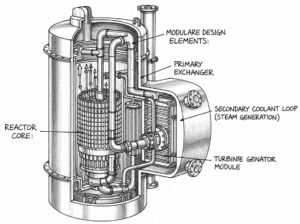
Os pequenos reatores modulares são sistemas de energia nuclear de fissão com capacidade de produção elétrica normalmente inferior a 300 MWe por unidade, projetados desde o início para fabricação em fábrica de módulos padronizados, transporte rodoviário ou ferroviário até o local e cronogramas de construção acelerados — uma inversão estrutural deliberada das usinas nucleares personalizadas de escala gigawatt, cujos custos de capital excessivos e prazos de construção de décadas efetivamente interromperam a implantação de novas usinas nucleares nos mercados ocidentais após a década de 1980.
A física dos reatores e a química dos fluidos refrigerantes variam substancialmente em todo o portfólio de projetos — reatores avançados de água leve que estendem a tecnologia comprovada de água pressurizada em escala reduzida, reatores de sal fundido que dissolvem o combustível diretamente em fluido refrigerante de fluoreto ou cloreto, reatores refrigerados a gás de alta temperatura usando hélio e partículas de combustível TRISO, projetos de espectro rápido refrigerados a sódio e chumbo e microrreatores térmicos destinados a locais industriais ou militares remotos com potência inferior a 10 MWe.
As publicações e patentes indexadas abaixo abordam física de reatores, termohidráulica, validação de segurança passiva, projeto de conjuntos de combustível, qualificação de materiais sob irradiação, processos de fabricação em fábrica, metodologia de licenciamento e avaliações técnico-econômicas em todo esse espectro de projeto.
Os SMRs prometem energia nuclear produzida em fábrica, em incrementos menores. Seu equivalente a longo prazo está em fusão nuclearOs fatores que impulsionam a demanda estão em redes inteligentes e dessalinização, ambos necessitando de energia constante. Os métodos de projeto digital aparecem em gêmeos digitais.
Esta é a nossa mais recente seleção de publicações e patentes mundiais em inglês sobre Pequenos Reatores Modulares (SMRs), provenientes de diversos periódicos científicos online, classificadas e focadas em reator modular pequeno, SMR, microrreator nuclear, reator avançado de água leve, reator de sal fundido, reator refrigerado a gás de alta temperatura, reator rápido refrigerado a chumbo, reator rápido refrigerado a sódio, sistema de segurança passiva de SMR, cogeração de SMR, aquecimento urbano com SMR, SMR com combustível HALEU, projeto de contenção de SMR e descomissionamento de SMR.
A foundation for systematic analysis of transformers and RNNs for tractography
Published on 2026-11-24 by @MIT
Abstract: AbstractMachine learning (ML) has emerged as a promising approach for improving diffusion MRI (dMRI) tractography, a task that remains limited by the intrinsic tension between local diffusion information and global anatomical plausibility. In this work, we systematically evaluate recurrent neural networks (RNNs) and Transformer models for iterative tractography, with particular attention to training strategies, input representations (including convolutional neural network (CNN)-based embeddings [...]
Our summary: This work evaluates RNNs and Transformer models for diffusion MRI tractography. It introduces a generation-validation phase for streamline-level supervision during training. Results show the highest performance to date and highlight the need for improved evaluation methods in in vivo validation.
machine learning, diffusion MRI, recurrent neural networks, Transformers
Publication
A molten salt nuclear reactor with gas system and method of operating such a reactor
Patent published on the 2026-11-19 in US under Ref US20260369435 by COPENHAGEN ATOMICS AS [DK] (Stubsgaard Aslak [dk])
Abstract: A molten salt nuclear reactor and method of operating such a reactor. The molten salt reactor comprises a closed and leaktight vessel (1,40) containing at least one molten salt loop (3,13), and a gas system for receiving gas originating from the at least one molten salt loop (3,13), the gas system comprises at least one gas-holder (30,34) of variable capacity configured for holding gas originating from the molten salt loop (3,13).[...]
Our summary: The content describes a molten salt nuclear reactor with a gas system. It features a closed and leaktight vessel containing a molten salt loop. The gas system includes a variable capacity gas-holder for gas from the molten salt loop.
molten salt reactor, gas system, closed vessel, operating method
Patent
Antiglare surfaces with abrasion-resistant properties
Patent published on the 2026-11-19 in US under Ref US20260365564 by CORNING INC [US] (Geiger Melanie Lian [us], Jin Yuhui [us], Nelson Cameron Robert [us], Price James Joseph [us], Stewart Ross Johnson [us], Verrier Florence Christine Monique [us], Weidman David Lee [us], Zhang Binwei [us])
Abstract: A textured article is described herein comprising a substrate comprising a textured region defined on a primary surface of the substrate, in which the textured region comprises (a) a Vmp/Sq of at least 0.084, (b) a Vmp/Sq of at least 0.084 and an Smrk2 of at least 90%, and/or (c) a Vmp of at least 10 nm and an Sdq of 0-0.1. The textured article generally has good abrasion resistance and optical properties including antiglare, haze, sparkle, and distinctness of image. A method for making a textur[...]
Our summary: The content describes a textured article with antiglare and abrasion-resistant properties. It details specific metrics for the textured region s surface characteristics. A method for creating the textured article involves a multi-step process of surface removal.
antiglare, abrasion-resistant, textured surfaces, optical properties
Patent
Process to produce a pyrolysis oil comprising liquid hydrocarbons from plastic material at high exergetic efficiency, and relative plant
Patent published on the 2026-11-19 in US under Ref US20260365925 by VERSALIS SPA [IT] (Felisari Riccardo [it], Galeotti Armando [it], Santilli Celeste [it], Assandri Fabio [it])
Abstract: Process for producing a pyrolysis oil which comprises liquid hydrocarbons from plastic material, preferably waste material, sustainably. The process is characterized by the use of solar radiation which is used to heat a heat transfer fluid (like molten salts) at multiple temperature levels, so as to use the hotter heat transfer fluid to the pyrolysis devices that require higher temperature. The heat transfer fluid returning from said devices is sent back to the respective solar radiation heaters[...]
Our summary: The process produces pyrolysis oil from plastic waste using solar radiation to heat a heat transfer fluid. It features a two-stage pyrolysis system that optimizes energy use and temperature requirements. This setup enhances exergetic efficiency and maximizes oil yield from solar power.
pyrolysis, solar energy, heat transfer fluid, exergetic efficiency
Patent
A method for producing syngas using catalytic reverse water gas shift
Patent published on the 2026-11-19 in US under Ref US20260365932 by SHELL USA INC [US] (Schoonebeek Ronald Jan [nl], Bos Alouisius Nicolaas Renée [nl], Unruh Dominik Johannes Michael [nl])
Abstract: The present invention relates to a method for producing syngas using a catalytic reverse water gas shift (RWGS) reaction, the method at least comprising the steps of: a) providing a feed stream comprising at least hydrogen (H2) and carbon dioxide (CO2); b) introducing the feed stream provided in step a) into a RWGS reactor and subjecting it to a catalytic RWGS reaction, thereby obtaining a syngas containing stream; wherein the RWGS reactor comprises a multitubular reactor heated by molten salt c[...]
Our summary: The method produces syngas through a catalytic reverse water gas shift reaction. It involves providing a feed stream of hydrogen and carbon dioxide. The process uses a multitubular reactor heated by circulating molten salt.
syngas, catalytic reaction, reverse water gas shift, molten salt
Patent
Methods of chemically strengthening glass, glass-based articles, and consumer electronic devices
Patent published on the 2026-11-12 in WO under Ref WO2026235866 by CORNING INC [US] (Jin Yuhui [us], Mckendrick William James [us], Meenakshi Sundaram Balamurugan [us], Pearl Shelby Kerin [us], Ukrainczyk Ljerka [us], Walker Stephen [us])
Abstract: Methods of chemically strengthening a glass-based substrate includes contacting a first major surface of the glass-based substrate with a molten salt solution maintained at a first temperature from 330°C to 530°C for from 10 minutes to 8 hours to form a compressive stress region extending from the first major surface to a first depth of compression. Methods further include adding a phosphate salt to the molten salt solution during the contacting.[...]
Our summary: Methods for chemically strengthening glass involve using molten salt solutions at high temperatures. The process creates a compressive stress region in the glass substrate. Adding phosphate salt to the solution enhances the strengthening effect.
chemical strengthening, glass substrate, molten salt solution, compressive stress
Patent
Systems and methods for quantifying aerosol in a nuclear reactor system
Patent published on the 2026-11-12 in WO under Ref WO2026236600 by ABILENE CHRISTIAN UNIV [US] (Pamplin Kim [us], Berry Alli [us])
Abstract: Operation of a molten salt reactor requires consistent oversight of the corrosivity level of the molten salt flowing therein as changes in the corrosivity level may causing damage to system components or otherwise reduce the efficacy of the system. The present disclosure relates to a reactor vessel system and methods of use for measuring the corrosivity of a molten salt within a molten salt system without a nebulizer. The reactor vessel system of the present disclosure enables online monitoring [...]
Our summary: The disclosure presents a reactor vessel system for measuring the corrosivity of molten salt in a nuclear reactor. It enables online monitoring of aerosols without using a nebulizer. The system ensures accurate aerosol sampling and quantification to prevent damage to reactor components.
aerosol quantification, molten salt reactor, corrosivity measurement, online monitoring
Patent
Study on Flow Field Excitation and Rotor Shaft Response of the High-Temperature Molten Salt Circulating Primary Pump
Published on 2026-01-31 by Xiongfa Gao, Xinyi Zhang, Weidong Shi, Daohong Wang, Ruijie Zhao, Zhiyu Zhu @MDPI
Abstract: This study examines the impact of fluid excitation forces on the dynamic response of high-temperature molten salt circulating primary pump rotor systems. Unsteady simulations were conducted in ANSYS CFX to characterize pressure pulsation and radial forces across all impeller stages. Critical speeds and vibration modes were subsequently analyzed using SAMCEF to evaluate transient responses under varying flow rates. Key findings: Numerical performance predictions align with experimental data withi[...]
Our summary: This study analyzes the impact of fluid excitation on the dynamic response of high-temperature molten salt pump rotors. Unsteady simulations in ANSYS CFX characterize pressure pulsations and radial forces, while critical speeds and vibration modes are evaluated using SAMCEF. Key findings indicate that numerical predictions align closely with experimental data, revealing significant variations in radial forces across impeller stages.
Fluid Excitation, Rotor Dynamics, Pressure Pulsation, ANSYS CFX
Publication