Product Design, Manufacturing & Innovation Resources
Home » The Square Root of 2 in Paper Sizes

The Square Root of 2 in Paper Sizes

1922
  • Walter Porstmann
  • Georg Christoph Lichtenberg
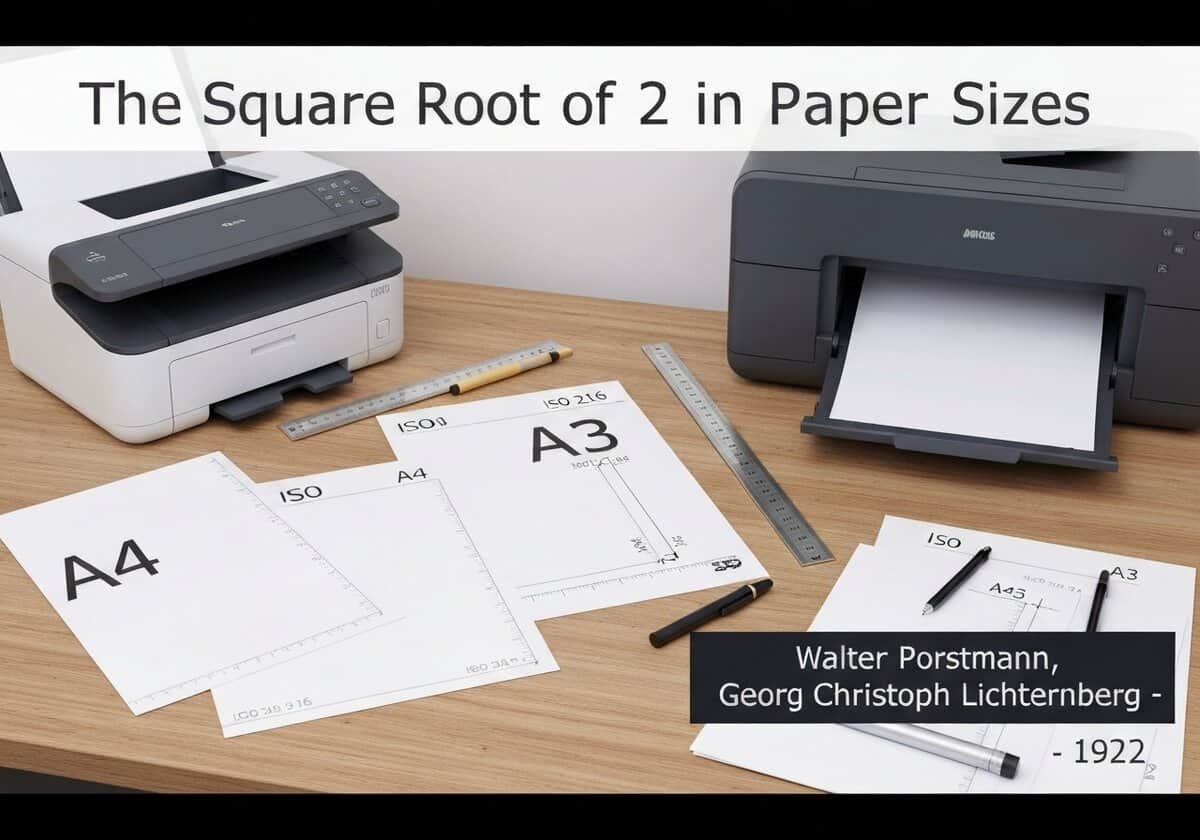
ISO 216 paper sizes A4 and A3 demonstrating the square root of 2 aspect ratio.

(generated image for illustration only)

The international standard for paper sizes, ISO 216 (e.g., A4, A3), is based on the square root of 2. The aspect ratio of every sheet is \(1:\sqrt{2}\). This unique property means that when a sheet is cut or folded in half parallel to its shorter sides, the resulting two smaller sheets have the exact same \(1:\sqrt{2}\) aspect ratio as the original.


The system, first proposed by Georg Christoph Lichtenberg in 1786 and later standardized in Germany as DIN 476 in 1922 by Walter Porstmann, is built on two principles: the total area of the base size (A0) is one square meter, and the ratio of the sides is \(1:\sqrt{2}\). Let the sides of an A0 sheet be \(x\) and \(y\). We have the system of equations: \(y/x = \sqrt{2}\) and \(xy = 1\). Solving this gives the dimensions of A0 as approximately 841 by 1189 millimeters.

Each subsequent size in the A series (A1, A2, A3, A4, etc.) is created by halving the previous size along its longer dimension. For example, cutting an A3 sheet in half produces two A4 sheets. Because of the \(\sqrt{2}\) aspect ratio, these new A4 sheets have the same proportions as the original A3 sheet. This elegant mathematical property is incredibly practical. It allows for easy scaling of documents on photocopiers and printers (e.g., enlarging from A4 to A3 is a simple 141% or \(\sqrt{2}\) magnification) without cropping or leaving empty margins. This efficiency and simplicity have led to its near-universal adoption worldwide, with the notable exceptions of the United States and Canada.

UNESCO Nomenclature: 3307
– Industrial engineering

Type

Abstract System

Disruption

Substantial

Usage

Widespread Use

Precursors

  • understanding of aspect ratios and geometric similarity
  • the mathematical properties of the square root of 2
  • the need for industrial standardization during the early 20th century
  • earlier proposals for standardized paper, such as by georg christoph lichtenberg in 1786

Applications

  • global standardization of paper for printing and copying
  • efficient scaling of documents without distortion (e.g., enlarging a4 to a3)
  • reduction of paper waste in the printing industry
  • simplified design of binders, folders, and envelopes
  • architectural drawing standards

Patents:

NA

Potential Innovations Ideas

Due to scrapping bot traffic, currently more than 40k per day, this content is reserved to community members.
> Login < or > Register < (100% free) to access this, so as all other restricted content and tools.

Related to: ISO 216, A4 paper, aspect ratio, paper size, standardization, Walter Porstmann, printing, scaling, document, design.

Historical Context

The Square Root of 2 in Paper Sizes

1920
1920
1920
1922
1924
1927
1930
1910
1920
1920
1920
1922
1925-01-01
1930
1930

(if date is unknown or not relevant, e.g. "fluid mechanics", a rounded estimation of its notable emergence is provided)

Related Invention, Innovation & Technical Principles

Full size images and downloads are only available, 100% free, for registered members.

> Login <