Product Design, Manufacturing & Innovation Resources
Home » Liquid Metal Embrittlement (LME)

Liquid Metal Embrittlement (LME)

1930
  • Adolph S. Rehbinder
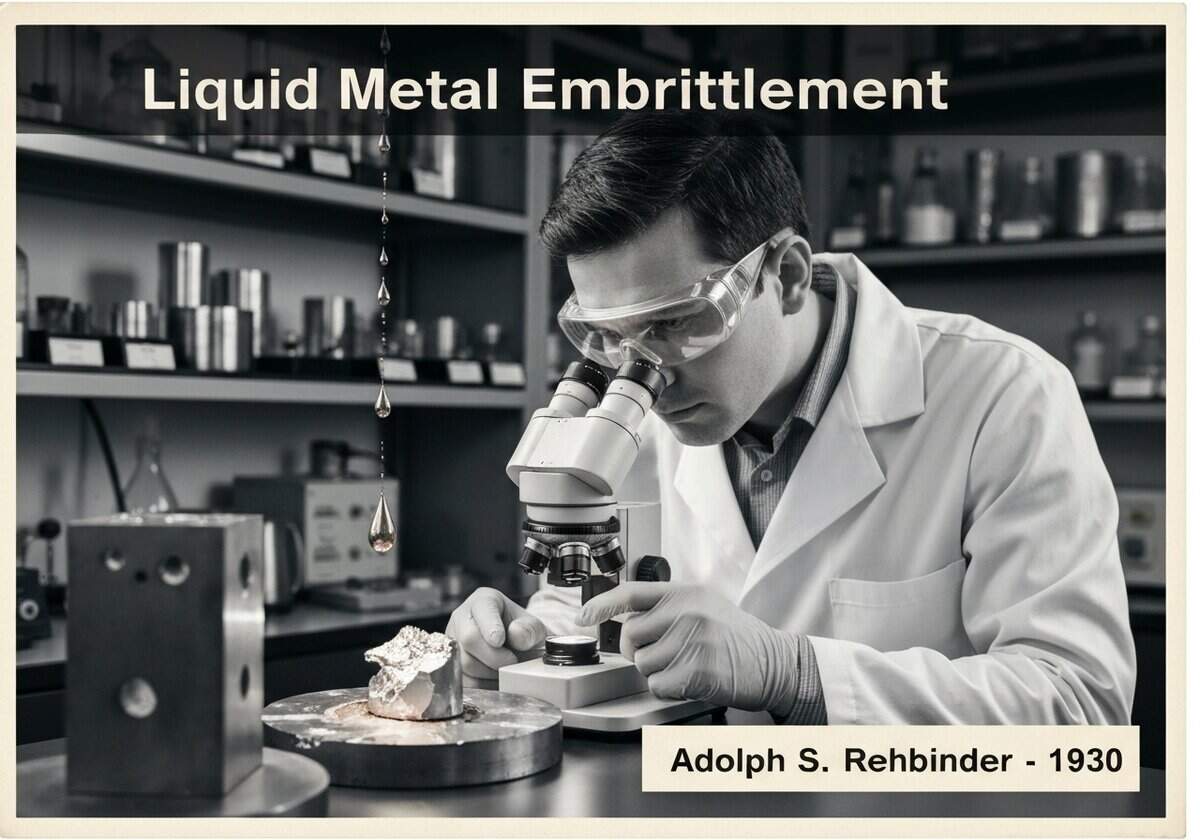
Materials scientist analyzing metal fracture due to liquid metal embrittlement in a laboratory.

(generated image for illustration only)

Liquid metal embrittlement is a phenomenon where a normally ductile solid metal experiences a severe loss of ductility and fails in a brittle manner when wetted by a specific liquid metal while under tensile stress. The failure is often catastrophic and rapid. The mechanism involves the liquid metal atoms adsorbing at a crack tip, which reduces the cohesive strength of the solid’s atomic bonds.


For LME to occur, several conditions must be met: the presence of a tensile stress, intimate contact between the solid and liquid metals, and a specific metallurgical pairing. A classic and dramatic example is the embrittlement of aluminum by liquid gallium. A small drop of gallium on an aluminum part under stress can cause it to fracture almost instantly. The technical novelty of understanding LME was the recognition that fracture could be driven by a surface energy phenomenon rather than bulk material properties alone. The liquid metal atoms effectively ‘unzip’ the atomic bonds at the crack tip by lowering the energy required for crack propagation.

The severity of LME depends on factors like temperature, stress level, and the specific solid-liquid metal couple. The solubility between the two metals is a key factor; systems with low mutual solubility are often highly susceptible. Historically, unexpected failures in structures like galvanized steel frameworks or in components where mercury thermometers broke were later attributed to LME. This knowledge became foundational for materials selection and compatibility assessment in engineering design, especially in aerospace and nuclear fields where dissimilar metals are often in close proximity.

UNESCO Nomenclature: 3308
– Materials science

Type

Physical Process

Disruption

Substantial

Usage

Widespread Use

Precursors

  • thomas young’s work on surface tension and cohesion
  • josiah willard gibbs’s development of thermodynamics and interfacial energy concepts
  • understanding of metallic bonding and crystal structures
  • industrial practices like hot-dip galvanizing and soldering which created opportunities to observe the effect

Applications

  • design guidelines to avoid contact between susceptible metal pairs in high-temperature applications (e.g., heat exchangers)
  • failure analysis in industries using molten metals, such as soldering, brazing, and galvanizing
  • understanding safety risks in nuclear reactors using liquid metal coolants
  • controlled fracture applications for material recycling or demolition

Patents:

NA

Potential Innovations Ideas

Due to scrapping bot traffic, currently more than 40k per day, this content is reserved to community members.
> Login < or > Register < (100% free) to access this, so as all other restricted content and tools.

Related to: liquid metal embrittlement, lme, brittle fracture, gallium, aluminum, mercury, stress corrosion, metallurgy, interfacial energy, adsorption.

Historical Context

Liquid Metal Embrittlement (LME)

1922
1925-01-01
1930
1930
1930
1930
1934
1922
1924
1927
1930
1930
1930
1930
1940

(if date is unknown or not relevant, e.g. "fluid mechanics", a rounded estimation of its notable emergence is provided)

Related Invention, Innovation & Technical Principles

Full size images and downloads are only available, 100% free, for registered members.

> Login <