Product Design, Manufacturing & Innovation Resources
Home » Joule-Thomson Effect

Joule-Thomson Effect

1852
  • James Prescott Joule
  • William Thomson (Lord Kelvin)
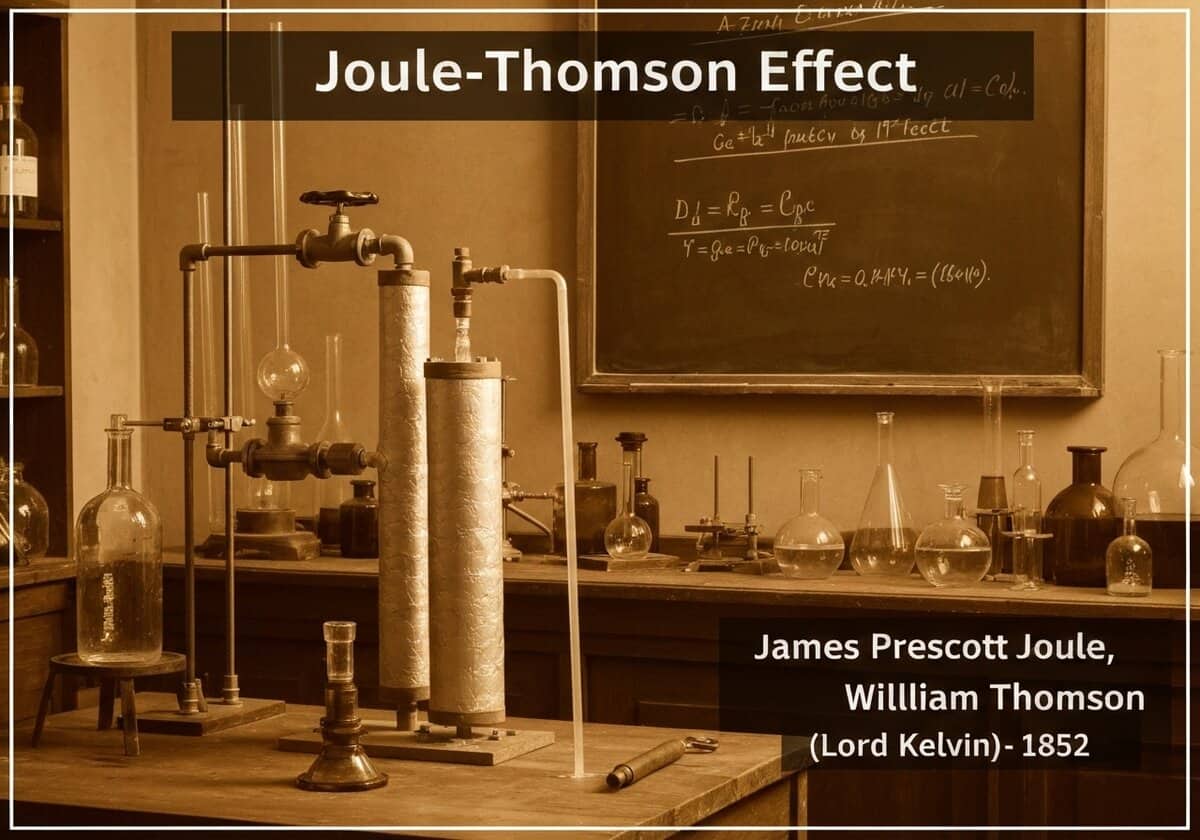
Laboratory apparatus demonstrating the Joule-Thomson effect in thermodynamics.

(generated image for illustration only)

The Joule-Thomson (or Joule-Kelvin) effect describes the temperature change of a real gas when it is forced through a valve or porous plug while kept insulated (an isenthalpic process). At a given pressure, a gas has an inversion temperature. If expanded below this temperature, it cools; if expanded above it, it heats up. This cooling effect is a cornerstone of modern refrigeration and liquefaction.


The effect arises from the work done against intermolecular forces (van der Waals forces) as the gas expands. For an ideal gas, where intermolecular forces are negligible, the Joule-Thomson coefficient \(\mu_{JT} = (\frac{\partial T}{\partial P})_H\) is zero, meaning no temperature change occurs. However, for real gases, these forces are significant. When a gas expands, the average distance between molecules increases. If attractive forces dominate (as they do at lower temperatures), the molecules must do work to overcome these forces, converting internal kinetic energy into potential energy, which results in a temperature decrease. Conversely, at high temperatures, repulsive forces can dominate, and expansion can lead to an increase in temperature. The temperature at which the effect switches from cooling to heating is the inversion temperature. This discovery was crucial for liquefying ‘permanent’ gases like oxygen and nitrogen, which have very low inversion temperatures, requiring pre-cooling before throttling could be effective.

UNESCO Nomenclature: 2212
– Thermodynamics

Type

Physical Principle

Disruption

Foundational

Usage

Widespread Use

Precursors

  • First Law of Thermodynamics (conservation of energy)
  • Concept of internal energy in gases
  • Joule’s earlier experiments on free expansion of gases (Joule expansion)
  • Theories on intermolecular forces (van der Waals forces)

Applications

  • hampson-linde cycle for air liquefaction
  • cryocoolers
  • refrigerators and air conditioning systems
  • liquefaction of hydrogen and helium
  • cryosurgery probes

Patents:

NA

Potential Innovations Ideas

Due to scrapping bot traffic, currently more than 40k per day, this content is reserved to community members.
> Login < or > Register < (100% free) to access this, so as all other restricted content and tools.

Related to: Joule-Thomson effect, throttling, isenthalpic process, inversion temperature, liquefaction, cryogenics, real gas, thermodynamics, refrigeration, Joule-Kelvin effect.

Historical Context

Joule-Thomson Effect

1850
1850
1851
1852
1859
1860
1861
1850
1850
1850
1851
1854
1859
1861
1865

(if date is unknown or not relevant, e.g. "fluid mechanics", a rounded estimation of its notable emergence is provided)

Related Invention, Innovation & Technical Principles

Full size images and downloads are only available, 100% free, for registered members.

> Login <