Product Design, Manufacturing & Innovation Resources
Home » South Atlantic Anomaly (SAA)

South Atlantic Anomaly (SAA)

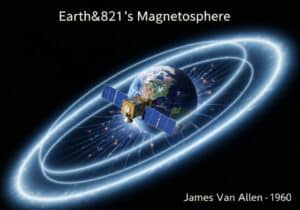
1960
Satellite in low Earth orbit monitoring radiation in the South Atlantic Anomaly region.

(generated image for illustration only)

The South Atlantic Anomaly (SAA) is a large area over the South Atlantic and South America where the Earth’s inner Van Allen radiation belt comes closest to the planet’s surface. In this region, the magnetic field intensity is significantly weaker, about one-third of the global average. This weakness allows charged particles to penetrate to lower altitudes.

The SAA is a direct consequence of the Earth’s magnetic field not being a perfect, centered dipole. The center of the magnetic dipole is offset from the Earth’s geometric center by about 500 km towards the Pacific Ocean. This offset brings the magnetic field lines, and thus the trapped radiation in the Van Allen belts, closer to the surface on the opposite side of the planet, creating the SAA.

For satellites and spacecraft in low Earth orbit, passing through the SAA is a significant operational concern. The increased flux of high-energy protons can cause single-event upsets (SEUs) in digital electronics, leading to data corruption or temporary malfunction. To mitigate this, operators may power down non-essential components when a satellite traverses the anomaly. The Hubble Space Telescope, for example, does not perform observations while passing through the SAA. The International Space Station has extra shielding in certain areas to protect the crew. The SAA is not static; it is drifting westwards and slowly intensifying, consistent with the overall secular variation and decay of the main dipole field.

UNESCO Nomenclature: 2505
– Geophysics

Type

Physical Phenomenon

Disruption

Substantial

Usage

Widespread Use

Precursors

  • discovery of the Van Allen radiation belts (1958)
  • development of satellite technology
  • mapping of the non-dipolar components of Earth’s magnetic field

Applications

  • satellite mission planning to minimize radiation exposure to sensitive electronics
  • radiation dose management for astronauts on the International Space Station
  • informing the design of radiation-hardened components for spacecraft
  • studying the interaction between the radiation belts and the upper atmosphere

Patents:

NA

Potential Innovations Ideas

Due to scrapping bot traffic, currently more than 40k per day, this content is reserved to community members.
> Login < or > Register < (100% free) to access this, so as all other restricted content and tools.

Related to: South Atlantic Anomaly, SAA, Van Allen belt, radiation, magnetic field, low earth orbit, satellite, single-event upset, spacecraft, geomagnetism.

Historical Context

South Atlantic Anomaly (SAA)

1940
1950
1950
1960
1970
1975
1980
1940
1946
1950
1960
1970
1970
1978
1980

(if date is unknown or not relevant, e.g. "fluid mechanics", a rounded estimation of its notable emergence is provided)

Full size images and downloads are only available, 100% free, for registered members.

> Login <