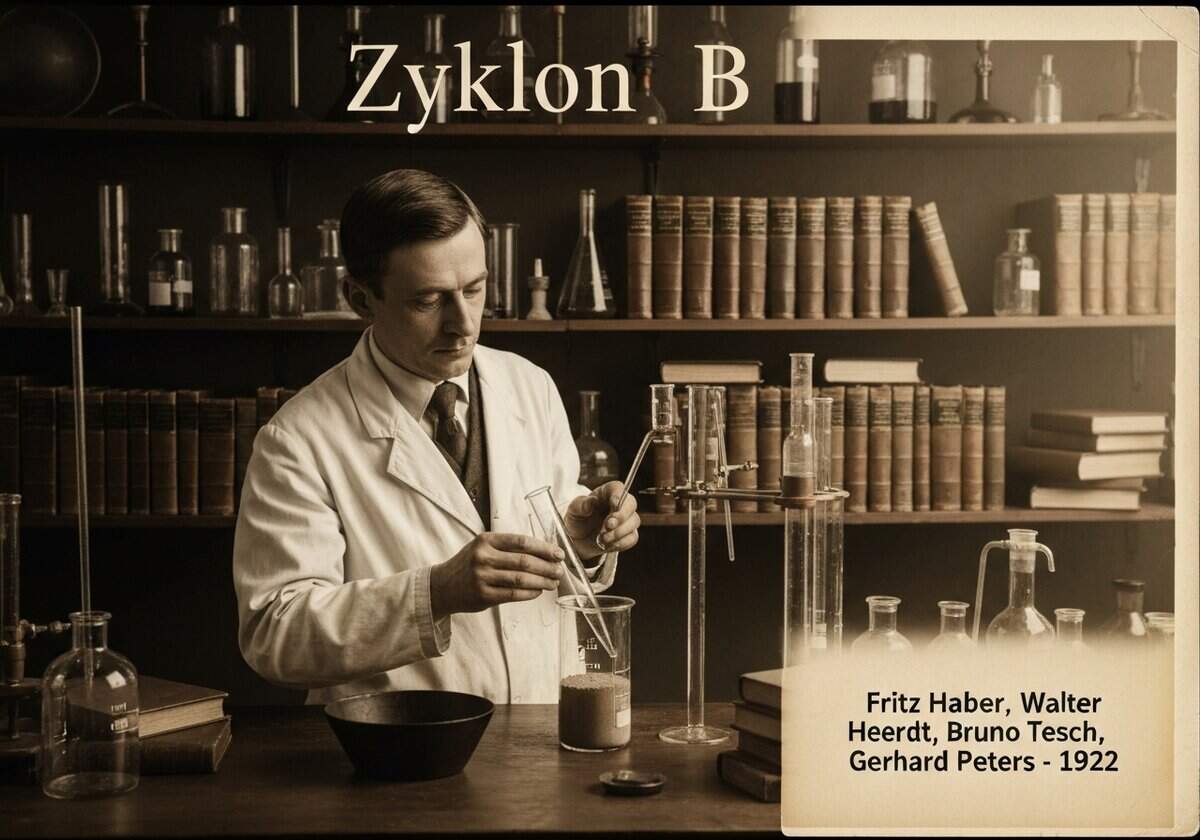
Zyklon B
1922
- Fritz Haber
- Walter Heerdt
- Bruno Tesch
- Gerhard Peters
Zyklon B was a trade name for a cyanide-based pesticide. Its active ingredient was hydrogen cyanide (\(HCN\)), a highly volatile poison. The liquid HCN was adsorbed onto a porous solid carrier, such as diatomaceous earth or wood pulp discs. A stabilizer was added to prevent polymerization, and a warning agent, an eye irritant, was typically included for safety (deliberately removed from the commercial version for the mass murder version).
Despite some fair pesticide applications, it shall only be infamously forever remembered as the gas agent used during WW2 by German Nazis to murder more than 1.1 million people in gas chambers.
Zyklon B’s formulation was an “innovation” in the handling of hydrogen cyanide (HCN), also known as prussic acid. HCN is a liquid with a low boiling point of 26 °C (79 °F), making it extremely volatile and dangerous to transport and apply directly. The key technical challenge was to create a stable, safe-to-handle product that could release the gaseous poison in a controlled manner. The solution, developed at Fritz Haber’s institute in the early 1920s, was to use a principle of adsorption. Liquid HCN was sealed in canisters containing a porous and inert carrier material. Diatomaceous earth, a naturally occurring, soft, siliceous sedimentary rock, was a common choice, as were gypsum pellets or wood pulp discs. This carrier acted like a sponge, holding the HCN. A stabilizer was also added to prevent the HCN from polymerizing, which could lead to an explosive reaction. Additionally, a warning odorant, typically a lachrymatory agent (tear gas) like methyl chloroacetate or chloropicrin, was included. When the canister was opened and the contents exposed to air, the HCN would evaporate from the carrier, with the rate of release dependent on the ambient temperature. A temperature above 26 °C was required for “efficient” release. This formulation turned a highly hazardous liquid into a manageable solid product for fumigation.
UNESCO Nomenclature: 3305
– Chemical technology and engineering
Precursors
- discovery of hydrogen cyanide by Carl Wilhelm Scheele in 1782
- development of industrial-scale synthesis of hydrogen cyanide (e.g., Andrussow process)
- Fritz Haber’s work on chemical warfare during world war I, including chlorine gas
- understanding of adsorption principles on porous materials
- use of cyanide compounds as insecticides in the late 19th century
Applications
- fumigation of ships and buildings
- delousing of clothing to control typhus
- pest control in agriculture
- infamously used as a chemical weapon in German gas chambers during the holocaust (see details)
Potential Innovations Ideas
Due to scrapping bot traffic, currently more than 40k per day, this content is reserved to community members.
> Login < or > Register < (100% free) to access this, so as all other restricted content and tools.
Related to: hydrogen cyanide, Zyklon B, pesticide, fumigation, adsorption, diatomaceous earth, Fritz Haber, prussic acid, chemical formulation, lachrymator.