Product Design, Manufacturing & Innovation Resources
Home » Oberth Effect

Oberth Effect

1927
  • Hermann Oberth
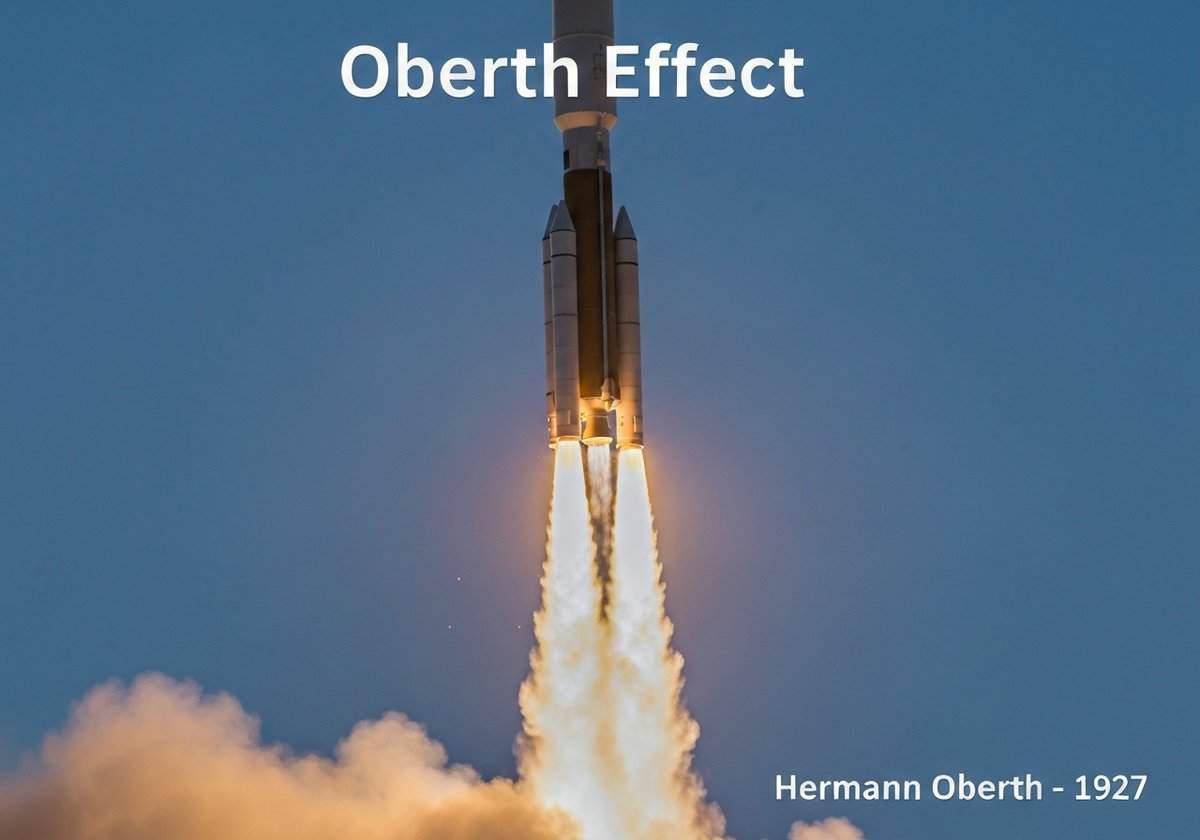
Rocket performing a burn at periapsis demonstrating the Oberth effect in aerospace engineering.

(generated image for illustration only)

The Oberth effect describes how a rocket engine’s use is more efficient at high speeds than at low speeds. A rocket burn performed at high speed, such as at the periapsis of an orbit, generates a greater change in kinetic energy than the same burn at low speed. This is because the propellant itself has kinetic energy before being burned.

The Oberth effect is a consequence of the work-energy theorem. The work done on a rocket by its engine is the thrust force multiplied by the distance traveled during the burn (\(W = F \cdot d\)). At higher speeds, the rocket travels a greater distance during the same burn time. Therefore, the same engine burn (same force, same duration, same delta-v) does more work on the vehicle and results in a larger increase in its kinetic energy (\(\Delta E_k\)).

This effect is most pronounced when a spacecraft is moving fastest, which in an orbit occurs at its lowest point, the periapsis. By firing the engine at periapsis, a spacecraft can gain significantly more orbital energy than if it performed the same burn at apoapsis (the highest, slowest point). This is why interplanetary missions often use a powered flyby or ‘Oberth maneuver’ around a massive body like Jupiter. The spacecraft dives deep into the planet’s gravity well to pick up speed, then fires its engine at maximum velocity to multiply the effect of the burn, flinging it out into the solar system at a much higher final speed than would otherwise be possible. The effect is not about getting more delta-v, but about getting more useful energy out of each unit of delta-v applied.

UNESCO Nomenclature: 3301
– Aerospace engineering

Type

Physical Principle

Disruption

Incremental

Usage

Widespread Use

Precursors

  • the work-energy theorem in classical mechanics
  • Newton’s laws of motion
  • understanding of gravitational potential and kinetic energy
  • early concepts of orbital mechanics from Kepler and Newton

Applications

  • performing orbital insertion burns at periapsis to maximize efficiency
  • designing gravity assist maneuvers for interplanetary probes
  • planning powered flybys to gain maximum velocity
  • optimizing deep-space burns for missions like the parker solar probe

Patents:

NA

Potential Innovations Ideas

Due to scrapping bot traffic, currently more than 40k per day, this content is reserved to community members.
> Login < or > Register < (100% free) to access this, so as all other restricted content and tools.

Related to: Oberth effect, astrodynamics, orbital mechanics, periapsis, gravity assist, powered flyby, specific energy, rocket engine, efficiency, Hermann Oberth.

Historical Context

Oberth Effect

1920
1922
1924
1927
1930
1930
1930
1920
1920
1922
1925-01-01
1930
1930
1930
1930

(if date is unknown or not relevant, e.g. "fluid mechanics", a rounded estimation of its notable emergence is provided)

Related Invention, Innovation & Technical Principles

Full size images and downloads are only available, 100% free, for registered members.

> Login <