Product Design, Manufacturing & Innovation Resources
Home » Log Mean Temperature Difference (LMTD)

Log Mean Temperature Difference (LMTD)

1910
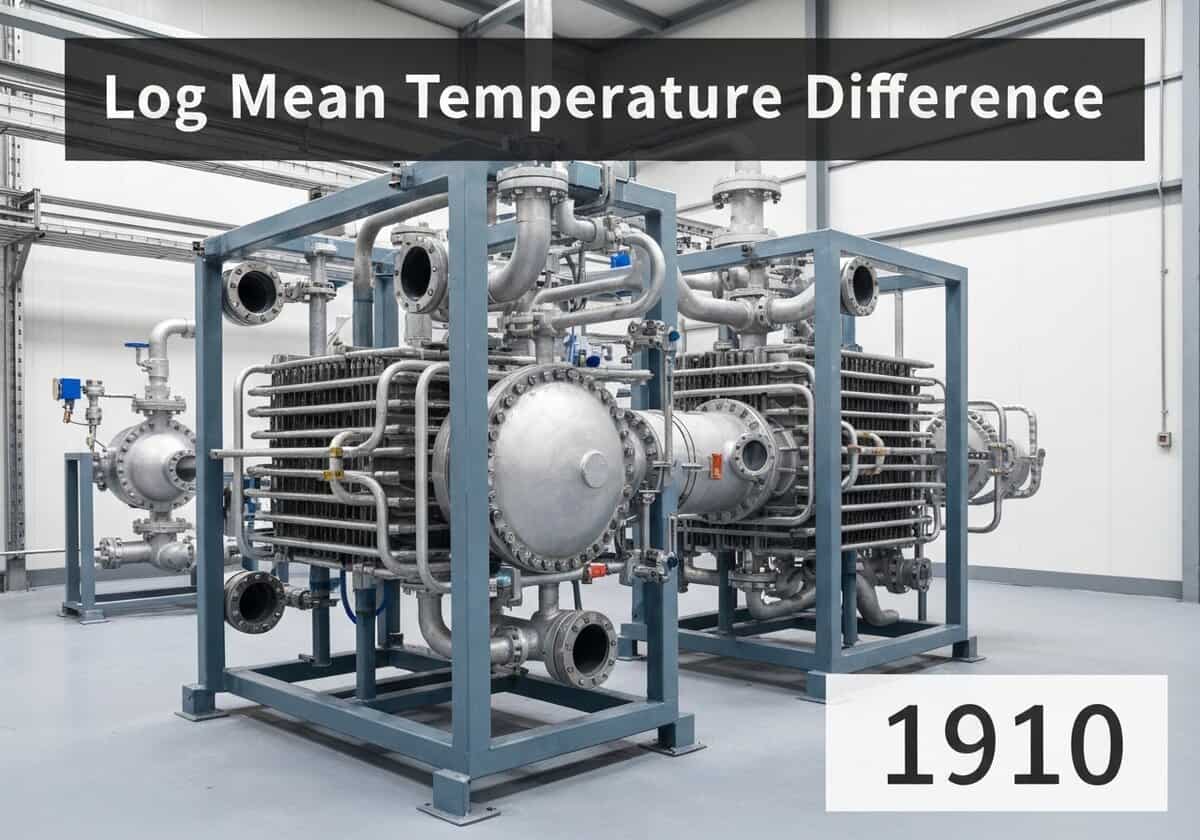
Shell and tube heat exchanger demonstrating Log Mean Temperature Difference in thermodynamics.

(generated image for illustration only)

The Log Mean Temperature Difference (LMTD) is the effective mean temperature difference for heat transfer in heat exchangers, particularly for counter-flow and parallel-flow arrangements. It is a logarithmic average of the temperature difference between the hot and cold fluids at each end. The LMTD is calculated using the formula: \(\Delta T_{LM} = \frac{\Delta T_A – \Delta T_B}{\ln(\Delta T_A / \Delta T_B)}\).


The LMTD method is a cornerstone of heat exchanger analysis. It arises from the integration of the heat transfer rate equation along the length of the exchanger, assuming constant fluid properties and overall heat transfer coefficient. The fundamental heat transfer equation is \(Q = U A \Delta T_{LM}\), where Q is the rate of heat transfer, U is the overall heat transfer coefficient, and A is the heat transfer surface area. The LMTD correctly accounts for the non-linear temperature profile of the fluids as they flow through the exchanger. For a counter-current flow exchanger, \(\Delta T_A\) and \(\Delta T_B\) are the temperature differences at the two ends of the exchanger. For a parallel flow exchanger, the same formula applies, but the temperature differences are calculated differently based on the inlet and outlet positions. The counter-flow arrangement is generally more efficient as it yields a higher LMTD for given inlet and outlet temperatures, allowing for a smaller required surface area A for the same heat duty Q. However, when the temperature difference at one end is equal to the other, the LMTD is simply that temperature difference. If one of the temperature differences is zero, the LMTD is mathematically undefined, but in practice, this represents a limit where heat transfer ceases to be effective. For more complex geometries like cross-flow or multi-pass shell-and-tube exchangers, a correction factor F is applied to the LMTD, such that \(\Delta T_{eff} = F \cdot \Delta T_{LM, counterflow}\).

UNESCO Nomenclature: 3328
– Thermodynamics

Type

Abstract System

Disruption

Incremental

Usage

Widespread Use

Precursors

  • Fourier’s law of heat conduction (1822)
  • first law of thermodynamics (conservation of energy)
  • Newton’s law of cooling
  • development of calculus for integration and logarithmic functions

Applications

  • design and performance analysis of shell and tube heat exchangers
  • sizing of industrial boilers and condensers
  • optimization of hvac systems
  • thermal management in power plants
  • chemical process engineering calculations

Patents:

NA

Potential Innovations Ideas

Due to scrapping bot traffic, currently more than 40k per day, this content is reserved to community members.
> Login < or > Register < (100% free) to access this, so as all other restricted content and tools.

Related to: LMTD, log mean temperature difference, heat exchanger, thermodynamics, heat transfer, counter-flow, parallel-flow, thermal engineering, nusselt, overall heat transfer coefficient.

Historical Context

Log Mean Temperature Difference (LMTD)

1910
1910
1910
1910
1920
1920
1920
1906
1910
1910
1910
1920
1920
1920
1922

(if date is unknown or not relevant, e.g. "fluid mechanics", a rounded estimation of its notable emergence is provided)

Related Invention, Innovation & Technical Principles

Full size images and downloads are only available, 100% free, for registered members.

> Login <