Product Design, Manufacturing & Innovation Resources
Home » Ideal Gas Law (Statistical Form)

Ideal Gas Law (Statistical Form)

1850
  • Ludwig Boltzmann
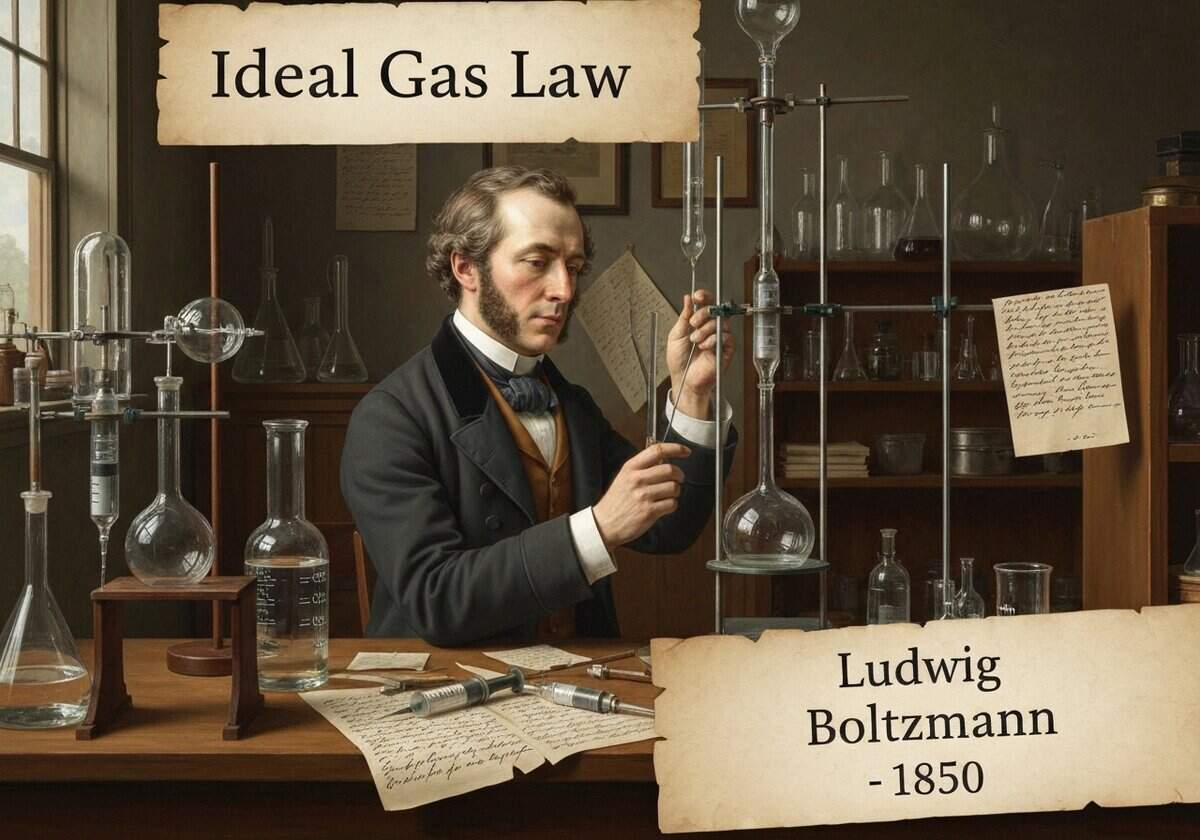
19th-century laboratory scene with Ludwig Boltzmann studying the Ideal Gas Law in statistical thermodynamics.

(generated image for illustration only)

The statistical mechanics formulation of the ideal gas law expresses the relationship in terms of the microscopic properties of the gas. It relates pressure (\(P\)) and volume (\(V\)) to the total number of particles (\(N\)) and the absolute temperature (\(T\)) through the Boltzmann constant (\(k_B\)): \(PV = Nk_BT\).

While the molar form of the ideal gas law (\(PV = nRT\)) is convenient for chemistry and macroscopic thermodynamics, the statistical form (\(PV = Nk_BT\)) provides a direct link to the microscopic world of atoms and molecules. In this equation, \(N\) is the total number of particles (atoms or molecules) in the gas, and \(k_B\) is the Boltzmann constant, a fundamental constant in physics named after Ludwig Boltzmann. The Boltzmann constant acts as a bridge between the macroscopic energy scale (related to temperature \(T\)) and the microscopic energy scale of individual particles. Its value is approximately \(1.38 \times 10^{-23}\) J/K.

This form of the law arises directly from the principles of statistical mechanics and the kinetic theory of gases. It highlights that the macroscopic pressure of a gas is a direct consequence of the collective motion of its constituent particles. The two forms of the ideal gas law are equivalent, connected by the relationship between the universal gas constant (\(R\)), the Boltzmann constant (\(k_B\)), and Avogadro’s number (\(N_A\)), which is the number of particles per mole: \(R = N_A k_B\). The statistical form is preferred in fields like condensed matter physics, plasma physics, and astrophysics, where it is more natural to consider the number of individual particles rather than the number of moles.

UNESCO Nomenclature: 2210
– Thermodynamics

Type

Abstract System

Disruption

Foundational

Usage

Widespread Use

Precursors

  • Ideal Gas Law (molar form)
  • Kinetic Theory of Gases (Clausius, Maxwell)
  • Development of statistical methods in physics
  • Avogadro’s hypothesis

Applications

  • statistical mechanics modeling
  • simulations of molecular dynamics
  • connecting macroscopic thermodynamic properties to microscopic particle behavior
  • plasma physics
  • astrophysics (modeling stellar atmospheres)

Patents:

NA

Potential Innovations Ideas

Due to scrapping bot traffic, currently more than 40k per day, this content is reserved to community members.
> Login < or > Register < (100% free) to access this, so as all other restricted content and tools.

Related to: statistical mechanics, Boltzmann constant, kinetic theory of gases, ideal gas, pressure, volume, temperature, Ludwig Boltzmann, microscopic properties, particle number.

Historical Context

Ideal Gas Law (Statistical Form)

1850
1850
1850
1850
1851
1852
1859
1850
1850
1850
1850
1850
1851
1854
1859

(if date is unknown or not relevant, e.g. "fluid mechanics", a rounded estimation of its notable emergence is provided)

Related Invention, Innovation & Technical Principles

Full size images and downloads are only available, 100% free, for registered members.

> Login <