Product Design, Manufacturing & Innovation Resources
Home » Lead-Acid Battery Chemistry

Lead-Acid Battery Chemistry

1859
  • Gaston Planté
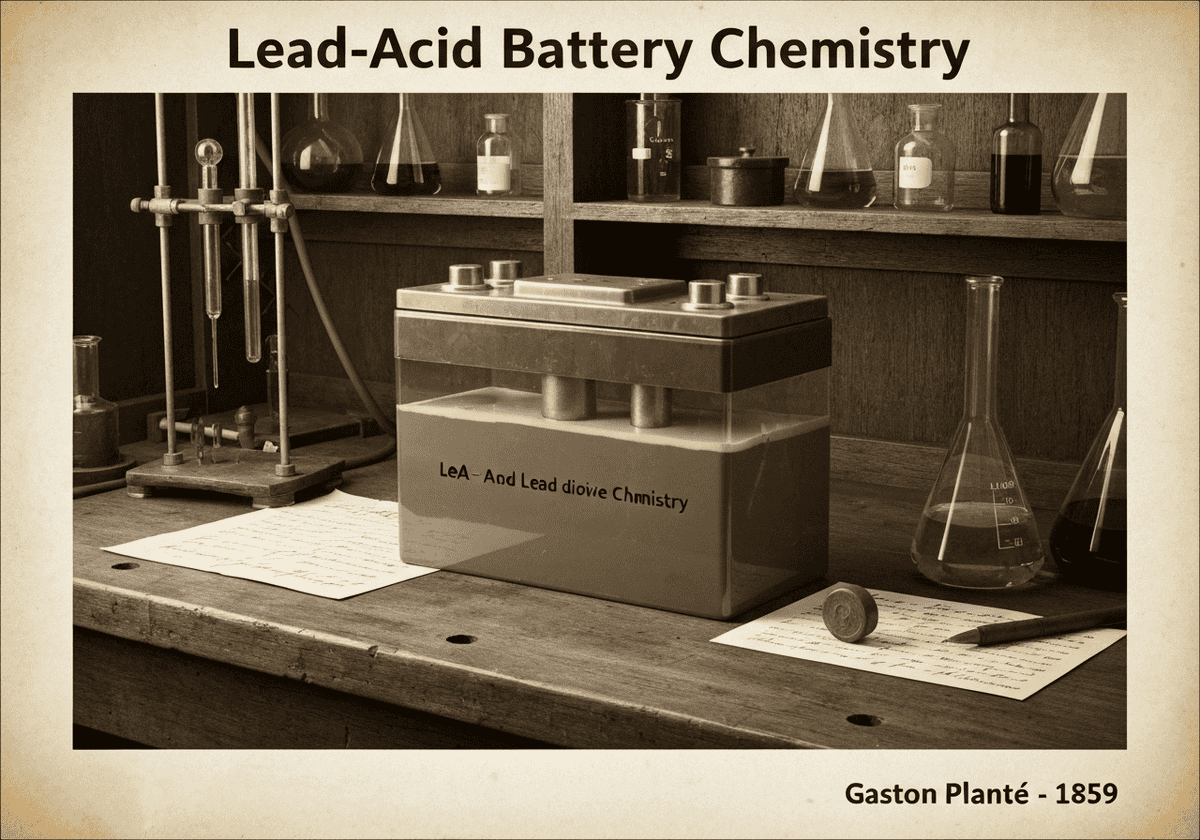
Lead-acid battery with lead anode and lead dioxide cathode in a historical lab setting.

(generated image for illustration only)

The first commercially successful rechargeable battery. It uses a lead (Pb) anode, a lead dioxide (PbO₂) cathode, and a sulfuric acid (H₂SO₄) electrolyte. During discharge, both electrodes are converted into lead sulfate (PbSO₄), and the sulfuric acid is consumed. This process is chemically reversible by applying an external current, making it a practical and robust energy storage system.


The lead-acid battery’s operation is based on a reversible double sulfate reaction. In a fully charged state, the negative electrode is pure, spongy lead (Pb), and the positive electrode is lead dioxide (PbO₂). Both are immersed in an electrolyte of approximately 37% sulfuric acid (H₂SO₄) in water.

During discharge, the following half-reactions occur. At the anode: \(Pb(s) + HSO_4^-(aq) \rightarrow PbSO_4(s) + H^+(aq) + 2e^-\). At the cathode: \(PbO_2(s) + HSO_4^-(aq) + 3H^+(aq) + 2e^- \rightarrow PbSO_4(s) + 2H_2O(l)\). In both reactions, the active material is converted to lead sulfate, and sulfuric acid is consumed while water is produced. This consumption of sulfuric acid causes the specific gravity (density) of the electrolyte to decrease, providing a simple and effective way to estimate the battery’s state of charge using a hydrometer.

To recharge the battery, an external voltage is applied, forcing the reactions to run in reverse. Lead sulfate on the negative plate is converted back to lead, and lead sulfate on the positive plate is converted back to lead dioxide. The water is consumed, and sulfuric acid is regenerated, increasing the electrolyte’s specific gravity. Despite its low energy-to-weight ratio and the environmental hazards of lead, the technology’s low cost, reliability, and ability to supply high surge currents have ensured its continued widespread use, especially in automotive applications.

UNESCO Nomenclature: 2203
– Electrochemistry

Type

Chemical Process

Disruption

Revolutionary

Usage

Widespread Use

Precursors

  • Discovery of electrolysis and the reversibility of some chemical reactions
  • Daniell Cell and other non-rechargeable galvanic cells
  • Development of dynamo generators capable of providing a direct current for recharging
  • Improved manufacturing techniques for lead plates

Applications

  • automotive starting, lighting, and ignition (SLI) batteries
  • uninterruptible power supplies (UPS) for data centers and hospitals
  • emergency lighting systems
  • off-grid power systems for remote homes
  • propulsion for forklifts and golf carts

Patents:

NA

Potential Innovations Ideas

Due to scrapping bot traffic, currently more than 40k per day, this content is reserved to community members.
> Login < or > Register < (100% free) to access this, so as all other restricted content and tools.

Related to: lead-acid, rechargeable battery, SLI, sulfuric acid, lead dioxide, anode, cathode, gaston planté.

Historical Context

Lead-Acid Battery Chemistry

1850
1851
1852
1859
1860
1861
1865
1850
1850
1851
1854
1859
1861
1865
1868

(if date is unknown or not relevant, e.g. "fluid mechanics", a rounded estimation of its notable emergence is provided)

Related Invention, Innovation & Technical Principles

Full size images and downloads are only available, 100% free, for registered members.

> Login <