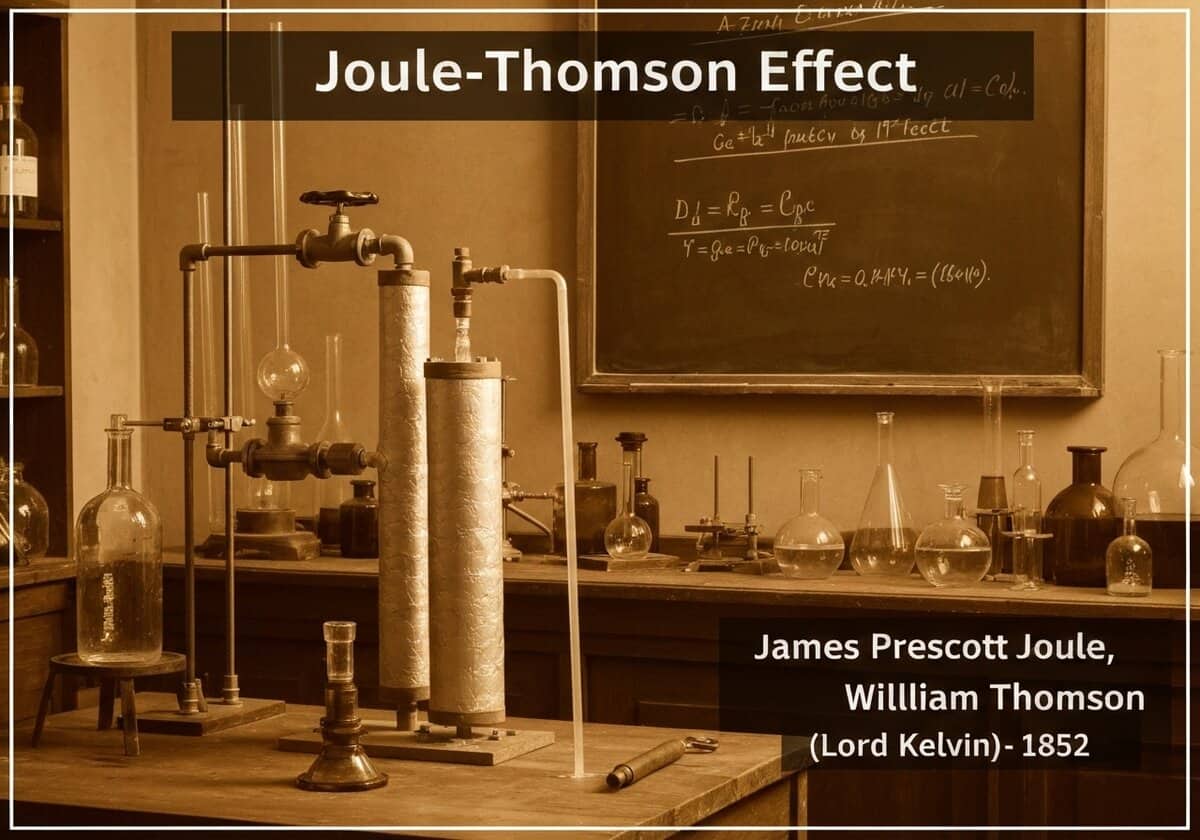
ジュール・トムソン効果(またはジュール・ケルビン効果)は、断熱された状態でバルブや多孔質プラグを通して実際の気体を強制的に通過させたときの気体の温度変化(等エンタルピー過程)を説明するものです。 プレッシャー気体には反転温度が存在する。この温度より低い温度で膨張させると冷却され、高い温度で膨張させると加熱される。この冷却効果は、現代の冷凍技術と液化技術の基礎となっている。


(画像はイメージです)
ジュール・トムソン効果(またはジュール・ケルビン効果)は、断熱された状態でバルブや多孔質プラグを通して実際の気体を強制的に通過させたときの気体の温度変化(等エンタルピー過程)を説明するものです。 プレッシャー気体には反転温度が存在する。この温度より低い温度で膨張させると冷却され、高い温度で膨張させると加熱される。この冷却効果は、現代の冷凍技術と液化技術の基礎となっている。

The effect arises from the work done against intermolecular forces (van der Waals forces) as the gas expands. For an ideal gas, where intermolecular forces are negligible, the Joule-Thomson coefficient [latex]\mu_{JT} = (\frac{\partial T}{\partial P})_H[/latex] is zero, meaning no temperature change occurs. However, for real gases, these forces are significant. When a gas expands, the average distance between molecules increases. If attractive forces dominate (as they do at lower temperatures), the molecules must do work to overcome these forces, converting internal kinetic energy into potential energy, which results in a temperature decrease. Conversely, at high temperatures, repulsive forces can dominate, and expansion can lead to an increase in temperature. The temperature at which the effect switches from cooling to heating is the inversion temperature. This discovery was crucial for liquefying ‘permanent’ gases like oxygen and nitrogen, which have very low inversion temperatures, requiring pre-cooling before throttling could be effective.
ボットによるトラフィック(現在1日あたり4万件以上)を排除するため、このコンテンツはコミュニティメンバー限定となっています。
> ログイン < または > 登録 < (100%無料)でこれにアクセスできます。他のすべての制限付きコンテンツとツールも同様です。
ジュール・トムソン効果
(日付が不明または関連性がない場合、例えば「流体力学」などでは、その注目すべき出現時期の概算値が提示されます。)

フルサイズの画像とダウンロードは、登録会員のみが100%無料で利用できます。
> ログイン <