Product Design, Manufacturing & Innovation Resources
Casa » Joule-Thomson Effect

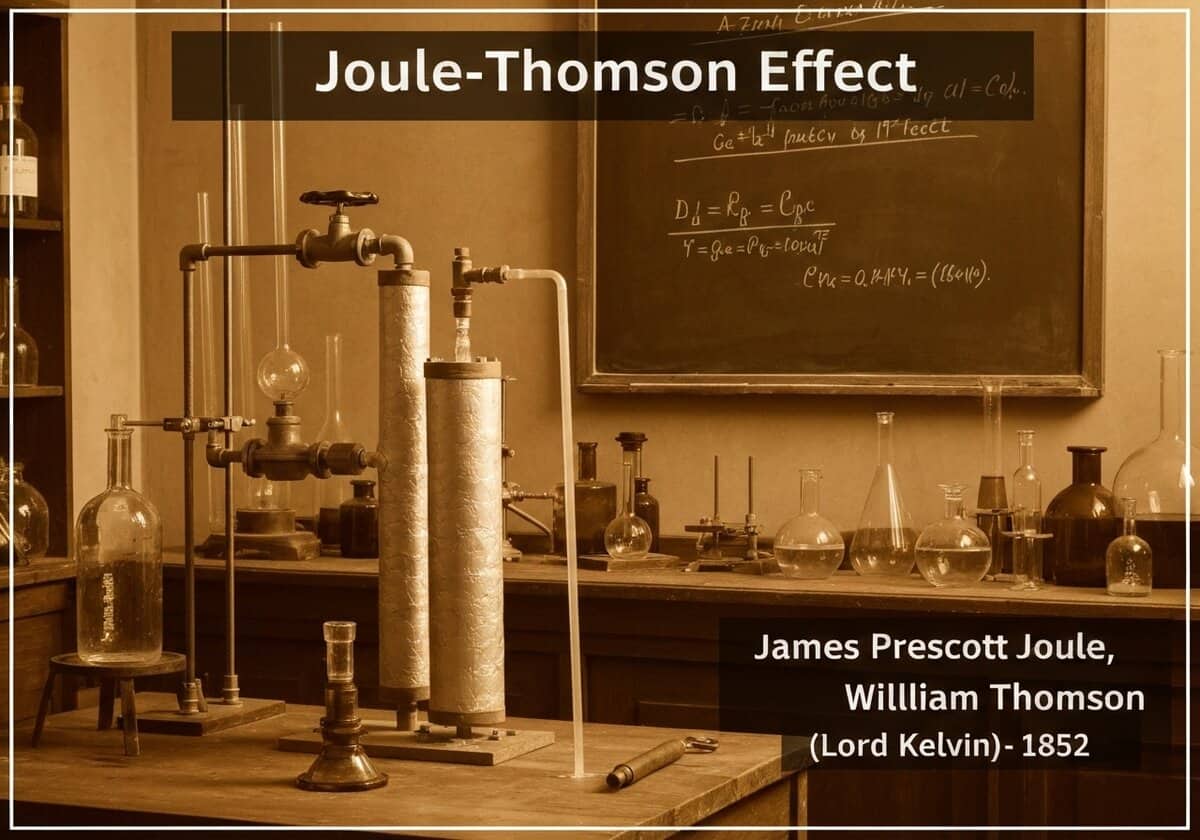
Joule-Thomson Effect

1852
  • James Prescott Joule
  • William Thomson (Lord Kelvin)
Apparecchio di laboratorio che dimostra l'effetto Joule-Thomson in termodinamica.

(Immagine generata a solo scopo illustrativo)

L'effetto Joule-Thomson (o Joule-Kelvin) descrive la variazione di temperatura di un gas reale quando viene forzato attraverso una valvola o un tappo poroso mentre viene mantenuto isolato (un processo isoentalpico). A una data temperatura pressioneUn gas possiede una temperatura di inversione. Se espanso al di sotto di questa temperatura, si raffredda; se espanso al di sopra, si riscalda. Questo effetto di raffreddamento è un principio fondamentale della refrigerazione e della liquefazione moderne.


The effect arises from the work done against intermolecular forces (van der Waals forces) as the gas expands. For an ideal gas, where intermolecular forces are negligible, the Joule-Thomson coefficient [latex]\mu_{JT} = (\frac{\partial T}{\partial P})_H[/latex] is zero, meaning no temperature change occurs. However, for real gases, these forces are significant. When a gas expands, the average distance between molecules increases. If attractive forces dominate (as they do at lower temperatures), the molecules must do work to overcome these forces, converting internal kinetic energy into potential energy, which results in a temperature decrease. Conversely, at high temperatures, repulsive forces can dominate, and expansion can lead to an increase in temperature. The temperature at which the effect switches from cooling to heating is the inversion temperature. This discovery was crucial for liquefying ‘permanent’ gases like oxygen and nitrogen, which have very low inversion temperatures, requiring pre-cooling before throttling could be effective.

UNESCO Nomenclature: 2212
- Termodinamica

Tipo

Principio fisico

Interruzione

Fondamento

Utilizzo

Uso diffuso

Precursori

  • First Law of Thermodynamics (conservation of energy)
  • Concept of internal energy in gases
  • I primi esperimenti di Joule sull'espansione libera dei gas (espansione di Joule)
  • Theories on intermolecular forces (van der Waals forces)

Applicazioni

  • hampson-linde cycle for air liquefaction
  • cryocoolers
  • refrigerators and air conditioning systems
  • liquefaction of hydrogen and helium
  • cryosurgery probes

Brevetti:

NA

Idee e potenziali innovazioni

A causa dell'eliminazione del traffico generato dai bot, che attualmente supera i 40.000 al giorno, questo contenuto è riservato ai membri della community.
> Accedi O > Registrati L'accesso a questo contenuto, così come a tutti gli altri contenuti e strumenti riservati, è (100% gratuito).

Argomenti correlati: effetto Joule-Thomson, laminazione, processo isoentalpico, temperatura di inversione, liquefazione, criogenia, gas reali, termodinamica, refrigerazione, effetto Joule-Kelvin.

Contesto storico

Joule-Thomson Effect

1850
1850
1851
1852
1859
1860
1861
1850
1850
1850
1851
1854
1859
1861
1865

(se la data è sconosciuta o non rilevante, ad esempio "meccanica dei fluidi", viene fornita una stima approssimativa della sua notevole comparsa)

Invenzioni, innovazioni e principi tecnici correlati

Le immagini a grandezza naturale e i download sono disponibili, 100% gratuitamente, solo per i membri registrati.

> Login <