Product Design, Manufacturing & Innovation Resources
Home » Gravitational Lensing

Gravitational Lensing

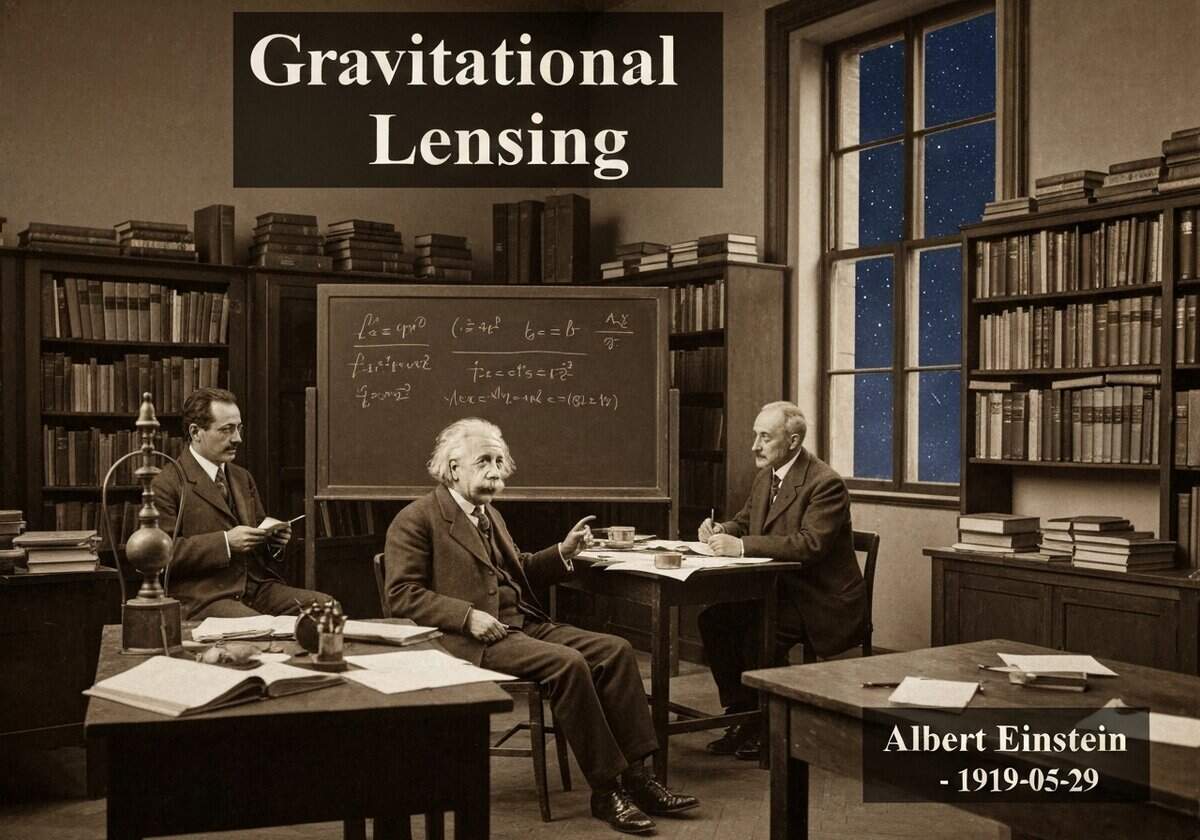
1919-05-29
  • Albert Einstein
Albert Einstein discussing gravitational lensing in a historical laboratory setting.

(generated image for illustration only)

General relativity predicts that the path of light is bent by gravity. When light from a distant source passes a massive object like a galaxy or a star, its path is deflected. This phenomenon, known as gravitational lensing, can magnify, distort, or create multiple images of the background source, acting like a cosmic telescope for observing the distant universe.

Gravitational lensing is a direct consequence of spacetime curvature. A massive object warps the spacetime around it, and light follows the straightest possible path—a geodesic—through this curved spacetime. From our perspective, this path appears bent. The degree of bending depends on the mass of the lensing object and the light’s proximity to it. There are three main classes of lensing. Strong lensing occurs with a massive object and precise alignment, producing multiple images, arcs, or a complete ‘Einstein ring’. Weak lensing involves subtle distortions of background galaxies’ shapes, which can be statistically analyzed to map mass distribution, including dark matter. Microlensing is a temporary brightening of a background star when a smaller object, like a planet, passes in front, briefly focusing its light. This is effective for finding objects that emit little or no light.

The first confirmation came in 1919 during a solar eclipse. Expeditions led by Sir Arthur Eddington and Sir Frank Dyson observed starlight passing near the Sun and confirmed its position was shifted by the amount predicted by Einstein’s theory. This result catapulted Einstein to international fame. Today, gravitational lensing is a fundamental tool in astronomy and cosmology, allowing scientists to weigh galaxy clusters, probe the distant universe by magnifying faint objects, and discover celestial bodies that would otherwise be undetectable.

UNESCO Nomenclature: 2211
– Relativity

Type

Abstract System

Disruption

Substantial

Usage

Widespread Use

Precursors

  • Newtonian prediction of light deflection (half the GR value)
  • Einstein’s theory of general relativity
  • Photography and astronomical observation techniques

Applications

  • mapping the distribution of dark matter
  • detecting exoplanets through microlensing
  • observing extremely distant galaxies and quasars
  • measuring the hubble constant and the expansion rate of the universe
  • testing the predictions of general relativity

Patents:

NA

Potential Innovations Ideas

Due to scrapping bot traffic, currently more than 40k per day, this content is reserved to community members.
> Login < or > Register < (100% free) to access this, so as all other restricted content and tools.

Related to: gravitational lensing, general relativity, dark matter, spacetime, light deflection, einstein ring, microlensing, cosmology.

Historical Context

Gravitational Lensing

1915-11
1916
1918
1919-05-29
1920
1920
1921
1915
1916
1917
1918
1920
1920
1921
1922

(if date is unknown or not relevant, e.g. "fluid mechanics", a rounded estimation of its notable emergence is provided)

Related Invention, Innovation & Technical Principles

Full size images and downloads are only available, 100% free, for registered members.

> Login <