정수론의 핵심 결과 중 하나는 소수 p가 두 정수 a와 b의 곱을 나누면 p는 적어도 두 정수 중 하나를 나눈다는 것입니다. 즉, p | ab이면 p | a[/latex]이거나 p | b[/latex]입니다. 이 성질은 기본 정리의 유일성 부분을 증명하는 데 필수적입니다. 산술 정리.
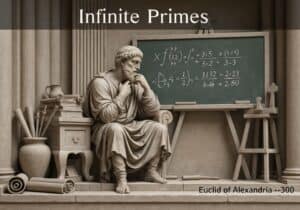
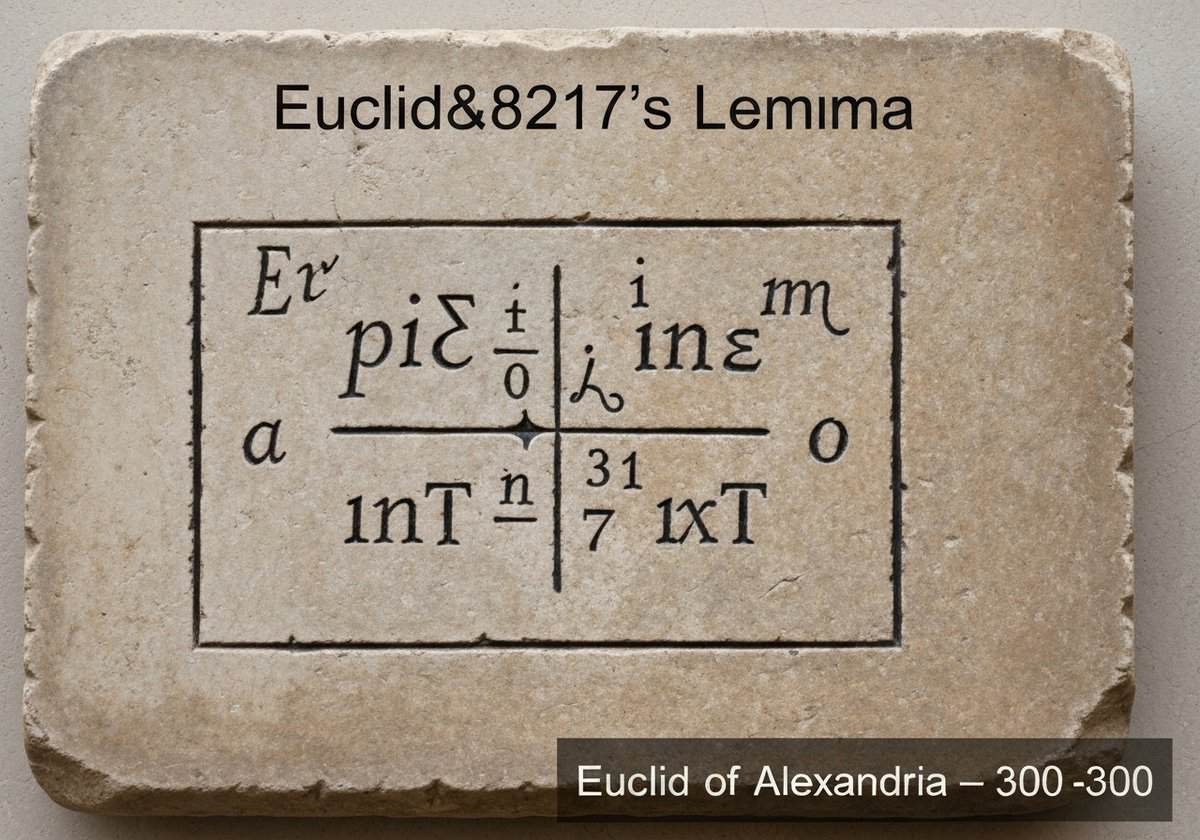
(설명을 위한 생성된 이미지입니다)
정수론의 핵심 결과 중 하나는 소수 p가 두 정수 a와 b의 곱을 나누면 p는 적어도 두 정수 중 하나를 나눈다는 것입니다. 즉, p | ab이면 p | a[/latex]이거나 p | b[/latex]입니다. 이 성질은 기본 정리의 유일성 부분을 증명하는 데 필수적입니다. 산술 정리.

Euclid’s Lemma is Proposition 30 in Book VII of his *Elements*. Its proof typically relies on another fundamental result, Bézout’s identity, which states that the greatest common divisor (GCD) of two integers `a` and `b` can be expressed as a linear combination `ax + by` for some integers `x` and `y`. The proof of the lemma proceeds as follows: Assume a prime `p` divides `ab`. If `p` does not divide `a`, then `p` and `a` are coprime (their GCD is 1), since the only divisors of `p` are 1 and `p`. By Bézout’s identity, there exist integers `x` and `y` such that `px + ay = 1`. Multiplying this entire equation by `b` gives `pbx + aby = b`. We know that `p` divides `pbx` (trivially) and `p` divides `aby` (by our initial assumption that `p` divides `ab`). Therefore, `p` must divide their sum, which is `b`. This completes the proof.
This lemma is the critical step in establishing the uniqueness of prime factorizations. Without it, one could potentially have two different sets of prime factors for the same number. The lemma ensures that if a prime appears in one factorization, it must also appear in any other factorization of the same number. The property described in the lemma is now used to define the more general concept of a ‘prime element’ in abstract algebra and ring theory, distinguishing it from an ‘irreducible element’.
현재 하루 4만 건이 넘는 봇 트래픽을 차단하기 위해 이 콘텐츠는 커뮤니티 회원만 이용할 수 있습니다.
> 로그인 < 또는 >등록 < 이 콘텐츠를 비롯한 모든 제한된 콘텐츠와 도구는 (100% 무료로) 이용할 수 있습니다.
유클리드의 보조정리
(날짜를 알 수 없거나 관련이 없는 경우, 예를 들어 "유체역학"의 경우, 주목할 만한 등장 시기를 대략적으로 추정하여 제공합니다.)

고화질 이미지 및 다운로드는 등록된 회원에게만 100% 무료로 제공됩니다.
> 로그인 <