Product Design, Manufacturing & Innovation Resources
Home » Design for X (DFX)

Design for X (DFX)

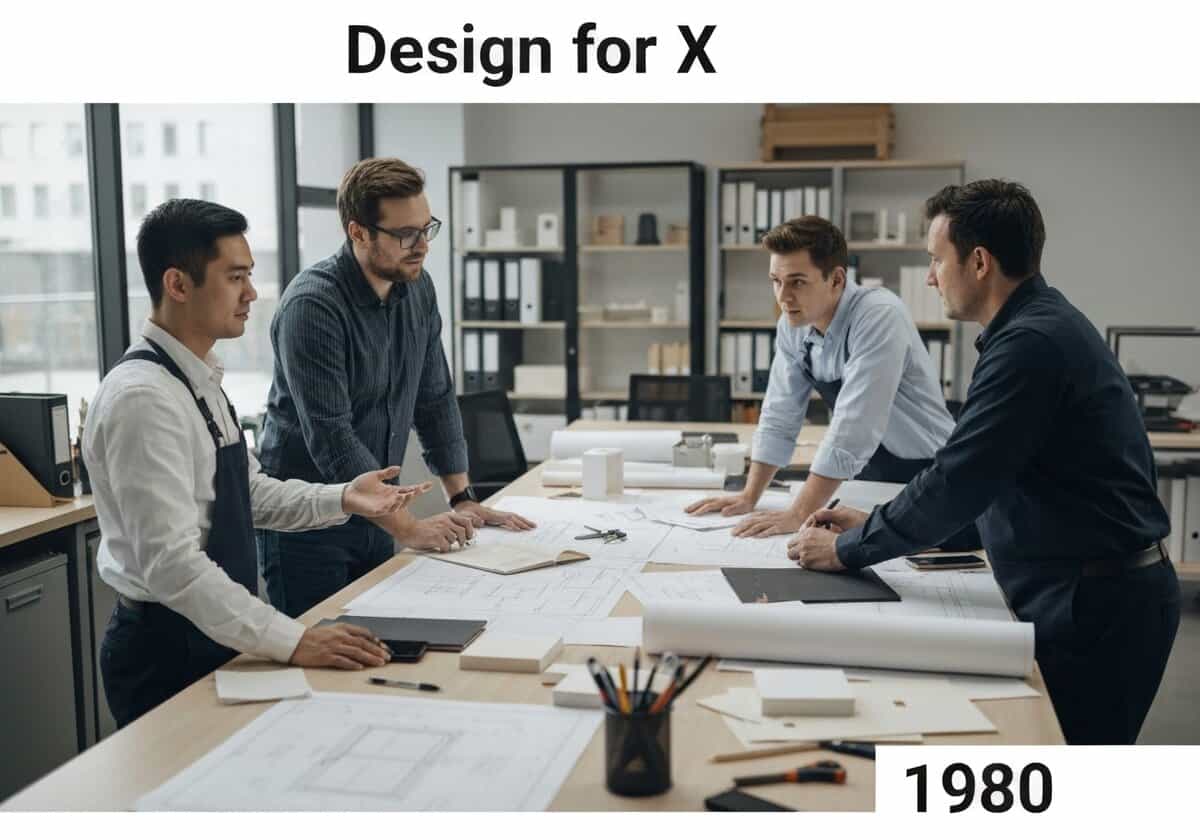
1980
Industrial Technology design office with engineers optimizing flat-pack furniture for assembly.

(generated image for illustration only)

A design methodology where ‘X’ represents a specific product life cycle objective. DFX encompasses a collection of guidelines and techniques aimed at optimizing a product’s design for a particular goal, such as manufacturability (DFM), assembly (DFA), reliability (DFR), or sustainability (DfS). This proactive approach addresses potential issues early in the design phase, reducing costs and improving quality.


Design for X (DFX), also known as Design for Excellence, is a systematic approach that integrates downstream life cycle considerations into the early stages of product design. The ‘X’ is a variable that can stand for numerous objectives. For instance, Design for Manufacturability (DFM) focuses on simplifying the design to make it easier and more cost-effective to produce, often by minimizing part count, using standard components, and designing parts that are easy to handle and process. Design for Assembly (DFA) is closely related, concentrating on reducing assembly time and errors by designing for top-down assembly, minimizing fasteners, and incorporating self-locating features. Other common ‘X’s include Reliability (DFR), which involves selecting robust components and incorporating redundancy; Serviceability (DFS), which ensures parts that are likely to fail are easily accessible for repair or replacement; and Sustainability (also DfS), which considers the environmental impact throughout the product’s life, from material sourcing to end-of-life disposal. By considering these factors upfront, companies can avoid costly redesigns, shorten time-to-market, and deliver a higher quality, more competitive product. It represents a shift from a sequential, ‘over-the-wall’ engineering process to a more concurrent and integrated one.

UNESCO Nomenclature: 3305
– Industrial Technology

Type

Abstract System

Disruption

Substantial

Usage

Widespread Use

Precursors

  • the principles of mass production pioneered by henry ford
  • value engineering techniques developed in the 1940s
  • statistical process control and quality management movements
  • the rise of concurrent engineering methodologies

Applications

  • flat-pack furniture design (ikea) for ease of assembly (dfa)
  • snap-fit enclosures in consumer electronics to reduce screw count and assembly time (dfa)
  • using common components across different car models to streamline manufacturing (dfm)
  • designing products with recycled materials and for easy disassembly (dfs)

Patents:

NA

Potential Innovations Ideas

Due to scrapping bot traffic, currently more than 40k per day, this content is reserved to community members.
> Login < or > Register < (100% free) to access this, so as all other restricted content and tools.

Related to: design for x, dfx, dfm, dfa, design for manufacturing, design for assembly, concurrent engineering, product life cycle.

Historical Context

Design for X (DFX)

1972
1974
1975-06-01
1980
1980
1980
1980
1970
1974
1974
1978
1980
1980
1980
1980

(if date is unknown or not relevant, e.g. "fluid mechanics", a rounded estimation of its notable emergence is provided)

Related Invention, Innovation & Technical Principles

Full size images and downloads are only available, 100% free, for registered members.

> Login <