Product Design, Manufacturing & Innovation Resources
Home » Clausius-Clapeyron Relation

Clausius-Clapeyron Relation

1850
  • Benoît Paul Émile Clapeyron
  • Rudolf Clausius
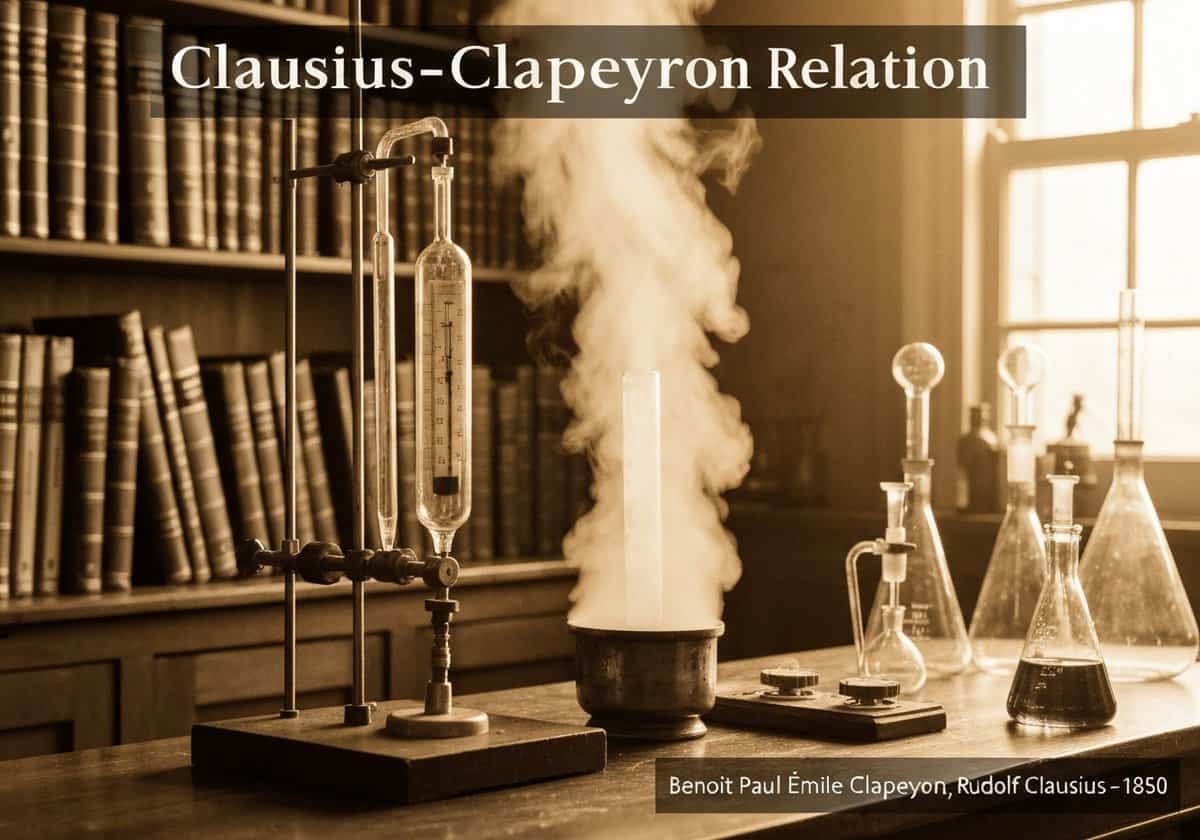
Laboratory apparatus for measuring vapor pressure and temperature in thermodynamics.

(generated image for illustration only)

The Clausius-Clapeyron relation describes the relationship between pressure and temperature for a substance at a phase transition, such as liquid and vapor. For water vapor, it shows that saturation vapor pressure increases exponentially with temperature. The approximate form is \(\frac{dp}{dT} = \frac{L}{T(V_v – V_l)} \approx \frac{L p}{R_v T^2}\), where L is latent heat.


The Clausius-Clapeyron relation is a cornerstone of physical chemistry and thermodynamics, providing a quantitative way to understand phase transitions. It is derived from the principle that at phase equilibrium, the specific Gibbs free energy of the two phases is equal. The relation’s most significant implication for humidity is that it mathematically explains why warm air can ‘hold’ significantly more water vapor than cold air. The saturation vapor pressure—the maximum partial pressure water vapor can exert at a given temperature—is not a linear function of temperature but an exponential one. This exponential increase means that a small rise in temperature leads to a large increase in the air’s capacity for moisture. This is fundamental to many weather phenomena. For example, it explains why tropical regions can be so humid and why convection in the atmosphere, where warm, moist air rises and cools, is such an effective mechanism for producing clouds and precipitation. The cooling of the rising air reduces its saturation vapor pressure, increasing relative humidity until it reaches 100%, triggering condensation. The original work by Clapeyron was based on Carnot’s theory, and it was later put on a firmer theoretical ground by Rudolf Clausius, who introduced the concept of entropy.

UNESCO Nomenclature: 2212
– Thermodynamics

Type

Physical Law

Disruption

Foundational

Usage

Widespread Use

Precursors

  • Sadi Carnot’s work on heat engines and the Carnot cycle
  • the development of the laws of thermodynamics
  • the concept of latent heat, described by Joseph Black
  • early experiments on the relationship between pressure and boiling point

Applications

  • meteorology for modeling cloud formation and atmospheric stability
  • thermodynamics for calculating vapor pressures at different temperatures
  • chemical engineering for designing distillation and evaporation processes
  • geophysics for understanding processes like geyser eruptions
  • refrigeration and heat pump cycle analysis

Patents:

NA

Potential Innovations Ideas

Due to scrapping bot traffic, currently more than 40k per day, this content is reserved to community members.
> Login < or > Register < (100% free) to access this, so as all other restricted content and tools.

Related to: Clausius-Clapeyron, thermodynamics, vapor pressure, phase transition, temperature, latent heat, saturation, meteorology, entropy, Clapeyron.

Historical Context

Clausius-Clapeyron Relation

1850
1850
1850
1850
1851
1854
1859
1850
1850
1850
1850
1851
1852
1859
1860

(if date is unknown or not relevant, e.g. "fluid mechanics", a rounded estimation of its notable emergence is provided)

Related Invention, Innovation & Technical Principles

Full size images and downloads are only available, 100% free, for registered members.

> Login <