Product Design, Manufacturing & Innovation Resources
Home » Enthalpy of Sublimation

Enthalpy of Sublimation

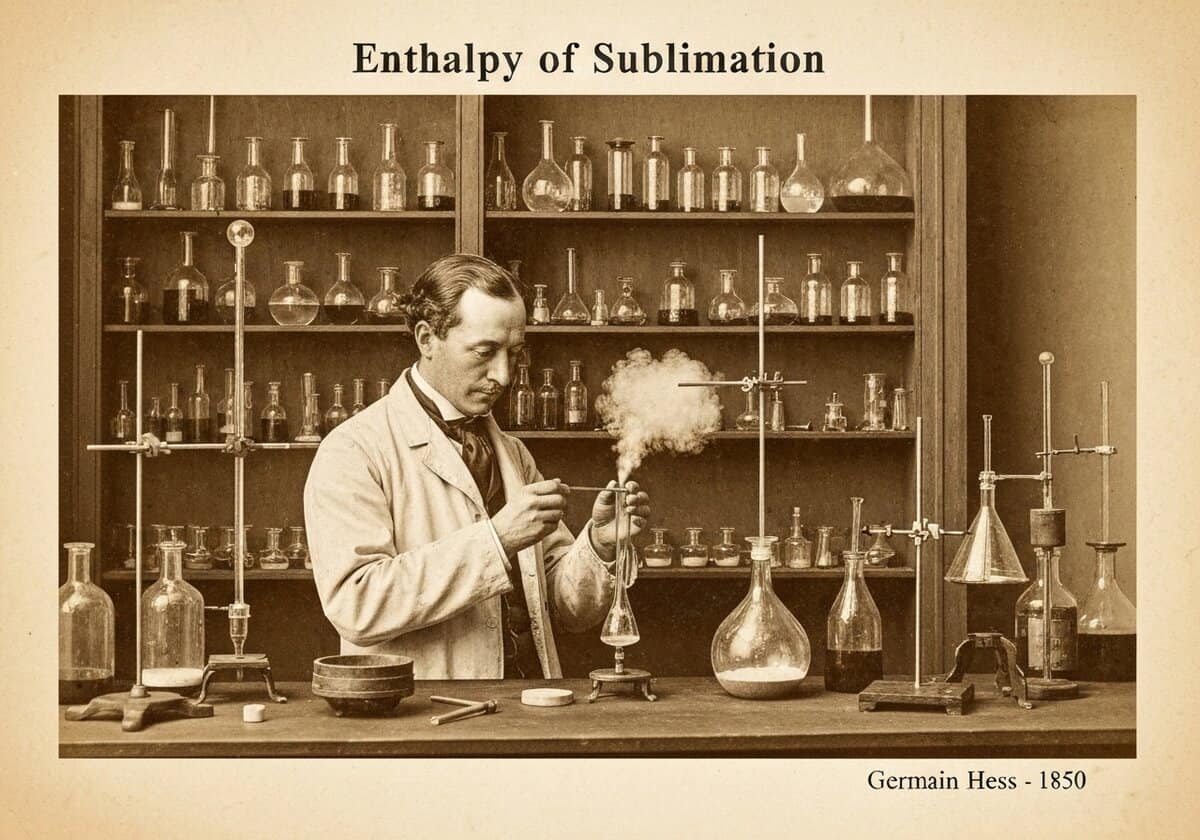
1850
  • Germain Hess
Scientist measuring sublimation in a vintage laboratory, thermodynamics study.

(generated image for illustration only)

The enthalpy of sublimation, \(\Delta H_{\text{sub}}\), is the heat required to convert one mole of a substance from solid to gas at a given temperature and pressure. According to Hess’s Law, since enthalpy is a state function, this energy change is the sum of the enthalpy of fusion (\(\Delta H_{\text{fus}}\)) and the enthalpy of vaporization (\(\Delta H_{\text{vap}}\)).


The relationship \(\Delta H_{\text{sub}} = \Delta H_{\text{fus}} + \Delta H_{\text{vap}}\) is a direct application of Hess’s Law of Constant Heat Summation, a fundamental principle in thermochemistry. This law states that the total enthalpy change during a chemical or physical process is the same regardless of the pathway taken, as long as the initial and final states are the same. In this context, the initial state is the solid phase and the final state is the gas phase. One can imagine two pathways to get from solid to gas: a direct one-step path (sublimation) or a two-step path (melting the solid to a liquid, then vaporizing the liquid to a gas).

The enthalpy change for the direct path is the enthalpy of sublimation, \(\Delta H_{\text{sub}}\). The enthalpy change for the two-step path is the sum of the enthalpy of fusion (\(\Delta H_{\text{fus}}\), for the solid-to-liquid transition) and the enthalpy of vaporization (\(\Delta H_{\text{vap}}\), for the liquid-to-gas transition). Since the initial and final states are identical for both pathways, Hess’s Law dictates that their total enthalpy changes must be equal. This principle is incredibly useful because it allows for the calculation of an unknown enthalpy change from known values. For instance, if the enthalpies of fusion and vaporization are experimentally easier to measure than the enthalpy of sublimation, the latter can be calculated accurately. This data is crucial for chemical engineers and physicists in designing processes and modeling physical phenomena where sublimation is a key factor, such as in material deposition, cryogenics, and astrophysics.

UNESCO Nomenclature: 2210
– Thermodynamics

Type

Physical Law

Disruption

Foundational

Usage

Widespread Use

Precursors

  • Antoine Lavoisier and Pierre-Simon Laplace’s work on calorimetry and heat changes in chemical reactions
  • the development of the concept of enthalpy (heat content)
  • the first law of thermodynamics (conservation of energy)

Applications

  • calculating energy requirements for industrial freeze-drying processes
  • modeling the ablation of heat shields on spacecraft during atmospheric reentry
  • predicting the behavior of comets as they approach the sun
  • designing chemical purification apparatus based on sublimation
  • thermodynamic database development for materials science

Patents:

NA

Potential Innovations Ideas

  • developing novel refrigerants that use the sublimation-deposition cycle for high-efficiency cooling
  • creating self-regulating temperature buffers for sensitive cargo using materials with a specific enthalpy of sublimation
  • designing atmospheric carbon capture systems that freeze co2 and then sublime it for collection
  • formulating energetic materials for rocket propulsion that sublime before combustion for better mixing
  • engineering phase-change materials for thermal energy storage that utilize the solid-gas transition
  • manufacturing biodegradable packaging that disintegrates via controlled sublimation
  • developing advanced fire suppressants that sublime into an inert gas, smothering flames without residue
  • creating artificial snow for indoor ski slopes with tailored sublimation rates for better texture
  • designing sublimating drones for covert surveillance that leave no physical trace after their mission
  • medical cryoablation tools that use sublimation for precise tissue removal
Related to: enthalpy of sublimation, Hess’s law, thermochemistry, phase transition, enthalpy of fusion, enthalpy of vaporization, state function, thermodynamics, heat of sublimation, energy.

Historical Context

Enthalpy of Sublimation

1841
1845
1850
1850
1850
1850
1850
1839-01-01
1842
1847
1850
1850
1850
1850
1850

(if date is unknown or not relevant, e.g. "fluid mechanics", a rounded estimation of its notable emergence is provided)

10th year anniversary

Full size images and downloads are only available, 100% free, for registered members.

> Login <