Product Design, Manufacturing & Innovation Resources
Home » Separation Factor (Alpha)

Separation Factor (Alpha)

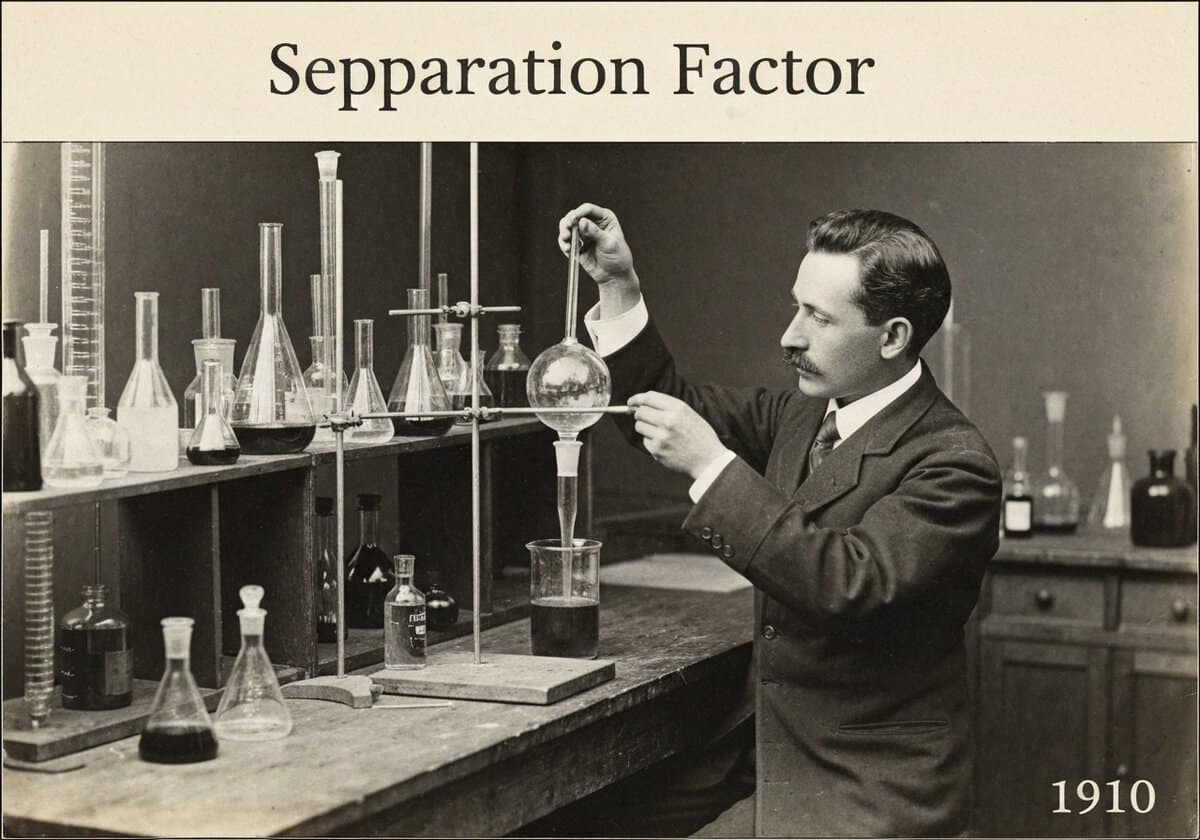
1910
Chemical engineer performing separation processes in a vintage laboratory.

(generated image for illustration only)

The separation factor, α (alpha), quantifies the selectivity of an extraction system for two different solutes, A and B. It is defined as the ratio of their individual distribution ratios, \(\alpha_{A,B} = \frac{D_A}{D_B}\). For a separation to be effective, α must be significantly different from unity. A larger α value implies an easier and more efficient separation.


The separation factor is a dimensionless quantity that provides a direct measure of the theoretical possibility of separating two components using a specific liquid-liquid extraction system. While the distribution ratio (D) indicates how well a single solute is extracted, the separation factor (α) compares the extraction behavior of two solutes. By convention, α is usually calculated with the larger distribution ratio in the numerator, ensuring \(\alpha \ge 1\). If \(\alpha = 1\), the two solutes are extracted equally well, and no separation is possible with that particular solvent system, regardless of the number of extraction stages used.

The magnitude of α dictates the complexity of the required separation process. A very high α value (e.g., >100) means the solutes can be separated easily, often in a single extraction stage. A low α value (e.g., <2) indicates that the solutes have very similar affinities for the solvent, requiring a more complex and energy-intensive process, such as a multi-stage counter-current extraction cascade, to achieve high purity. The goal in developing a new LLE process is often to find a solvent or a complexing agent (an ‘extractant’) that maximizes the separation factor for the desired components. This involves tuning parameters like solvent type, pH, temperature, and the concentration of additives to selectively enhance the distribution ratio of one component over the other.

UNESCO Nomenclature: 3305
– Chemical engineering

Type

Performance Metric

Disruption

Incremental

Usage

Widespread Use

Precursors

  • concept of the distribution ratio (d)
  • fractional distillation principles and the concept of relative volatility
  • chromatographic theory and retention factors
  • advances in coordination chemistry for designing selective ligands

Applications

  • separation of chemically similar rare earth elements
  • purification of isomers in the pharmaceutical industry
  • fractionation of isotopes, such as in nuclear applications
  • design of selective metal recovery processes in hydrometallurgy
  • development of analytical methods for separating complex mixtures

Patents:

NA

Potential Innovations Ideas

  • computational screening of solvents to maximize α for specific solute pairs
  • development of ‘molecularly imprinted’ solvents with tailored cavities for ultra-high selectivity
  • dynamic LLE systems where α is modulated in real-time using external fields
  • using machine learning to predict α from molecular structures of solutes and solvents
  • design of bifunctional extractants that simultaneously bind two different metal ions to achieve complex separations
  • LLE systems for separating plastic micro-particles based on polymer type
  • high-selectivity extraction of valuable proteins from complex biological broths
  • development of chiral ionic liquids to achieve high α for enantiomer separation
  • using nanoparticles as extractants with tunable surface chemistry to control α
  • separation of different isotopologues for applications in medical imaging and research
Related to: separation factor, selectivity, liquid-liquid extraction, distribution ratio, counter-current extraction, hydrometallurgy, rare earth elements, process design, chemical engineering, alpha value.

Historical Context

Separation Factor (Alpha)

1903-05-10
1910
1910
1910
1910
1920
1920
1903
1906
1910
1910
1910
1920
1920
1920

(if date is unknown or not relevant, e.g. "fluid mechanics", a rounded estimation of its notable emergence is provided)

10th year anniversary

Full size images and downloads are only available, 100% free, for registered members.

> Login <