Product Design, Manufacturing & Innovation Resources
Home » Vapor Pressure Enhancement Factor

Vapor Pressure Enhancement Factor

1980
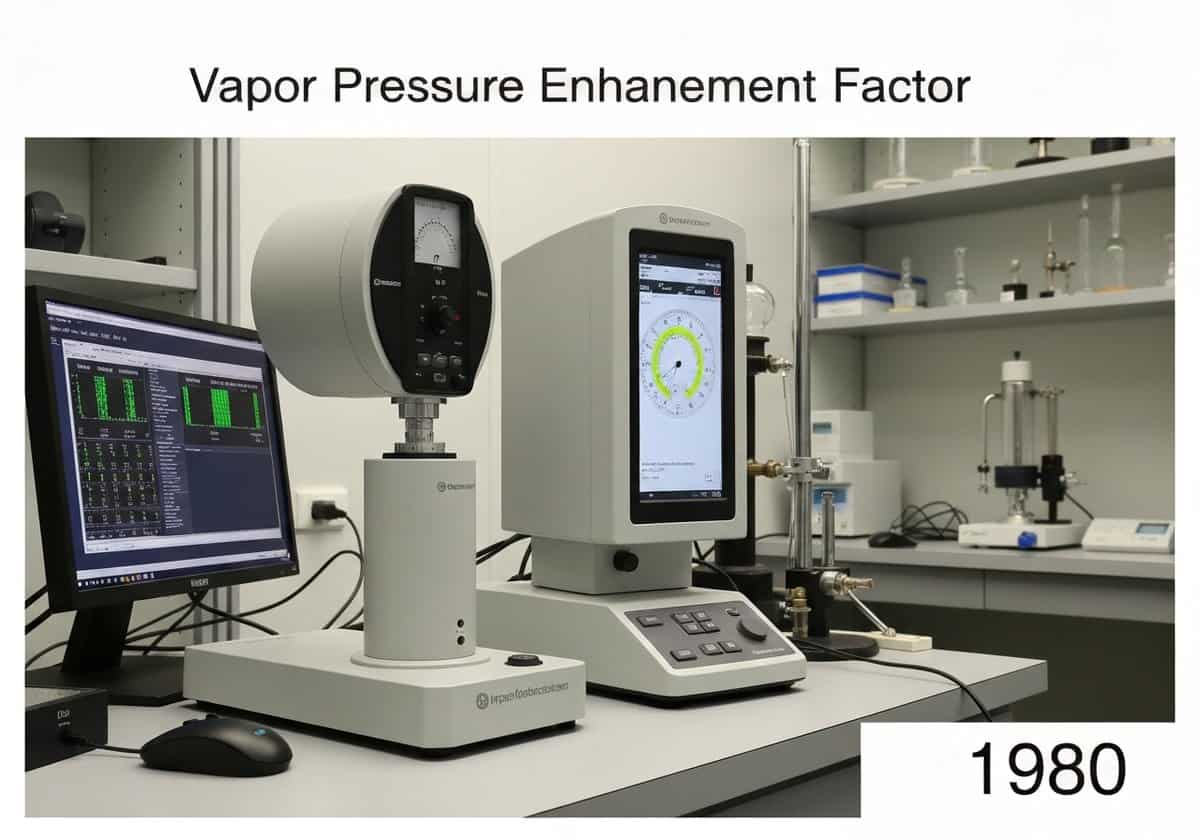
High-precision hygrometer in a laboratory for measuring vapor pressure enhancement factors.

(generated image for illustration only)

The equilibrium vapor pressure of water over a liquid surface in moist air (\(p^*_{H_2O,a}\)) is slightly greater than the equilibrium vapor pressure over a pure water surface (\(p^*_{H_2O}\)). This difference is quantified by the water vapor enhancement factor, \(f_w\), which depends on temperature and the pressure of the moist air. The relationship is \(p^*_{H_2O,a} = f_w(T, p_{ms}) \cdot p^*_{H_2O}\).

The enhancement factor accounts for the non-ideal behavior of moist air. In a pure water vapor system, molecules interact only with each other. In moist air, water molecules also interact with molecules of nitrogen, oxygen, and other constituent gases. These interactions slightly alter the chemical potential of the water vapor, leading to a small increase in the saturation vapor pressure compared to a pure system at the same temperature. The effect is generally small, with the enhancement factor \(f_w\) being close to 1.00. For example, at sea level pressure and 20°C, the factor is approximately 1.004.

However, for applications requiring high accuracy, such as in national metrology institutes or for the calibration of precision instruments, this correction is essential. The value of \(f_w\) increases with total pressure and decreases with temperature. Various empirical formulas have been developed to calculate the enhancement factor, often based on extensive experimental data. Ignoring this factor in high-precision calculations can lead to errors in relative humidity determination, particularly at high pressures and low temperatures. It is a subtle but important concept in advanced psychrometrics and thermodynamics.

UNESCO Nomenclature: 2212
– Thermodynamics

Type

Abstract System

Disruption

Incremental

Usage

Niche/Specialized

Precursors

  • Gibbs free energy and chemical potential concepts
  • Dalton’s law of partial pressures
  • ideal gas law and its limitations
  • Poynting effect (effect of total pressure on vapor pressure)
  • development of precision manometers and thermometers

Applications

  • high-precision metrology and calibration of hygrometers
  • fundamental thermodynamic and atmospheric modeling
  • chemical engineering processes requiring precise humidity control
  • standards development for humidity measurement (e.g., by nist)

Patents:

NA

Potential Innovations Ideas

Due to scrapping bot traffic, currently more than 40k per day, this content is reserved to community members.
> Login < or > Register < (100% free) to access this, so as all other restricted content and tools.

Related to: enhancement factor, vapor pressure, moist air, thermodynamics, non-ideal gas, psychrometrics, metrology, calibration, saturation, poynting effect.

Historical Context

Vapor Pressure Enhancement Factor

1974-11-15
1980
1980
1980
1984
1985
1986
1970
1975
1980
1980
1980
1984
1986
1986

(if date is unknown or not relevant, e.g. "fluid mechanics", a rounded estimation of its notable emergence is provided)

Related Invention, Innovation & Technical Principles

Full size images and downloads are only available, 100% free, for registered members.

> Login <