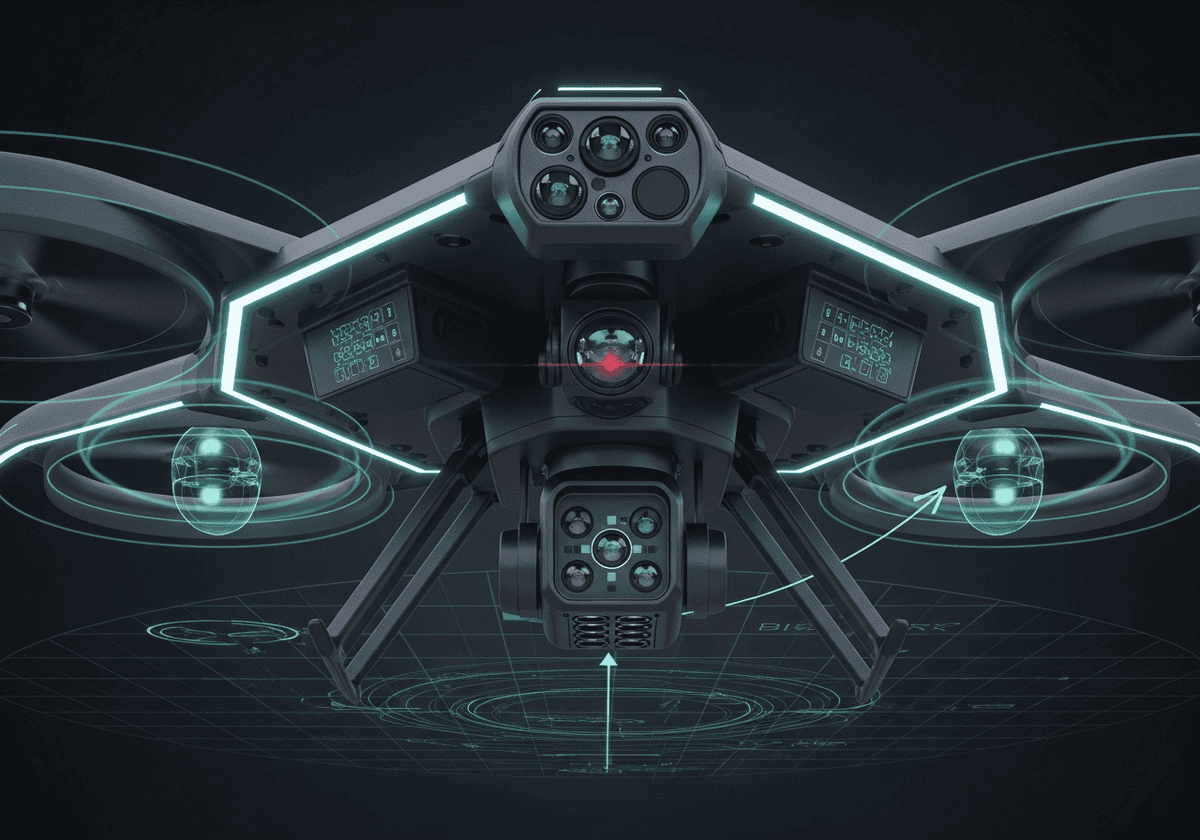
Die Technologie unbemannter Luftfahrzeuge (UAV) integriert Aerodynamik, eingebettete Systeme, Sensorfusion und autonome Steuerung, um ferngesteuerte oder autonome Flugoperationen auf verschiedenen Plattformen wie Multikoptern, Starrflüglern und Hybridkonfigurationen zu ermöglichen. Zu den Kernbereichen gehören Flugsteuerungsalgorithmen, Navigation in GPS-freien Umgebungen, Kollisionsvermeidung, Schwarmkoordination und Nutzlastintegration für Überwachung, Kartierung und Datenerfassung. Fortschritte bei Kommunikationsprotokollen, Energiemanagement und Echtzeit-Telemetrie verbessern die Einsatzdauer und Zuverlässigkeit. Diese Zusammenstellung präsentiert die neuesten Fachpublikationen und Patente, die Innovationen im UAV-Design, der autonomen Missionsplanung, der Sensortechnologien und der regulatorischen Rahmenbedingungen detailliert beschreiben und die Entwicklung der Luftrobotik prägen.
Drohnen verwandeln Sensoren in Fluggeräte. Die Flugforschung ist im Gange. aeronauticsNavigation auf 3D-SLAM Und Computer Visionund Gruppenmissionen auf SchwarmrobotikUnterwassergeschwister sind auf ferngesteuerte Fahrzeuge.
Dies ist unsere neueste Auswahl weltweiter Veröffentlichungen und Patente in englischer Sprache zum Thema Unbemanntes Luftfahrzeug (UAV), aus vielen wissenschaftlichen Online-Journalen, klassifiziert und fokussiert auf Quadrocopter, Drohnenflugsteuerung, UAV-Navigation, autonomen Flug, GPS-verweigerte Navigation, Flugregler, Multirotor, Starrflügel-UAV, UAV-Nutzlast, Fernpilot, UAV-Kommunikation, Kollisionsvermeidung, UAV-Missionsplanung, UAV-Sensorfusion, UAV-Schwarm, UAV-Flugstabilisierung, UAV-Batterie, UAV-Telemetrie, UAV-Bodenstation, unbemannte Luftfahrzeuge, UAV-Hindernisvermeidung, UAV-Pfadplanung, UAV-Bildverarbeitung, UAV-Lidar, UAV-Flugdynamik, UAV, UAV-Vorschriften, UAV-Datenlink und UAV-Nutzlastintegration.
Unmanned aerial vehicle management
Patent published on the 2026-11-19 in US under Ref US20260369169 by IMAGEKEEPER LLC [US] (Speasl Jerry [us], Patterson Mike [us], Roberts Marc [us])
Abstract: A base module may be used to receive and house one or more unmanned aerial vehicles (UAVs) via one or more cavities. The base module receives commands from a manager device and identifies a flight plan that allows a UAV to execute the received commands. The base module transfers the flight plan to the UAV and frees the UAV. Once the UAV returns, the base module once again receives it. The base module then receives sensor data from the UAV from one or more sensors onboard the UAV, and optionally [...]
Our summary: The base module manages unmanned aerial vehicles (UAVs) by receiving and executing flight plans. It collects sensor data during UAV operations and evaluates the success or failure of the flight. The data is transmitted to a storage medium for further analysis by the manager device.
UAV management, base module, flight plan, sensor data
Patent
Uncrewed aerial vehicle
Patent published on the 2026-11-19 in AU under Ref AU2025270112 by SOVEREIGN PROPULSION SYSTEMS PTY LTD [AU] (Kalisch Nathan Luke, Salotti Gregory John)
Abstract: An uncrewed aerial vehicle (UAV) has four arms, each of which has at least one rotor attached thereto. The arms include a joint, which permits movement of the rotors between a stowed configuration and a deployed configuration. The UAV is arranged to permit movement of the rotors from the stowed configuration to the deployed configuration while in freefall, particular after having been deployed from a fixed wing aircraft.[...]
Our summary: An uncrewed aerial vehicle (UAV) features four arms with rotors. The rotors can transition between stowed and deployed configurations. This movement occurs during freefall after deployment from a fixed wing aircraft.
UAV, rotor, freefall, configuration
Patent
Methods, systems and devices for providing low latency communications for unmanned aerial vehicles (uavs) over terrestrial 5g networks
Patent published on the 2026-11-19 in US under Ref US20260371321 by AT & T IP I LP [US] (Vivanco Daniel [us], Jia Yupeng [us])
Abstract: Aspects of the subject disclosure may include, for example, receiving unmanned aerial vehicle (UAV) data traffic comprising command and control (C2) data traffic and payload data traffic, configuring a first cell of a first base station for a mini-slot transmission scheme, and identifying a second cell of a second base station that is configured for a regular slot transmission scheme. Further embodiments include transmitting the C2 data traffic to the first base station, the first base station t[...]
Our summary: This document discusses methods and systems for low latency communication for UAVs over 5G networks. It details the transmission of command and control data and payload data using different slot transmission schemes. The first base station uses a mini-slot scheme for C2 data, while the second base station uses a regular slot scheme for payload data.
UAV, 5G, low latency, communication
Patent
Method and device for detecting and neutralizing low-altitude self-controlled unmanned aerial vehicles
Patent published on the 2026-11-19 in US under Ref US20260366846 by ANTSELEVICH MIKHAIL ALEKSANDROVICH [IL] (Antselevich Mikhail Aleksandrovich [il])
Abstract: Some embodiments are directed toward the detection of aerial targets, low-altitude unmanned aerial vehicles (UAVs), in particular drones, including those without external control. The technical result of the presently disclosed subject matter is an increase in the detection range of UAVs, including those without external control, using multi-frequency nonlinear radar and recording of combination frequencies of the second and third order, parametric location (electromagnetic, acoustic, etc.) and [...]
Our summary: The method involves detecting low-altitude unmanned aerial vehicles (UAVs) using multi-frequency nonlinear radar. It enhances detection range and includes parametric location techniques. The neutralization is achieved by disrupting UAV systems with a powerful electromagnetic pulse.
UAV detection, electromagnetic pulse, multi-frequency radar, neutralization technology
Patent
First-person view (fpv) drone carrier uav
Patent published on the 2026-11-19 in WO under Ref WO2026240743 by STEPURA OLEKSANDR [UA] (Stepura Oleksandr [ua])
Abstract: The invention relates to a field of unmanned aerial vehicles (UAVs) that act as carriers for other UAVs that imply remote control of the UAV based on a first- person view, i.e., FPV drones. The FPV drone carrier UAV comprises a self-powered payload platform that is equipped with a flight control tool and an FPV drone fixation mechanism. The carrier UAV is equipped with a real-time video signal relay device that is arranged on the payload platform and comprises a system for receiving an analog si[...]
Our summary: The invention describes a first-person view (FPV) drone carrier UAV designed to transport other UAVs. It features a self-powered platform with a flight control tool and a video signal relay system. This system enhances the operational range of FPV systems by utilizing real-time video transmission capabilities.
FPV drones, UAV carrier, video signal relay, flight control
Patent
A collision avoidance system for an unmanned aerial vehicle (uav) and a method thereof
Patent published on the 2026-11-19 in WO under Ref WO2026239362 by AYAAN AUTONOMOUS SYSTEMS PVT LTD [IN] (Chaudhari Atul Narayan [in])
Abstract: The present disclosure envisages a collision avoidance system for an unmanned aerial vehicle (UAV) and a method thereof. The UAV comprises a main body and a plurality of arms supporting propulsion motor assemblies. A plurality of wide-angle camera assemblies mounted on the body, collectively defines a continuous perimeter and generates a first set of image frames. A pair of auxiliary wide-angle cameras (206A, 206B) are mounted on an upper surface and a lower surface of the main body respectively[...]
Our summary: The collision avoidance system for UAVs utilizes multiple wide-angle cameras and sensors to detect surrounding objects. It processes image frames and sensor signals to create navigation commands. These commands are then converted into motor control signals for safe flight operations.
collision avoidance, unmanned aerial vehicle, image processing, sensor integration
Patent
Comprehensive performance evaluation and three-dimensional UAV trajectory path planning under multiple constraints
Published on 2026-06-25 by @OXFORD
Abstract: AbstractThe Kepler Optimization Algorithm (KOA), as a recently developed metaheuristic algorithm, has demonstrated promising performance in various optimization tasks. However, its performance is still constrained by slow convergence speed, limited convergence accuracy, and an imbalance between exploration and exploitation capabilities. To overcome these limitations, this paper proposes a multi-strategy improved Kepler Optimization Algorithm, termed the Sophisticated Policies-based Kepler Optimi[...]
Our summary: The paper introduces the Sophisticated Policies-based Kepler Optimization Algorithm (SPKOA) to enhance the original Kepler Optimization Algorithm. SPKOA employs techniques such as Latin Hypercube Sampling and a dynamic Lévy flight mechanism to improve exploration and exploitation balance. Experimental results indicate that SPKOA outperforms existing algorithms in both optimization accuracy and three-dimensional UAV path planning under complex constraints.
Kepler Optimization Algorithm, UAV trajectory planning, multi-strategy improvement, optimization performance
Publication
A frequency-enhanced transformer-based UAV multi-scale small object detector for aerial imagery
Published on 2026-04-02 by @OXFORD
Abstract: AbstractSmall object detection in UAV (Unmanned Aerial Vehicle) aerial imagery faces significant challenges, including insufficient feature representation, severe background noise interference, and inadequate multi-scale fusion. To address these issues, this study proposes UMS-DET (Unmanned Aerial Vehicle Multi-scale Small-object Detector), a specialized framework engineered to optimize multi-scale representation and small object discrimination in UAV views. Firstly, we design the Multi-Scale Co[...]
Our summary: UMS-DET is a specialized framework for small object detection in UAV aerial imagery. It optimizes multi-scale representation and discriminative capabilities through advanced feature fusion techniques. Experimental results show significant improvements in accuracy and efficiency, making it suitable for complex environments.
UAV, small object detection, multi-scale representation, frequency enhancement
Publication