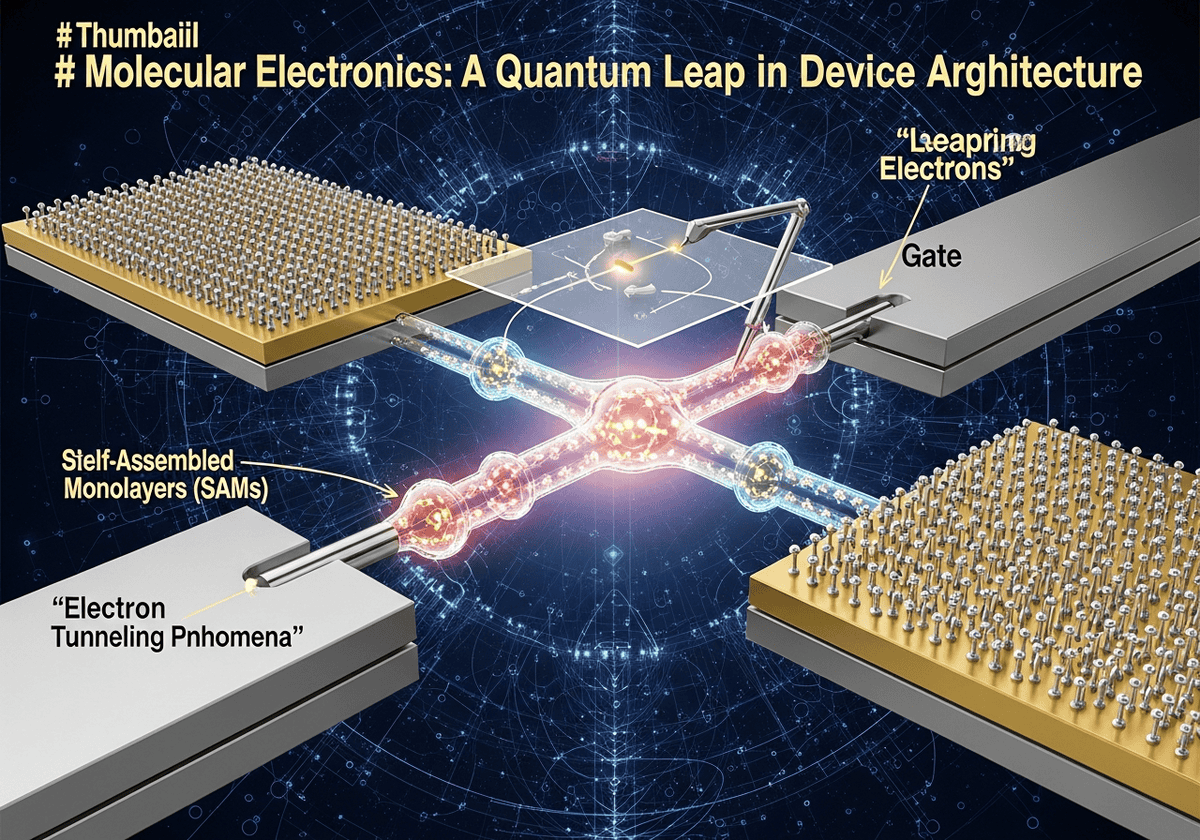
Molecular Electronics explores charge transport and electronic functionality at the scale of individual molecules and molecular assemblies, integrating principles of quantum mechanics, organic chemistry, and nanofabrication. Central topics include molecular junctions, self-assembled monolayers, single-molecule transistors, and electron tunneling phenomena, with emphasis on controlling conductance, switching behavior, and spin-dependent effects. Research advances focus on molecular wires, rectifiers, switches, and memory elements, employing techniques such as scanning tunneling microscopy and break junctions to characterize electronic properties. Our following collection compiles the most recent peer-reviewed articles and patents, highlighting innovations in device architectures, molecular synthesis, and measurement methodologies driving the miniaturization of electronic components beyond conventional semiconductor technology.
Dies ist unsere neueste Auswahl weltweiter englischsprachiger Veröffentlichungen und Patente zur Molekularelektronik aus vielen wissenschaftlichen Online-Zeitschriften, klassifiziert und fokussiert auf molekulare Grenzflächen, selbstorganisierte Monoschichten, Einzelmolekültransistoren, Leitfähigkeitsmessungen, Elektronentransport, molekulare Drähte, Quantentunnel, Redoxmoleküle, Rastertunnelmikroskopie, Break-Junction-Technik, Ladungsträger, molekulare Schalter, Nano-Elektroden, Spintronik, molekulare Gleichrichter, organische Halbleiter, Molekülorbitale, Elektron-Phonon-Kopplung, molekulare Spintronik, Quanteninterferenz, molekulare Dioden, Elektromigration, Nanoporen, molekulare Anordnung, Oberflächenplasmonenresonanz, Elektronentransfer, molekulare Leitfähigkeit, molekulare Nanostromkreise, molekulare Speicher und molekulare Optoelektronik.
Low-dimensional tellurium iodide perovskite structure and an aqueous zinc battery using the same
Patent published on the 2026-06-11 in US under Ref US20260163071 by CITY UNIV OF HONG KONG [HK] (Zhi Chunyi [hk], Wang Shixun [hk])
Abstract: The present invention relates to a low-dimensional tellurium iodide perovskite structure. The low-dimensional structure, specifically an organic-inorganic hybrid benzyltriethylammonium tellurium iodide ((BzTEA)2TeI6), enables a highly efficient eleven-electron transfer process involving redox pairs of Cl0/Cl−, I+/I0/I−, and Te6+/Te4+/Te0/Te2−. This innovative perovskite structure confines both chalcogen and halogen elements, effectively mitigating the shuttle effect and enhancing stability[...]
Our summary: The invention presents a low-dimensional tellurium iodide perovskite structure for efficient electron transfer. The Zn∥(BzTEA)2TeI6 battery demonstrates high capacity and energy density with excellent cycle stability. This work advances the design of high-energy batteries using chalcogen-halide perovskite cathodes.
perovskite, tellurium iodide, zinc battery, energy density
Patent
Organic electroluminescent materials and devices
Patent published on the 2026-06-04 in US under Ref US20260157024 by UNIVERSAL DISPLAY CORP [US] (Margulies Eric A [us], Weaver Michael S [us], Adamovich Vadim [us])
Abstract: An organic electroluminescent device (OLED) comprising an anode; a cathode; and an emissive layer, disposed between the anode and the cathode is provided. The emissive layer comprises a phosphorescent dopant, a first host, and a second host, where the first host is a hole transporting host, the second host is an electron transporting host, the first host has a HOMO energy≤−5.45 eV and/or the first host comprises a structure of Formula V:and the phosphorescent dopant has a formula Ir(LA)x(LB)[...]
Our summary: The content describes an organic electroluminescent device (OLED) with an anode, cathode, and emissive layer. The emissive layer includes a phosphorescent dopant and two hosts for hole and electron transport. It also mentions consumer products that incorporate this OLED technology.
OLED, phosphorescent dopant, emissive layer, organic materials
Patent
Organic electroluminescent element, electronic element, and electronic apparatus
Patent published on the 2026-06-04 in WO under Ref WO2026116295 by SFC CO LTD [KR] (Hirayama Yuta [jp], Park Young-hwan [jp], Shin Bong-ki [jp], Cha Soon-wook [kr], Lee Se-jin [kr])
Abstract: Provided is an organic EL element having excellent carrier balance and capable of achieving a low driving voltage, high efficiency, and a long service life. According to the present invention, disclosed is an organic EL element which comprises, in the stated sequence, an anode, a hole transport layer, an electron-blocking layer, a light-emitting layer, an electron transport layer, and a cathode. The electron-blocking layer contains a specific arylamine compound having a substituted phenyl group [...]
Our summary: The invention describes an organic electroluminescent (EL) element with improved carrier balance. It features a specific structure including an anode, various transport layers, and a light-emitting layer. Key components include arylamine compounds that enhance performance metrics like efficiency and service life.
Organic EL element, carrier balance, low driving voltage, arylamine compound
Patent
System, device, and method for radiation hardness of organic semiconductors and photovoltaic devices
Patent published on the 2026-06-04 in US under Ref US20260157016 by THE REGENTS OF THE UNIV OF MICHIGAN [US] (Li Yongxi [us], Forrest Stephen R [us])
Abstract: [0000] Provided are small molecules for organic photovoltaic cells lacking pendant aliphatic groups with labile hydrogens. Small-molecule OPVs grown by vacuum thermal evaporation are resistant to degradation by 30 keV proton irradiation, in contrast to polymer-based OPVs that suffer a 50% efficiency loss under similar conditions. Also provided are formulations comprising these compounds. Further provided are optoelectronic devices that utilize these compounds.[...]
Our summary: Small molecules for organic photovoltaic cells are resistant to 30 keV proton irradiation. Polymer-based OPVs experience significant efficiency loss under similar conditions. The technology includes formulations and optoelectronic devices utilizing these compounds.
organic photovoltaics, radiation hardness, small molecules, optoelectronic devices
Patent
Compound of formula (i) and their use in an organic electronic device
Patent published on the 2026-06-03 in EP under Ref EP4752132 by NOVALED GMBH [DE] (Luschtinetz Regina [de], NÜllen Max Peter [de], Schulze Benjamin [de], Wudarczyk Jakob Jacek [de])
Abstract: The present invention relates to a compound of formula (I) and said use in organic electronic devices, an organic semiconductor layer comprising the compound of formula (I), an organic electronic device comprising the organic semiconductor layer, and a display device comprising the organic electronic device.[...]
Our summary: The invention involves a compound of formula (I) used in organic electronic devices. It includes an organic semiconductor layer containing the compound. Additionally, it describes a display device that incorporates the organic electronic device.
organic semiconductor, electronic device, compound formula, display technology
Patent
Electroluminescent display device
Patent published on the 2026-05-28 in US under Ref US20260150549 by LG DISPLAY CO LTD [KR] (Park Jinho [kr])
Abstract: [0000] An electroluminescent display device can include a substrate including a first sub-pixel and a second sub-pixel, a first electrode in each of the first sub-pixel and the second sub-pixel on the substrate, a light emitting part on the first electrode, and a second electrode on the light emitting part. The light emitting part includes a hole transport layer, a first light emitting layer disposed in the first sub-pixel, a second light emitting layer disposed in the second sub-pixel, and an e[...]
Our summary: An electroluminescent display device comprises a substrate with two sub-pixels. Each sub-pixel includes a first and second electrode, and a light emitting part. The light emitting part consists of a hole transport layer and two light emitting layers, with specific arrangements between them.
Electroluminescent, display device, light emitting layers, substrate
Patent
assessing the robustness of topological insulating states against realistic structural defects
Published on 2026-04-24 by Shuoke Xu, Wenjin Gao, Pengfei Yu, Guo-Xiang Zhi, Ke Xu, Yujing Zhang and Miao Zhou @IOP SCIENCE
Abstract: Two-dimensional topological insulator, or quantum spin Hall (QSH) insulator, holds topologically protected edge states with significant implications for diverse fields, yet the robustness against realistic structural defects remains elusive. Here, by combining first-principles calculations, ab initio molecular dynamics (AIMD) and Monte Carlo simulations, we consider Bi(111) bilayer–a large-gap QSH insulator–under ion irradiation, and explore the topological robustness with the generated defe[...]
Our summary: This study investigates the robustness of two-dimensional topological insulators against structural defects. Using first-principles calculations and simulations, it identifies dominant defects and their impact on topological edge states. The findings highlight the limitations of QSH insulators in practical applications under defect conditions.
topological insulators, quantum spin Hall, structural defects, first-principles calculations
Publication
Artificial Light at Night Alters Photosynthetic Electron Transport in Two Deciduous Species
Published on 2026-02-03 by Monika A. Czaja, Anna Ko?ton @MDPI
Abstract: Although light pollution is one of the fastest-growing environmental problems today, we still know little about its impact on specific organisms. Plants are the least understood group in this context. Although environmental observations may suggest some conclusions, we still need more specific experimental data. The present study involved two deciduous species—common beech (Fagus sylvatica L.) and white dogwood (Cornus alba L.)—which, after being placed in growth room[...]
Our summary: Artificial light at night negatively impacts photosynthetic electron transport in common beech and white dogwood. The study measured chlorophyll fluorescence to analyze leaf physiology under different nighttime lighting conditions. Results indicate significant disruptions in electron transport parameters, highlighting the adverse effects of light pollution on plant functioning.
light pollution, photosynthesis, electron transport, chlorophyll fluorescence
Publication