Product Design, Manufacturing & Innovation Resources
Heim » Molekulare Elektronik

Molekulare Elektronik

1974-11-15
  • Ari Aviram
  • Mark Ratner
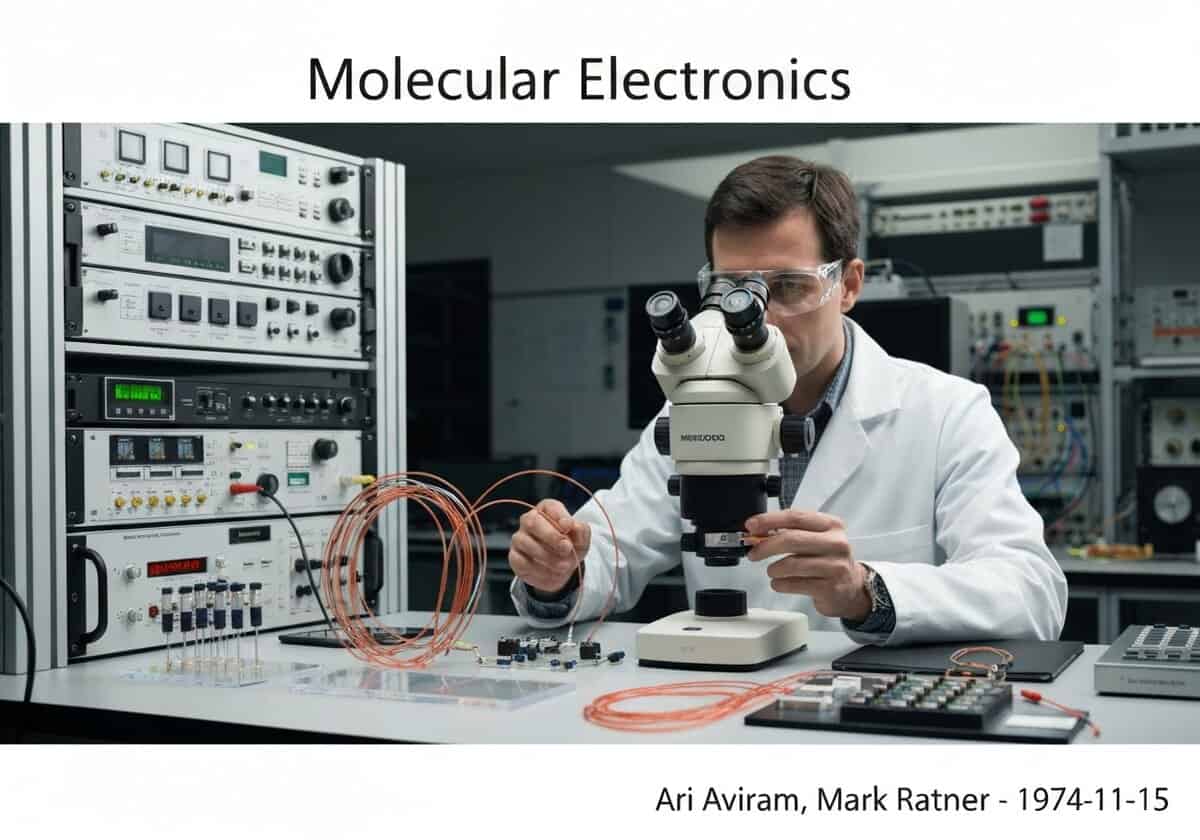
Molekularelektronische Komponenten im Labormaßstab, einschließlich molekularer Drähte und Schalter.

(Abbildung dient nur zur Veranschaulichung)

Die Molekularelektronik erforscht die Nutzung einzelner Moleküle oder nanoskaliger Molekülansammlungen als grundlegende elektronische Komponenten. Ziel dieses Ansatzes ist der Bau von Schaltkreisen an der äußersten Grenze der Miniaturisierung, weit über die traditionelle Siliziumtechnologie hinaus. Zu den Schlüsselkomponenten gehören molekulare Drähte, Schalter und Gleichrichter, deren Funktion quantenmechanische Eigenschaften wie das Tunneln von Elektronen durch Molekülorbitale nutzt.

The concept of molecular electronics, first conceptualized by Ari Aviram and Mark Ratner in 1974, represents a paradigm shift from top-down lithography to bottom-up self-assembly for creating electronic circuits. Their seminal paper proposed a molecular rectifier, a D-σ-A molecule (Donor-sigma bridge-Acceptor), which would allow current to flow preferentially in one direction, analogous to a semiconductor p-n diode. The principle relies on the alignment of molecular energy levels (HOMO and LUMO) under an applied bias voltage. When a voltage is applied, electrons can tunnel from an electrode, through the molecule’s orbitals, to the other electrode. The asymmetry in the D-A structure creates an asymmetric current-voltage (I-V) characteristic, which is the basis of rectification.

Beyond simple rectifiers, researchers have demonstrated molecular wires (e.g., conjugated Polymere), switches that can be toggled between ‘on’ and ‘off’ states using light, heat, or electric fields, and even molecular transistors. The primary challenge lies in reliably connecting these tiny molecules to macroscopic electrodes and creating stable, reproducible devices. Techniques like scanning tunneling microscopy (STM) break junctions and mechanically controllable break junctions (MCBJs) are used in laboratory settings to measure the conductance of single molecules. While full-scale molecular computers remain a distant goal, the principles are being applied in areas like molecular sensing, where the electronic properties of a molecule change upon binding to a specific target analyte, and in organic light-emitting diodes (OLEDs), which rely on charge transport through organic molecular films.

Das Gebiet ist stark interdisziplinär und vereint Quantenchemie, Materialwissenschaften und Physik der kondensierten Materie. It promises not only extreme miniaturization but also novel functionalities derived from the unique quantum properties of individual molecules, potentially leading to devices with lower power consumption and entirely new computational models.

UNESCO Nomenclature: 2205
- Elektronik

Typ

Abstraktes System

Störung

Grundlegendes

Verwendung

Aufstrebende Technologie

Vorläufer

  • Entdeckung des Elektrons
  • Entwicklung der Quantenmechanik
  • Synthese komplexer organischer Moleküle
  • Erfindung der Halbleiterdiode
  • Entwicklung der Rastertunnelmikroskopie (STM)

Anwendungen

  • molekulare Sensoren
  • Datenspeicher mit ultrahoher Dichte
  • organische Leuchtdioden (OLEDs)
  • Potenzial für molekulare Computerarchitekturen

Patente:

NA

Potenzielle Innovationsideen

  • biokompatible Logikgatter für In-vivo-Computing
  • self-assembling neural networks for pattern recognition
  • In Textilien integrierte molekulare Sensoren zur Echtzeit-Gesundheitsüberwachung
  • catalytic surfaces with embedded electronic feedback loops
  • Quantenpunkt-Molekül-Hybridsysteme für fortschrittliche Photovoltaik
  • programmierbare Materie, bei der molekulare Schalter die Materialeigenschaften verändern
  • Ultra-Low-Power-Speicher basierend auf molekularen Konformationsänderungen
  • chemisch angetriebene molekulare Motoren für die Nanorobotik
Related to: molecular electronics, single-molecule, aviram-ratner, molecular rectifier, quantum tunneling, bottom-up fabrication, molecular switch, nanoelectronics.

Historischer Kontext

Molekulare Elektronik

1965
1970
1970
1974-11-15
1980
1980
1980
1964
1968
1970
1970
1975
1980
1980
1980

(wenn das Datum unbekannt oder nicht relevant ist, z. B. „Strömungsmechanik“, wird eine gerundete Schätzung seines bemerkenswerten Auftretens bereitgestellt)

10. Jahr Jubiläum

Bilder in voller Größe und Downloads sind ausschließlich für registrierte Mitglieder kostenlos verfügbar.

> Login <