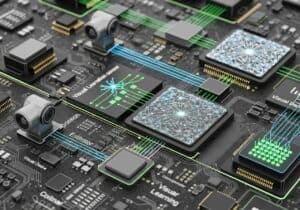
Computer Vision konzentriert sich auf die automatisierte Extraktion, Analyse und Interpretation visueller Informationen aus Bildern und Videos. Diese Disziplin integriert Bildverarbeitung, Mustererkennung und maschinelles Lernen, um Aufgaben wie Objekterkennung, Segmentierung, Identifizierung und 3D-Rekonstruktion zu bewältigen. Die Forschung untersucht Fortschritte bei Convolutional Neural Networks (CNNs), optischem Fluss, Tiefenschätzung und Szenenverständnis und ermöglicht so Anwendungen in Robotik, Überwachung, medizinischer Bildgebung und autonomen Systemen. Die folgende Sammlung präsentiert aktuelle wissenschaftliche Publikationen und patentierte Technologien, die Methoden und Anwendungen innerhalb der Computer Vision weiterentwickeln:
Computer Vision lehrt Maschinen, Bilder und Videos zu lesen. Kernmodelle sind auf neuronale Netzeund Kartierung auf 3D-SLAMFahrzeuge und Drohnen wenden es an auf autonome Fahrzeuge Und UAV Seiten. Overlay-Anzeigen sind aktiviert. Augmented Reality.
Dies ist unsere neueste Auswahl an weltweiten Veröffentlichungen und Patenten in englischer Sprache zum Thema Computer Vision, aus vielen wissenschaftlichen Online-Zeitschriften, klassifiziert und fokussiert auf Bildsegmentierung, Objekterkennung, Merkmalsextraktion, Faltungsneuronale Netze, Bildklassifizierung, Optischer Fluss, Stereosehen, Tiefenschätzung, Bilderkennung, Szenenverständnis, Bildrekonstruktion, Bildverbesserung, Mustererkennung, Gesichtserkennung, Bewegungsverfolgung, 3D-Rekonstruktion, Bildregistrierung, Computer Vision, semantische Segmentierung, Instanzsegmentierung, visuelles SLAM, Bildstitching, Texturanalyse, Kantendetektion, Objektverfolgung, Superresolution, Bildentrauschung, Videoanalyse, Anomalieerkennung und Bildbeschriftung.
A foundation for systematic analysis of transformers and RNNs for tractography
Published on 2026-11-24 by @MIT
Abstract: AbstractMachine learning (ML) has emerged as a promising approach for improving diffusion MRI (dMRI) tractography, a task that remains limited by the intrinsic tension between local diffusion information and global anatomical plausibility. In this work, we systematically evaluate recurrent neural networks (RNNs) and Transformer models for iterative tractography, with particular attention to training strategies, input representations (including convolutional neural network (CNN)-based embeddings [...]
Our summary: This work evaluates RNNs and Transformer models for diffusion MRI tractography. It introduces a generation-validation phase for streamline-level supervision during training. Results show the highest performance to date and highlight the need for improved evaluation methods in in vivo validation.
machine learning, diffusion MRI, recurrent neural networks, Transformers
Publication
Industrial camera with image reconstruction for optics equipped with a multifocal element
Patent published on the 2026-11-19 in WO under Ref WO2026239188 by OPTO ENG S P A [IT] (Bertolucci Andrea [it])
Abstract: A computer-implemented method to obtain a focused object image (FI) from an object image (I) of at least one observed object acquired by means of an image sensor (S) optically coupled to a multifocal optical system (MOS). The method comprises, by means of a deconvolution module, deconvolving the object image (I) based on at least one optical parameter (OP) associated with the multifocal optical system (MOS), in order to obtain a deconvolved object image (DI) (step a). The method further comprise[...]
Our summary: The method involves obtaining a focused object image from an object image captured by an image sensor. It uses a deconvolution module to process the object image based on optical parameters of the multifocal optical system. A post-deconvolution noise correction module further refines the image to achieve the final focused object image.
industrial camera, image reconstruction, multifocal optical system, deconvolution
Patent
Denoising parameter determination and image denoising method, device, and medium
Patent published on the 2026-11-19 in US under Ref US20260368865 by XG TECH PTE LTD [SG] (Lin Tao [sg], Fan Man [sg])
Abstract: A denoising parameter determination method, comprising: obtaining multiple denoised images corresponding to an undenoised image; for any of the denoised images: determining a difference between any of the denoised images and the undenoised image to obtain a difference image corresponding to any of the denoised images; determining a difference dispersion degree of the difference image corresponding to any of the denoised images; and performing singular value decomposition on the difference image [...]
Our summary: The method involves obtaining multiple denoised images from an undenoised image. It calculates difference images and their dispersion degrees, followed by singular value decomposition to derive singular value sets. Finally, it determines a target parameter value group for effective image denoising processing.
Denoising, Parameter determination, Singular value decomposition, Image processing
Patent
Fine-tuning computer vision neural networks using task rewards
Patent published on the 2026-11-19 in US under Ref US20260369047 by GOOGLE LLC [US] (Kolesnikov Alexander [ch], Zhai Xiaohua [ch], Susano Pinto André [ch], Shi Yuge [gb], Beyer Lucas Klaus [ch])
Abstract: Methods, systems, and apparatus, including computer programs encoded on computer storage media, for fine-tuning a computer vision neural network. In particular, the neural network is fine-tuned using task rewards and through reinforcement learning.[...]
Our summary: This content discusses methods for fine-tuning computer vision neural networks. It emphasizes using task rewards to enhance performance. The approach incorporates reinforcement learning techniques for optimization.
fine-tuning, computer vision, neural networks, reinforcement learning
Patent
Image processing model training method and image processing method
Patent published on the 2026-11-19 in WO under Ref WO2026237584 by ALIBABA DAMO HANGZHOU TECH CO LTD [CN] (Zhang Jianfeng [cn], Qiu Zhongwei [cn], Xia Yingda [us], Zheng Zhilin [cn], Lin Tiancheng [cn], Xu Jianwei [cn], Yun Boxiang [cn], Zhang Ling [us], Hu Can [cn], Cheng Xiangdong [cn])
Abstract: Provided in the embodiments of the present disclosure are an image processing model training method and an image processing method. The image processing model training method comprises: acquiring a training sample pair, wherein the training sample pair comprises a plurality of sample target images corresponding to a target detection region, and a sample detection result; inputting the plurality of sample target images into an initial image processing model to obtain a predicted detection result [...]
Our summary: The content describes a method for training an image processing model using sample target images and detection results. It involves inputting images into a model with feature extraction networks to predict detection results. The method adjusts model parameters based on loss values to enhance accuracy.
image processing, model training, feature extraction, detection result
Patent
Electronic device, image converter, image display method and electronic device readable recording medium
Patent published on the 2026-11-19 in US under Ref US20260370793 by THERMALTAKE TECH CO LTD [TW] (Lin Pei-Hsi [tw], Chen Jyh-Woei [tw], Lin Hung-Liang [tw], Hsieh Chu-An [tw], Liu Chun-Ko [tw], Peng Chien-Wen [tw])
Abstract: The present disclosure provides an electronic device, including a plurality of screens and a converter, where the plurality of screens are arranged according to a spatial relationship and the converter is coupled to the plurality of screens and used to receive an input image and a selection instruction, the input image is a panoramic image, and the selection instruction is used to frame a selection area in the input image. The converter executes an image segmentation algorithm and converts the i[...]
Our summary: The electronic device includes multiple screens and a converter for processing panoramic images. It uses a selection instruction to define a specific area for segmentation. The output images create a synchronized three-dimensional display effect across the screens.
image converter, electronic device, 3D display, image segmentation
Patent
Object classification in images
Patent published on the 2026-11-19 in US under Ref US20260369034 by BAE SYSTEMS PLC [GB] (Colosimo Nicholas Giacomo Robert [gb])
Abstract: The present invention relates to image classification, in particular to object recognition/detection in images. According to an aspect of the present invention, there is provided a computer implemented method of classifying an object in an image. The method comprises: identifying, using one or more ma-chine-learned local feature identification models, a plurality of local features of an object in the image, each local feature comprising a respective feature identity and a respective feature area[...]
Our summary: The invention describes a method for classifying objects in images using machine-learned local feature identification models. It involves identifying local features of an object and comparing them to masked images of candidate objects. The classification is based on the overlap between identified features and feasible search zones in the masked images.
object classification, image recognition, machine learning, feature identification
Patent
Processing strategies for improving cortical thickness correspondence between low-field and high-field MRI in young people
Published on 2026-11-17 by @MIT
Abstract: AbstractPortable low-field MRI systems are a promising complement to conventional high-field systems, enabling broader access to MRI. However, correspondence in cortical thickness estimates between low- and high-field MRI in young people remains limited despite its importance for neurodevelopment and psychopathology. To evaluate how multiple low-field image processing approaches improve cortical thickness correspondence with high-field MRI in a large sample of young individuals, we collected T1-[...]
Our summary: This study evaluates processing strategies to enhance cortical thickness correspondence between low-field and high-field MRI in young individuals. Multiple low-field image processing approaches were tested, with the recon-all-clinical pipeline showing the highest correspondence. Results indicate significant improvements in cortical thickness estimates using low-field MRI, particularly in specific brain regions.
MRI, cortical thickness, deep learning, neurodevelopment
Publication