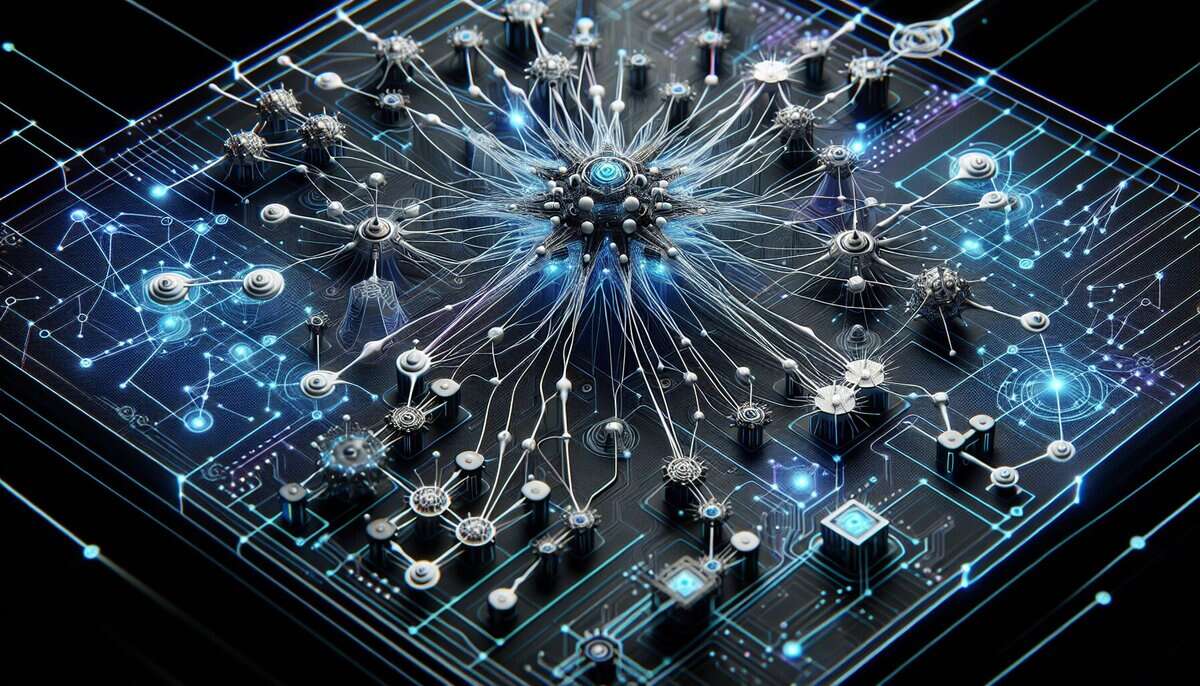
Neuromorphes Rechnen ist ein interdisziplinäres Gebiet, das Hardware- und Softwaresysteme entwickelt, die von der Struktur und Funktion biologischer neuronaler Netze, insbesondere des menschlichen Gehirns, inspiriert sind. Dabei werden Nicht-von-Neumann-Architekturen verwendet, bei denen Prozessoren und Speicher eng integriert sind, was massiv parallele Berechnungen, ereignisgesteuerte Informationsverarbeitung und stromsparenden Betrieb ermöglicht. Durch die Verwendung von Elementen wie künstlichen Spike-Neuronen und Synapsen ahmen neuromorphe Systeme die Mechanismen des Gehirns für Lernen, Anpassung und sensorische Verarbeitung nach.
Dies ist unsere neueste Auswahl an weltweiten Veröffentlichungen und Patenten in englischer Sprache zum Thema Neuromorphic Computing, die in zahlreichen wissenschaftlichen Online-Zeitschriften zu den Themen Neuromorphic Computing, spiking neural network, leaky integrate-and-fire neuron, memristor, neuromorphic, synaptic plasticity, axonal delay, silicon neuron, analog VLSI, Hebbian learning und spiking neural.
Systems and methods for geometric cognition on spiking neuromorphic substrates for persistent cognitive machines
Patent published on the 2026-07-02 in US under Ref US20260187437 by ATOMBEAM TECH INC [US] (Galvin Brian [us])
Abstract: [0000] A neuromorphic computing system is disclosed in which inputs are embedded onto a continuous manifold realized by a dynamical substrate of interconnected processing elements that update their states in response to events. The substrate converges to attractor states that encode input-dependent representations, from which geometric properties, including metric tensor components and curvature, are derived from physical characteristics such as spike timing, synaptic weights, and conduction del[...]
Our summary: A neuromorphic computing system utilizes interconnected processing elements to embed inputs onto a continuous manifold. The substrate evolves to attractor states that encode geometric properties derived from physical characteristics. Adaptive modifications enable experience-driven reshaping of the manifold geometry through activity-dependent plasticity rules.
neuromorphic computing, geometric cognition, spiking neural networks, manifold dynamics
Patent
Methods for encoding and decoding data from array-based sensing systems
Patent published on the 2026-07-01 in EP under Ref EP4769224 by STICHTING IMEC NEDERLAND [NL] (He Yuming [nl], Liaw Hua-peng [nl], Liu Yao-hong [nl], Tang Guangzhi [nl], Gandham Venkata Sai Lohit [nl])
Abstract: [0001] Example embodiments describe a computer-implemented methods for training a spiking neural network for encoding and decoding event information obtained from a set of sensors in an array-based sensing system. Further embodiments describe a neural network training system as well as a sensor and an edge gateway device employing such encoding and decoding spiking neural networks.[...]
Our summary: This content discusses methods for encoding and decoding data using spiking neural networks. It describes a computer-implemented approach for training these networks with event information from sensors. Additionally, it mentions a neural network training system and devices that utilize this technology.
data encoding, spiking neural networks, array-based sensing, edge gateway
Patent
Reconfigurable ferroelectric chiral nanostructures enable fast-switchable optical spatial differentiation
Published on 2026-06-26 by Wen Chen, Dong Zhu, Su-Nan Chen, Yi-Heng Zhang, Si-Jia Liu, Rui Sun, Yi-Ming Wang, Lin Zhu, Shi-Hui Ding, Shi-Jun Ge, Yan-Qing Lu, Peng Chen @NATURE
Abstract: Light: Science & Applications, Published online: 26 June 2026; doi:10.1038/s41377-026-02363-wWe propose a reconfigurable space-variant ferroelectric chiral nanostructure to dynamically control the optical differentiation. Via switching the polarity of external electric field, spatial differentiation or bright-field imaging can be actively selected with an ultra-short response time. This work advances the ingenious building of ferroelectric nanostructures, and offers an important glimpse into[...]
Our summary: Reconfigurable ferroelectric chiral nanostructures allow for dynamic control of optical differentiation. The polarity of an external electric field enables active selection of spatial differentiation with ultra-short response times. This research highlights the potential applications in neuromorphic photonics, biomedical microscopy, and artificial intelligence.
reconfigurable nanostructures, ferroelectric materials, optical differentiation, neuromorphic photonics
Publication
Multiply-accumulate (mac) apparatus for in-memory computing
Patent published on the 2026-06-24 in EP under Ref EP4764821 by NOKIA SOLUTIONS & NETWORKS OY [FI] (Jiang Zhewei [us], Chow Hungkei [us])
Abstract: [0001] A capacitive charge-coupling mode analog compute in-memory (CIM) bitcell array is configured to generate an analog output voltage corresponding to a multiply-accumulate (MAC) operation result using a multibit weight. The analog output voltage is inputted to a dual-mode activation module which is selectively operable either in a Deep Neural Network (DNN) mode and a Spiking Neural Network (SNN) mode. The activation module comprises a sample and hold (S&H) circuit, a comparator, a digital-to[...]
Our summary: The apparatus performs multiply-accumulate operations using a capacitive charge-coupling mode analog compute in-memory bitcell array. It generates an analog output voltage that is processed by a dual-mode activation module for Deep Neural Network and Spiking Neural Network applications. The activation module includes components such as a sample and hold circuit, comparator, and reconfigurable digital-to-analog converter.
multiply-accumulate, in-memory computing, analog compute, neural networks
Patent
Memristor devices for neuromorphic computing
Patent published on the 2026-06-18 in US under Ref US20260170319 by TETRAMEM INC [US] (Ge Ning [us], Zhang Minxian [us])
Abstract: The present disclosure relates to memristor devices for neuromorphic computing. A memristor device may include a first electrode, a switching oxide layer, and a second electrode fabricated on the interface layer. The first electrode may include a noble metal and/or an inert metal, such as platinum, palladium, iridium, tungsten, molybdenum, ruthenium, etc. The switching oxide layer may include a polycrystalline oxide. The polycrystalline oxide may be a base oxide (e.g., silicon dioxide, hafnium d[...]
Our summary: Memristor devices are designed for neuromorphic computing applications. They consist of a first electrode, a switching oxide layer, and a second electrode. The materials used include noble metals and doped polycrystalline oxides to facilitate ion movement upon voltage application.
Memristor, Neuromorphic Computing, Switching Oxide, Electrode Materials
Patent
Shared channel-based artificial intelligence neuromorphic device
Patent published on the 2026-06-18 in US under Ref US20260173404 by POSTECH RES AND BUSINESS DEVELOPMENT FOUNDATION [KR] (Kim Seyoung [kr], Byun Jinho [kr], Kim Seungkun [kr])
Abstract: [0000] A shared channel-based artificial intelligence neuromorphic device includes a substrate, a shared channel layer stacked on the substrate, a source electrode at least partially overlapping one end of the shared channel layer, a drain electrode at least partially overlapping the other end of the shared channel layer, a shared gate dielectric stacked on the shared channel layer between the source electrode and the drain electrode on the substrate, a transistor stack including a first gate el[...]
Our summary: The device features a shared channel layer and a shared gate dielectric. It includes overlapping source and drain electrodes with a transistor and synapse stack. Both stacks utilize portions of the shared channel layer and dielectric for functionality.
neuromorphic device, artificial intelligence, shared channel, transistor stack
Patent
Spiking neural network arrangement for active spad imaging
Patent published on the 2026-06-04 in US under Ref US20260156384 by ECOLE POLYTECHNIQUE FED DE LAUSANNE EPFL [CH] (Lin Yang [ch], Charbon Edoardo [ch])
Abstract: [0000] A spiking neural network system for single-photon imaging is disclosed. The system comprises: a light source for emitting a series of light pulses, one pulse per repetition period, for repeatedly illuminating one or more objects; a single-photon detector for detecting photons received from the one or more objects; a ring circuit connected to the single-photon detector, the ring circuit comprising a set of delay elements connected to one another thereby forming a ring structure, a respecti[...]
Our summary: A spiking neural network system is designed for single-photon imaging. It utilizes a ring circuit with delay elements to store and rotate spikes from a single-photon detector. The system generates images by processing the spikes while preserving their arrival time differences.
spiking neural networks, single-photon imaging, delay elements, ring circuit
Patent
Event-Driven Computer Vision with Spiking Transformers for Energy-Efficient Edge Perception in Sustainable Water Conservancy and Urban Water Utilities
Published on 2026-02-03 by Jing Liu, Hong Liu, Yangdong Li @MDPI
Abstract: Digital transformation in water conservancy and urban water utilities demands perception systems that are accurate, fast, and energy-efficient and maintainable over long service lifecycles at the edge. We present HydroSNN, a neuromorphic computer-vision framework that couples an event-driven sensing pipeline with a spiking-transformer backbone to support monitoring of canals, reservoirs, treatment plants, and buried pipeline networks. By reducing always-on compute and unnecessary data movement, [...]
Our summary: HydroSNN is a neuromorphic computer-vision framework designed for energy-efficient monitoring of water infrastructure. It utilizes an event-driven sensing pipeline and a spiking-transformer backbone to enhance accuracy and reduce operational energy use. The framework introduces novel components for improved performance and sustainability in edge perception systems.
Event-Driven, Spiking Transformers, Energy-Efficient, Water Utilities
Publication