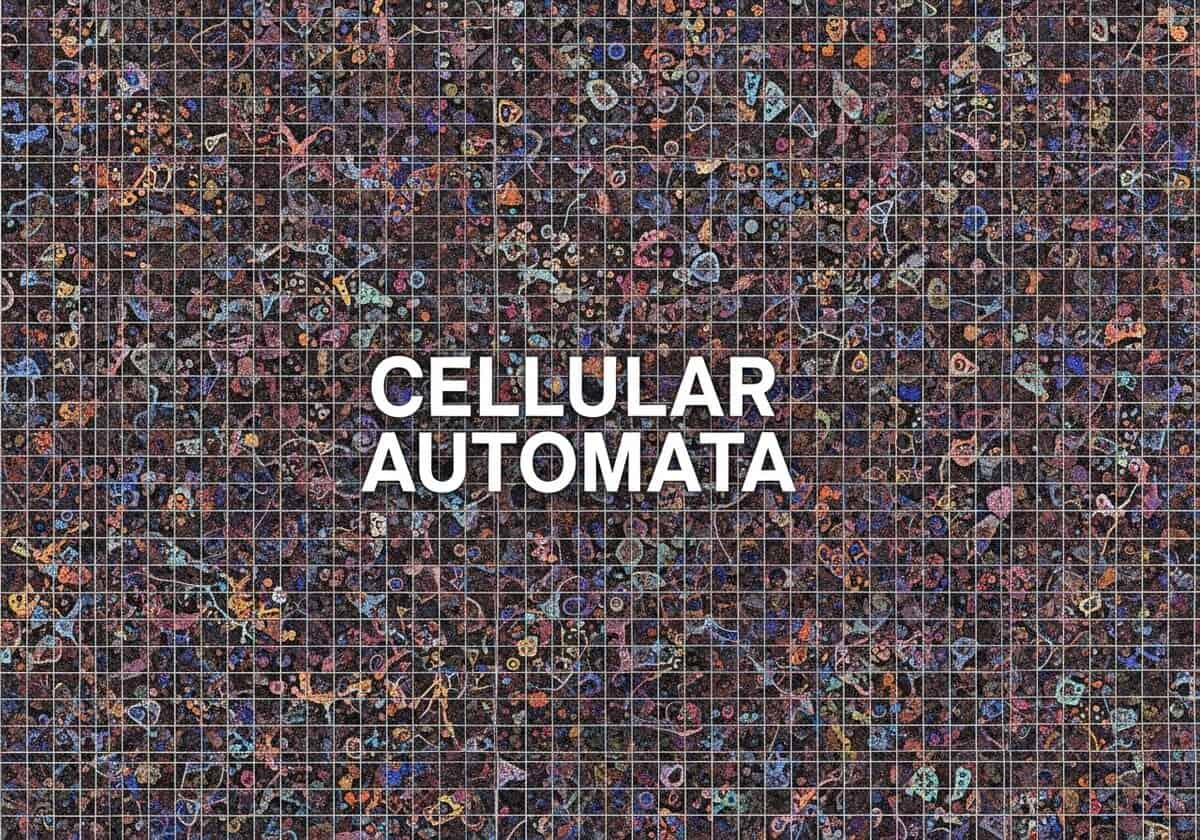
Zelluläre Automaten sind diskrete Modelle, die aus einem Gitter von Zellen bestehen, wobei jede Zelle eine begrenzte Anzahl von Zuständen einnehmen kann. Der Zustand jeder Zelle ändert sich in bestimmten Zeitintervallen gemäß einer Reihe von festgelegten Regeln, die die Zustände benachbarter Zellen berücksichtigen. Trotz der Einfachheit der Regeln können diese Systeme komplizierte und sich entwickelnde Muster und Verhaltensweisen erzeugen. Letztendlich können zelluläre Automaten eine Vielzahl von realen Systemen simulieren, darunter physikalische Prozesse wie die Dynamik von Flüssigkeiten, biologische Phänomene wie die Ausbreitung von Krankheiten und das Wachstum von Populationen jeglicher Art.
Zelluläre Automaten zeigen, wie einfache lokale Regeln komplexe Muster erzeugen. Verwandte Modelle finden sich auf neuronale Netze Und Schwarmrobotik, wo viele einfache Agenten auch globales Verhalten erzeugen. Rechenverbindungen sind aktiv. FPGA Und neuromorphes RechnenDie Ausbildung von Lebensmustern findet statt. Synthetische Biologie.
Dies ist unsere neueste Auswahl weltweiter Veröffentlichungen und Patente in englischer Sprache zu Zellularautomaten, zwischen vielen wissenschaftlichen Online-Zeitschriften, klassifiziert und fokussiert auf zelluläre Automaten, zelluläre Automaten, Automatentheorie, zellulärer Raum, Mosaik-Automaten, iterative Anordnung, Stanislaw Ulam, Mosaik-Struktur, zelluläre Struktur, John von Neumann, Spiel des Lebens, Conway, homogene Struktur, Stephen Wolfram, turing-vollständige und Automaten.
Glove with a knuckle protector
Patent published on the 2026-11-19 in US under Ref US20260363372 by IVAN VOS HOLDING B V [NL] (Den Dekker Jasper [nl], Mozsgai Dávid Zoltán [nl])
Abstract: A motorcycle glove includes a knuckle protector embodied as a one-piece injection moulded part made of a thermoplastic elastomer such as TPU or a one-piece 3D printed part. The knuckle protector has a preformed 3D curved inner surface and a preformed 3D curved outer surface, wherein the curved inner surface shape is adapted to fit over the knuckles of a human hand, and wherein the protector has at least one portion comprising a cellular structure including cellular ventilation passages extending[...]
Our summary: A motorcycle glove features a knuckle protector made from thermoplastic elastomer or 3D printed material. The protector has a preformed 3D curved design for a comfortable fit over the knuckles. It includes a cellular structure with ventilation passages for airflow.
knuckle protector, thermoplastic elastomer, 3D printing, cellular ventilation
Patent
Padding Material for Protective Equipment
Patent published on the 2026-11-19 in US under Ref US20260363371 by MILWAUKEE ELECTRIC TOOL CORP [US] (Worple Joseph R [us])
Abstract: A padding material for protective equipment is provided. The padding material is formed from a single, integral piece of material with a cellular structure. The size and/or shape of the cellular structure is non-uniform to provide support and reduce pressure in chosen areas. One embodiment of the protective equipment includes knee pad with a shell, padding disposed in front of the knee of the wearer, the padding including a non-uniform stiffness.[...]
Our summary: The padding material is a single piece with a cellular structure designed for protective equipment. It features a non-uniform size and shape to support and reduce pressure in specific areas. An example includes a knee pad with padding that has varying stiffness for enhanced protection.
padding material, protective equipment, cellular structure, non-uniform stiffness
Patent
Systems and methods for determining object perimeter size in pixelated digital images
Patent published on the 2026-11-19 in WO under Ref WO2026241414 by MOLECULAR DEVICES LLC [US] (Hanna Braden [us])
Abstract: Systems and methods for determining perimeter size of an object in a pixelated digital image. The systems and methods may be used for determining the perimeter sizes of small objects in microscopy images. The small objects may be small biological structures such as cellular structures. The resulting calculated perimeter sizes may be used to aid in analyzing the biological structures. The systems and methods use vectorized operations, including matrix shifting operations and geometric corrections[...]
Our summary: The systems and methods determine the perimeter size of objects in pixelated digital images. They are particularly useful for small biological structures in microscopy images. The techniques utilize vectorized operations for fast and accurate perimeter calculations.
perimeter calculation, digital imaging, vectorized operations, microscopy
Patent
Hybrid receiving device for salt cores
Patent published on the 2026-11-19 in WO under Ref WO2026238626 by EMIL MUELLER GMBH [DE] (Hofmann Felix [de])
Abstract: The invention relates to a receiving device for a salt core for processing same, which salt core can be used to produce a cast component in foundry technology. In order that the salt core can be held securely, and in an immovable manner during processing, such that also special contours can be introduced on the salt core, and in order that a simple and automatable replacement of the salt core is also possible, the invention proposes that the receiving device comprises a base plate, a flexible ho[...]
Our summary: The invention presents a hybrid receiving device for salt cores used in foundry technology. It features a base plate, a flexible holding plate with fingers, and a support plate. The holding plate can transition between open and closed positions to secure or release the salt core efficiently.
receiving device, salt core, foundry technology, automation
Patent
Novel in vitro method
Patent published on the 2026-11-19 in WO under Ref WO2026239094 by CLOCK HEALTH LTD [GB] (D'orazio Fabio [gb], Tavares Joana [gb], Patili Eleni [gb], Santos Rodrigo [gb], Kotter Mark [gb])
Abstract: The present invention relates to an in vitro method for determining the phenotypic age of a cell. The method comprises measuring one or more cellular parameter, which may be selected from one or more of: the number, function and/or morphology, including shape, structure, texture, pattern, intensity and size, of a cellular structure, organelle and/or component. Also provided is an in vitro method for determining the phenotypic age of a cell together with a hallmark of ageing, comprising measuring[...]
Our summary: The invention presents an in vitro method to determine the phenotypic age of a cell by measuring various cellular parameters. It includes assessing characteristics such as number, function, and morphology of cellular structures. Additionally, the method can identify compounds or genes that may influence aging.
in vitro, phenotypic age, cellular parameters, age-modulating effect
Patent
Methods for biological video analysis
Patent published on the 2026-11-19 in US under Ref US20260369084 by UNIV KENTUCKY RES FOUND [US] (Weiss Blaine Everett [us], Norris Christopher [us])
Abstract: This disclosure is directed to machine learning-based methods including capturing a digital video of cellular structure and/or motion in one or more fields of view. The captured video is digitally filtered, and one or more regions of interest (ROI) are identified by a masking process to identify cell somas. The method has application in identifying and quantifying cell signaling events as well as identifying and quantifying arteriole movement.[...]
Our summary: This disclosure presents machine learning methods for analyzing biological videos of cellular structures and motion. It involves capturing digital video, filtering it, and identifying regions of interest to locate cell somas. The methods can quantify cell signaling events and arteriole movement.
biological video analysis, machine learning, digital filtering, cell signaling
Patent
Unitary realizations of synchronizing automata in quantum systems
Published on 2026-11-04 by J?drzej Stempin, Jan Wjcik, Gabriela Banaszak, Andrzej Grudka, Marcin Karczewski, Pawe? Kurzy?ski and Antoni Wjcik @IOP SCIENCE
Abstract: We introduce a quantum analogue of a classical synchronizing automaton. In the classical case the state of a system evolves according to a set of rules forming an alphabet, and sequences of these rules, called words, govern its evolution. Certain special words, known as synchronizing words, drive the automaton into a predetermined state regardless of its initial configuration. Although such an apparently irreversible process seems incompatible with the unitarity of quantum mechanics, we present [...]
Our summary: We present a quantum version of classical synchronizing automata using auxiliary qubits. A resetting protocol allows the automaton to evolve into a predetermined state independent of its initial configuration. The entanglement generated depends on the rule set and the initial state of the automaton.
quantum automata, synchronizing words, unitary operations, entanglement
Publication
Validating the neurite exchange imaging (NEXI) model of gray matter using Monte Carlo simulations in numerical substrates
Published on 2026-10-06 by @MIT
Abstract: AbstractNEXI is a gray matter (GM) microstructural model designed to probe brain tissue microstructure in vivo using diffusion MRI. NEXI describes GM as two exchanging Gaussian compartments—neurites, modeled as randomly oriented, infinitely long sticks, and the extracellular space—allowing the estimation of biophysically interpretable parameters related to neurite microstructure and intercompartmental exchange. While modeling cell processes as sticks and each compartment as Gaussian are comm[...]
Our summary: The study validates the NEXI model for gray matter using Monte Carlo simulations. It evaluates the model s accuracy against realistic microstructural features like neurite beading and somas. Results indicate that somas and permeability significantly bias NEXI estimates, while structural irregularities have a modest impact.
NEXI, Monte Carlo simulations, diffusion MRI, gray matter
Publication